
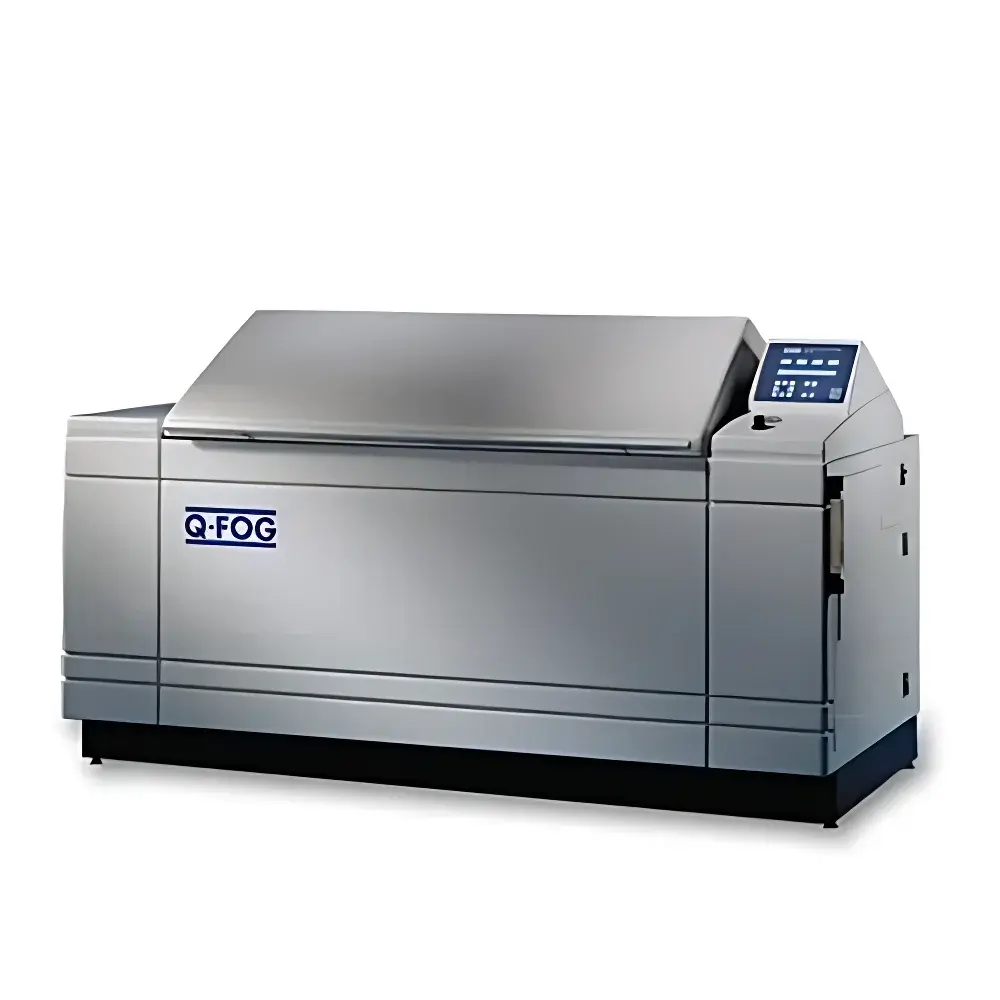
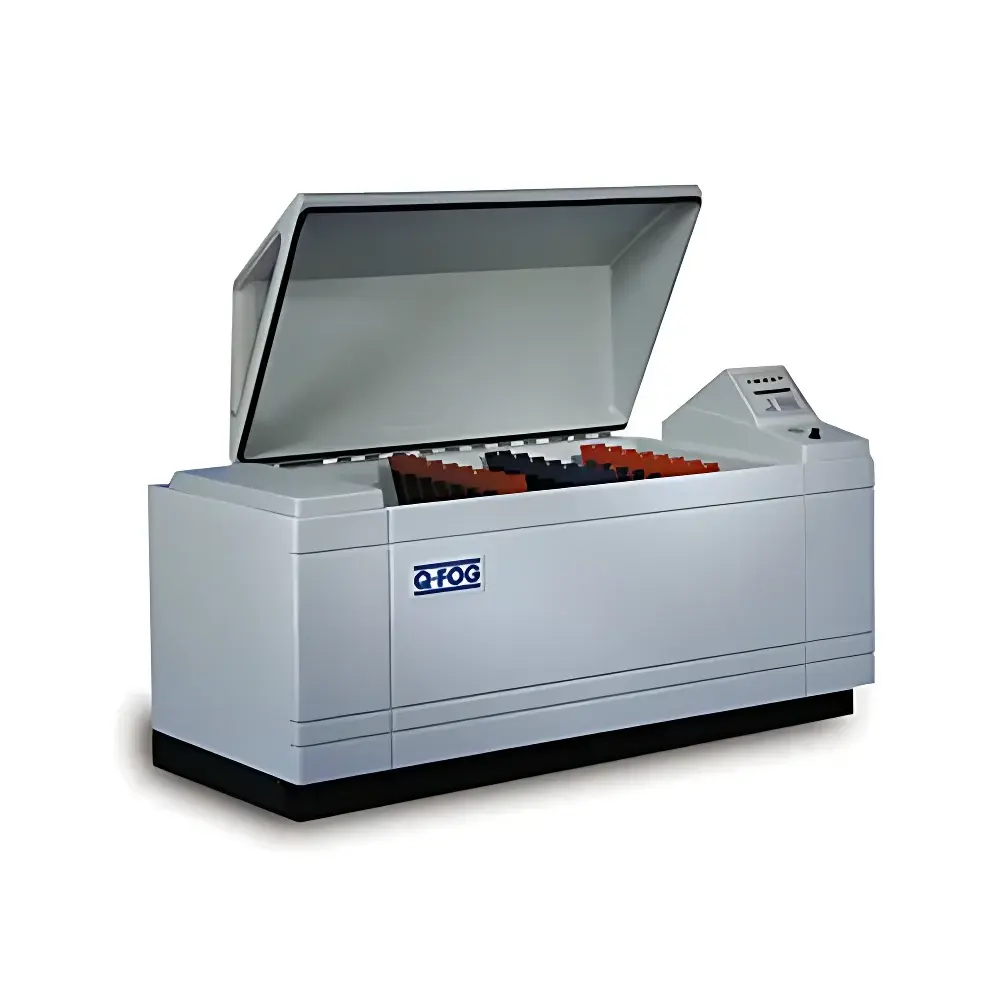
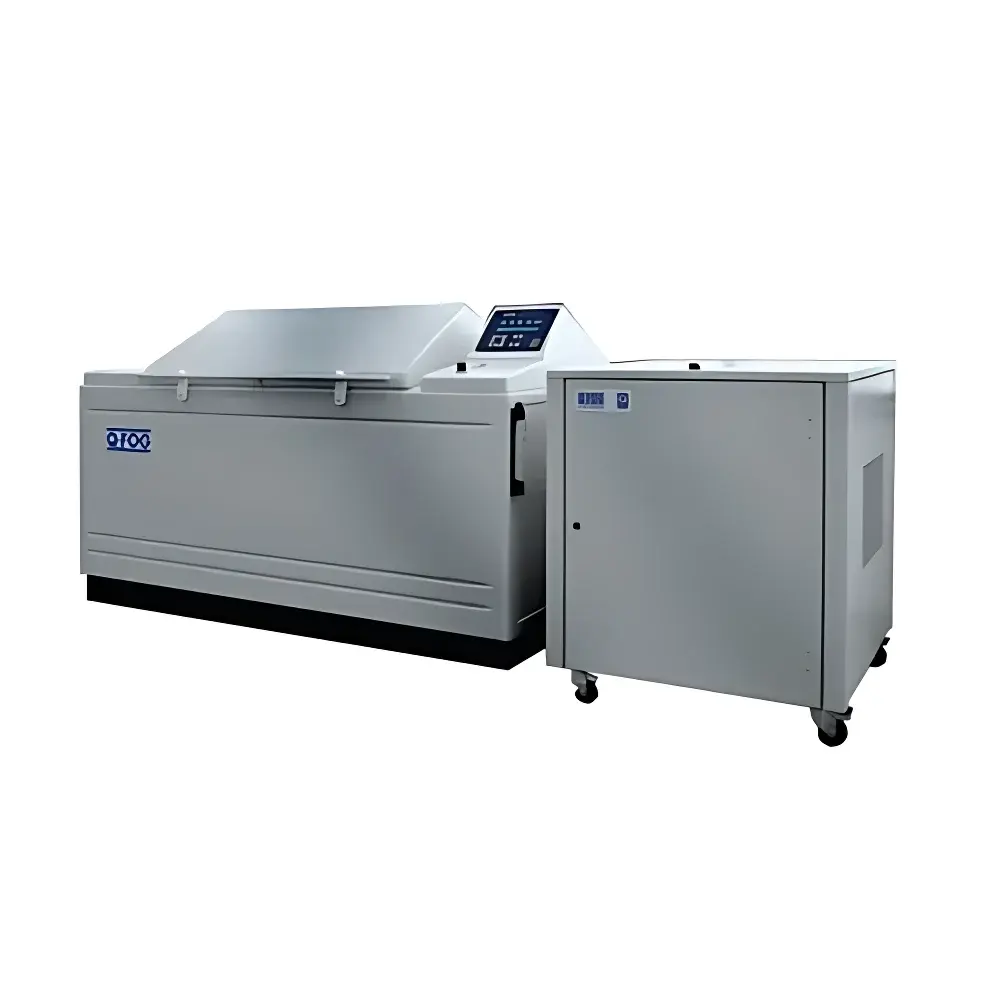
Q-Lab Q-FOG SSP 1100 Salt Spray Corrosion Test Chamber
| Brand | Q-Lab |
|---|---|
| Origin | USA |
| Model | Q-FOG SSP 1100 |
| Spray Mode | Continuous Atomization |
| Spray Rate | 1–5 L/h per 180 cm² |
| Nozzle Air Pressure | 0.7–1.0 kg/cm² |
| Fog Removal Method | Compressed-air-assisted雾 expulsion |
| Salt Fog Deposition Rate | 1–2 mL per 80 cm²·h |
| Temperature Range | 20–60 °C |
Overview
The Q-Lab Q-FOG SSP 1100 is a precision-engineered cyclic corrosion test chamber designed to replicate and accelerate real-world atmospheric degradation mechanisms under tightly controlled laboratory conditions. Unlike static salt spray cabinets governed solely by ASTM B117, the SSP 1100 implements programmable multi-phase environmental cycles—including salt fog, dry-off, and ambient rest—enabling simulation of complex service environments encountered by coated metals, automotive components, aerospace hardware, and electronic enclosures. Its core architecture follows the principles of cyclic corrosion testing (CCT), where time-dependent transitions between aggressive electrolyte exposure and desiccating or humid conditions drive electrochemical and hygrothermal degradation pathways more representative of field performance than single-condition testing. The chamber’s thermal inertia is minimized through direct electric heating elements and high-capacity forced-air cooling/drying systems—enabling rapid temperature transitions critical for Prohesion®-type protocols and other accelerated automotive standards.
Key Features
- Continuous, digitally regulated salt fog generation via variable-speed peristaltic pump and precision air pressure control—ensuring repeatable deposition rates across the test area.
- Independent adjustment of fog density and spray distance: unlike conventional nozzles with fixed geometry, the SSP 1100 decouples solution flow rate from atomization air pressure, allowing fine-tuned optimization of droplet size distribution and spatial uniformity.
- Low-thermal-mass chamber design with auxiliary air heaters enables fast transition (<15 min) between 20 °C and 60 °C, supporting low-humidity drying phases essential for Prohesion® and SAE J2334 testing.
- Front-access hinged lid and low-profile base facilitate ergonomic sample loading; accommodates up to 240 standard test panels (75 mm × 150 mm) or equivalent volumetric load (1103 L internal volume).
- Microprocessor-based controller with intuitive menu-driven interface supports user-defined multi-step cycles, real-time parameter logging, and embedded self-diagnostic routines—including predictive maintenance alerts and automatic safety shutdown on thermal or pressure anomaly detection.
Sample Compatibility & Compliance
The Q-FOG SSP 1100 meets the physical and operational requirements of internationally recognized corrosion test standards, including but not limited to: ASTM B117 (Neutral Salt Spray), ASTM G85 Annex A5 (Prohesion®), ISO 9227, DIN EN ISO 9227, BS EN ISO 9227, JIS Z2371, and GB/T 10125. It is engineered for compatibility with metallic substrates, electrodeposited and conversion-coated parts, organic coatings (e.g., automotive OEM finishes, coil coatings), and assembled electro-mechanical assemblies. All chamber materials—including PVC-free interior linings, corrosion-resistant stainless steel solution reservoirs, and non-reactive fog distribution manifolds—are selected to prevent cross-contamination and ensure long-term metrological stability. The system supports GLP-compliant operation when integrated with audit-trail-enabled data acquisition software (see Software & Data Management section).
Software & Data Management
While the SSP 1100 operates autonomously via its onboard controller, optional Q-Lab’s Q-FOG Control Software (v5.0+) provides full remote monitoring, cycle programming, and data export capabilities via Ethernet or USB. The software logs time-stamped records of chamber temperature, relative humidity (where applicable), spray duration, and fault codes—structured in CSV or XML format for traceability. When deployed in regulated environments (e.g., automotive Tier 1 suppliers, aerospace MRO facilities), the software optionally supports 21 CFR Part 11 compliance through electronic signature workflows, user access levels, and immutable audit trails—facilitating FDA, AS9100, or IATF 16949 audits. Calibration records, service logs, and sensor verification reports are retained within the system’s secure database.
Applications
This chamber is routinely deployed in R&D laboratories and quality assurance departments for evaluating: corrosion resistance of zinc-nickel and trivalent chromium passivations; durability of powder-coated aluminum extrusions in architectural applications; adhesion integrity of primer-topcoat systems on steel chassis components; and long-term reliability of printed circuit board conformal coatings under coastal exposure profiles. In the automotive sector, it serves as a primary tool for validating cycle-specific protocols such as GMW 14872, Ford CETP 00.00-L-467, and Renault D17 2020. Industrial users leverage its reproducibility for supplier qualification, batch release testing, and failure analysis root-cause investigations—particularly where blistering, scribe creep, or filiform corrosion modes dominate.
FAQ
What distinguishes the SSP model from the CCT series?
The SSP (Salt Spray Prohesion) model supports only salt fog and dry-off cycles, whereas the CCT (Cyclic Corrosion Tester) adds 100% RH humidity and condensation phases—enabling full implementation of standards like ASTM D5894 and SAE J2334.
Can the Q-FOG SSP 1100 perform ASTM B117 testing?
Yes—it fully complies with ASTM B117 requirements for neutral salt spray, including specified fog deposition rate (1–2 mL/80 cm²·h), temperature control (35 ± 2 °C), and pH range (6.5–7.2) when operated in continuous spray mode.
Is calibration documentation provided with shipment?
Each unit ships with a factory calibration certificate verifying temperature uniformity, fog deposition uniformity, and pressure regulator accuracy—traceable to NIST standards.
What maintenance intervals are recommended?
Daily visual inspection of nozzles and reservoir; monthly cleaning of air filters and drain lines; annual verification of temperature sensors and pressure transducers using certified reference equipment.
Does the system support third-party integration via Modbus or analog outputs?
Yes—optional I/O expansion modules provide 4–20 mA analog outputs for temperature and spray status, plus Modbus RTU over RS-485 for PLC or SCADA integration.



