
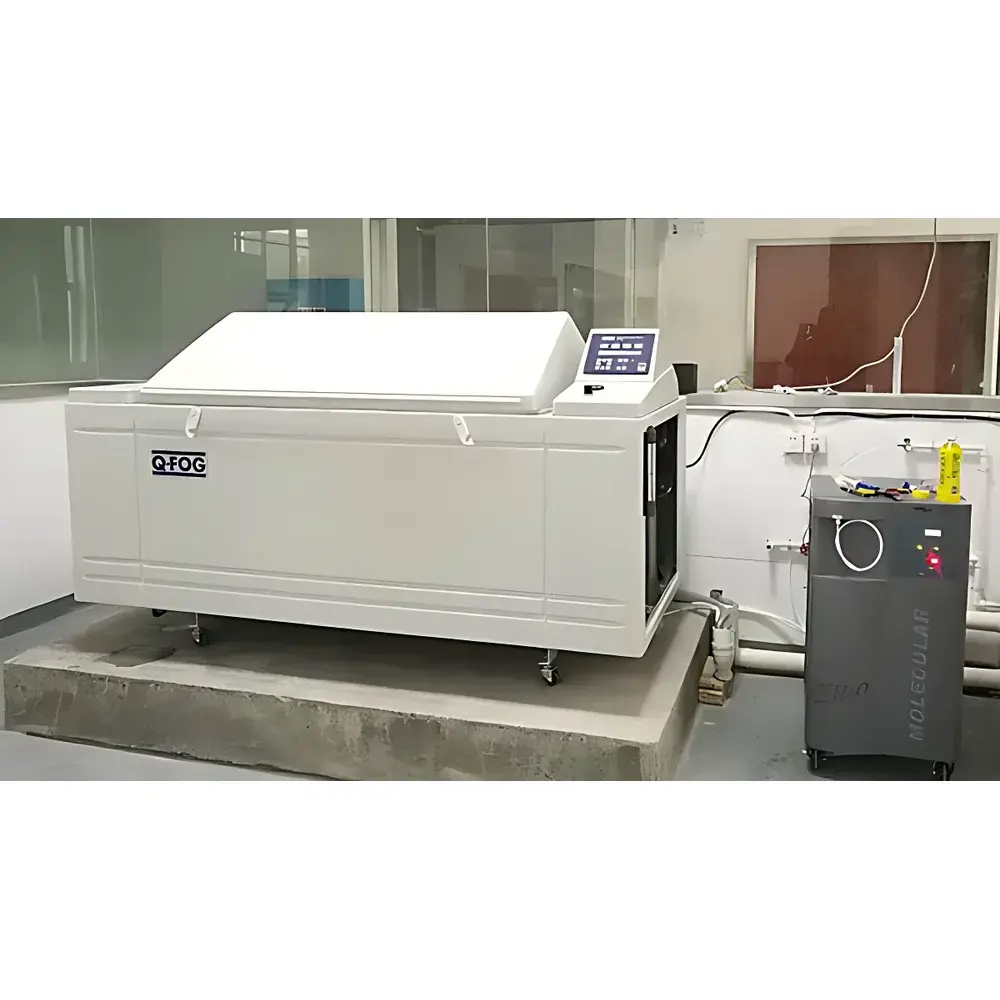
Q-Lab Q-FOG SSP-600 Cyclic Corrosion Test Chamber
| Brand | Q-Lab |
|---|---|
| Origin | USA |
| Model | Q-FOG SSP-600 |
| Compliance | ASTM B117, ASTM G85 (Annex A2–A5), ISO 9227, BS 3900 F4/F9, DIN 50021 |
| Chamber Capacity | 160 × 75 mm × 150 mm test panels |
| Internal Solution Reservoir | 120 L |
| Operating Modes | Salt Spray, Dry-off, Humidity Hold (CCT models only), Rest |
| Control System | Microprocessor-based programmable controller with self-diagnostic functions |
| Required Supply | Deionized or purified water (≥1 MΩ·cm resistivity) |
Overview
The Q-Lab Q-FOG SSP-600 is a precision-engineered cyclic corrosion test chamber designed to replicate complex, time-dependent atmospheric corrosion mechanisms observed in real-world service environments. Unlike conventional continuous-salt-spray systems operating under static conditions (e.g., ASTM B117 at 35 °C), the SSP-600 implements dynamic multi-phase exposure cycles—including salt fog, dry-off, ambient rest, and optional humidity conditioning—to simulate natural diurnal and seasonal transitions. Its core methodology is grounded in electrochemical corrosion acceleration principles: controlled electrolyte deposition followed by evaporation-induced concentration gradients and oxygen diffusion dynamics drive realistic anodic/cathodic activity on metallic and coated substrates. This architecture enables high-fidelity correlation between laboratory test data and field performance—particularly for automotive OEMs, aerospace component suppliers, and industrial coating formulators validating long-term durability under variable climatic stress.
Key Features
- Programmable multi-stage cycling capability supporting up to four distinct exposure phases per cycle: salt spray, forced-air drying, ambient rest, and (in CCT variants) saturated humidity hold.
- Independent control of salt solution delivery rate (via variable-speed peristaltic pump) and spray dispersion distance (via regulated compressed air pressure), enabling precise reproducibility of deposit density and droplet size distribution.
- Integrated 120 L internal reservoir with built-in saline filtration system and low-level solution alarm—designed for uninterrupted operation over ≥7 days under typical test protocols.
- Rapid thermal response enabled by direct-chamber electric heating elements and high-capacity cooling/drying fans; eliminates thermal inertia associated with water-jacketed enclosures, allowing fast transition between wet and dry phases (critical for Prohesion-type cycles).
- Intuitive microprocessor controller featuring preloaded standard test methods (ASTM G85 Annex A2–A5, ISO 9227, BS 3900 F4/F9), user-defined cycle programming, real-time status monitoring, and automated diagnostic alerts including maintenance reminders and safety interlock triggers.
- Ergonomic sample access via low-profile entry threshold and wide-opening lid; accommodates 160 standard test panels (75 mm × 150 mm) or customizable fixtures for 3D components using 20 mm diameter suspension rods.
Sample Compatibility & Compliance
The Q-FOG SSP-600 supports standardized specimen geometries per ISO 1514 and ASTM D609, including flat panels mounted at 15° inclination for optimal salt deposition uniformity. It is fully compliant with internationally recognized corrosion testing standards including ASTM B117 (continuous salt spray), ASTM G85 Annex A2 (Prohesion™), A3 (acidified salt fog), A4 (SO₂-acidified fog), and A5 (dilute electrolyte cyclic test). The chamber meets requirements for GLP-compliant laboratories through traceable calibration records, audit-ready operational logs, and configurable data retention policies aligned with FDA 21 CFR Part 11 electronic record integrity guidelines. All internal wetted surfaces are constructed from non-reactive polypropylene and PVC to prevent cross-contamination and ensure chemical stability during extended exposure to aggressive chloride, sulfate, and nitrate solutions.
Software & Data Management
The embedded controller provides timestamped cycle execution logs, temperature/humidity profiles, and solution usage metrics stored internally for ≥30 days. Optional Q-Lab’s CR-100 software enables remote monitoring, export of CSV-formatted datasets, and synchronization with enterprise LIMS platforms. Audit trails include operator ID, parameter changes, alarm events, and calibration timestamps—supporting full traceability required under ISO/IEC 17025 accreditation and automotive IATF 16949 process validation frameworks. Firmware updates are delivered via secure USB interface with version-controlled release notes and rollback capability.
Applications
This chamber serves critical roles across multiple industrial sectors: automotive OEMs use it to qualify primer-surfacer-topcoat systems against cyclic corrosion per GMW 14872 and Ford CETP 00.00-L-467; aerospace manufacturers apply it for evaluating cadmium-plated fasteners and aluminum alloy claddings per AMS 2700 and MIL-STD-810H Method 509; electronics suppliers deploy it for assessing conformal coating integrity on PCBAs exposed to coastal or industrial atmospheres. It is also widely adopted in R&D labs developing self-healing coatings, zinc-aluminum-magnesium alloys, and graphene-enhanced barrier layers—where accelerated aging must reflect actual failure modes such as filiform corrosion, crevice initiation, or cathodic delamination rather than arbitrary mass loss.
FAQ
What distinguishes Prohesion™ testing from ASTM B117?
Prohesion™ employs rapid alternation between low-humidity drying and dilute acidified salt fog—mimicking urban/industrial rainfall-dry cycles—whereas ASTM B117 maintains constant 35 °C saturated salt fog without drying phases.
Is deionized water mandatory for operation?
Yes. Resistivity ≥1 MΩ·cm is required to prevent nozzle clogging, scale formation, and inconsistent spray characteristics due to mineral precipitation.
Can the SSP-600 perform humidity-controlled cycles?
No—humidity conditioning is exclusive to the CCT-series models. The SSP-600 supports only salt spray, dry-off, and ambient rest phases.
How often does the peristaltic pump tubing require replacement?
Under normal usage (8 h/day), Q-Lab recommends replacement every 6 months; a 1-year maintenance kit (part #F-9000-K) includes eight pump tubes, air filters, and solution filters.
What sample mounting options are available beyond standard panels?
Custom fixtures include 20 mm diameter suspension rods (F-9014-K/F-9017-K), adjustable-angle brackets, and non-metallic racks compatible with threaded inserts or adhesive-backed substrates.



