
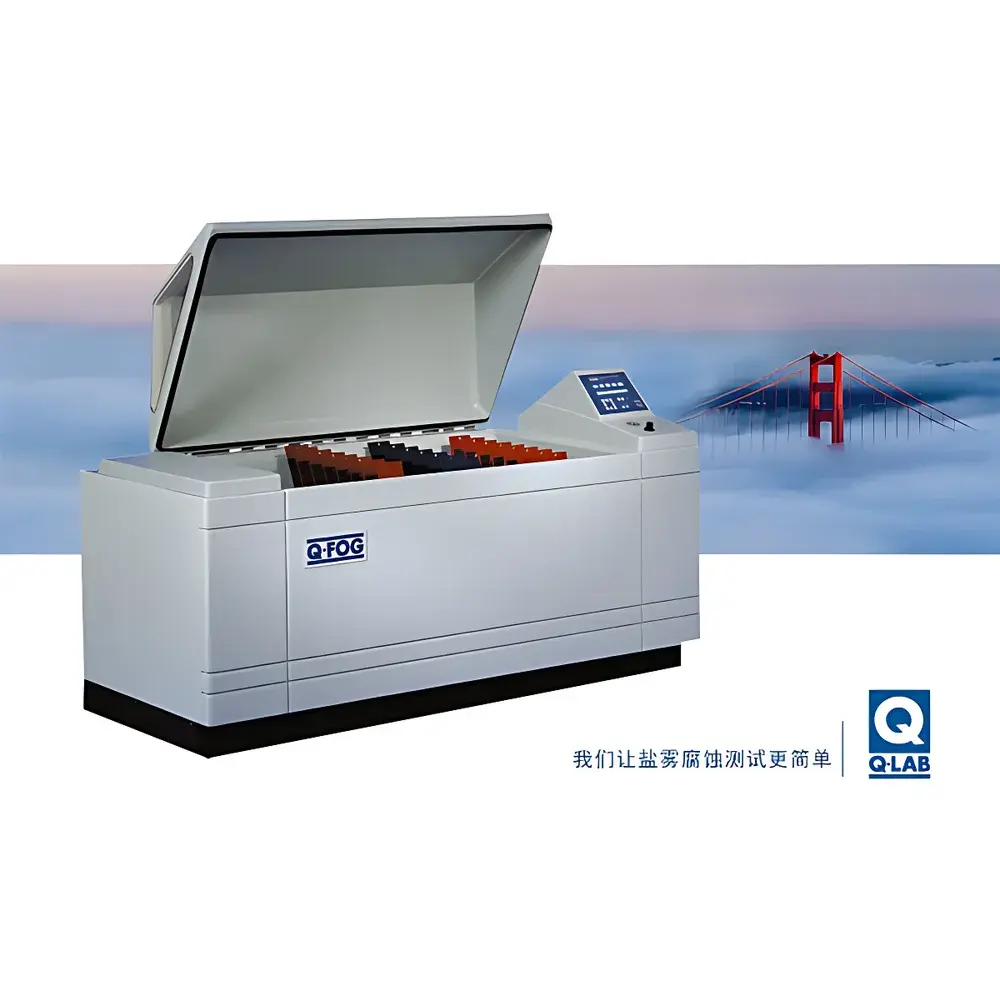

Q-LAB Q-FOG SSP Salt Spray Test Chamber
| Brand | Q-LAB |
|---|---|
| Origin | USA |
| Model | Q-FOG SSP |
| Compliance | ASTM B117, ASTM G85, ISO 9227, BS 3900 F4/F9, DIN 50021 |
| Cycle Capabilities | Salt Spray, Prohesion®, Dry-off, Optional Humidity (CCT only) |
| Control System | Microprocessor-based dual-line LCD interface with programmable multi-step cycling |
| Construction | Fiberglass-reinforced polymer (FRP) chamber body, corrosion-resistant stainless steel hardware |
| Temperature Range | Ambient to 50 °C (spray/dry modes), up to 60 °C (optional humidified mode in CCT models) |
| Solution Delivery | Pneumatic air-assisted atomization via adjustable nozzles, bubble-tower humidified air (except Prohesion®) |
Overview
The Q-LAB Q-FOG SSP Salt Spray Test Chamber is an engineered environmental test system designed for accelerated corrosion evaluation of metallic substrates, coated components, and protective finishes under controlled, reproducible saline exposure conditions. It operates on the principle of cyclic corrosion testing (CCT), where specimens undergo sequential, programmable exposures to salt fog, dry-off, and—depending on configuration—high-humidity or condensation phases. Unlike static salt spray chambers governed solely by ASTM B117, the Q-FOG SSP implements dynamic environmental transitions that better emulate real-world service degradation mechanisms observed in automotive, aerospace, marine, and infrastructure applications. Its core architecture integrates precision fluid delivery, thermally stabilized chamber control, and a robust FRP enclosure resistant to chloride-induced degradation—ensuring long-term operational stability and measurement repeatability across thousands of test hours.
Key Features
- Microprocessor-controlled dual-line LCD interface enabling intuitive creation, editing, and execution of custom multi-step test cycles—including start-from-any-step functionality for diagnostic or interrupted testing.
- Preloaded standardized test protocols: ASTM B117 (neutral salt spray), ASTM G85 Annex A5 (Prohesion®), ISO 9227, BS 3900 F4/F9, DIN 50021, and OEM-specific methods including GMW 14872, Ford CETP, and SAE J2334.
- Corrosion solution delivery via pneumatic air-assisted atomization; compressed air is humidified through a bubble tower (except during Prohesion® cycles) to ensure consistent droplet size distribution and deposition uniformity per ISO 9227 Annex B.
- Independent chamber heating and forced-air drying systems allow precise control of temperature (±1.0 °C) and relative humidity during each phase—critical for replicating coastal diurnal cycles or industrial atmospheric transitions.
- Fiberglass-reinforced polymer (FRP) chamber construction eliminates galvanic coupling risks and resists long-term chloride attack, supporting GLP-compliant validation and extended calibration intervals.
- Built-in diagnostic cycle (Cycle I) verifies actuator response, temperature stability, spray uniformity, and airflow integrity—facilitating routine preventive maintenance and audit-ready traceability.
Sample Compatibility & Compliance
The Q-FOG SSP accommodates flat panels, fasteners, electronic housings, painted assemblies, and small structural components up to 610 mm × 914 mm × 305 mm (W × D × H). Fixturing supports vertical or angled specimen orientation per ASTM B117 requirements. All operational parameters—including solution concentration (5 ± 1 wt% NaCl), pH (6.5–7.2), collection rate (1.0–2.0 mL/80 cm²/h), and chamber temperature—are continuously monitored and logged to support ISO/IEC 17025-compliant laboratory accreditation. The system meets regulatory expectations for data integrity under FDA 21 CFR Part 11 when paired with optional Q-LAB’s Q-FOG Data Logger software, providing electronic signatures, audit trails, and user-access controls.
Software & Data Management
While the SSP model features an embedded microprocessor controller with non-volatile memory for up to 100 user-defined cycles, full data governance requires integration with Q-LAB’s optional Q-FOG Data Logger software (Windows-based). This application captures time-stamped temperature, humidity, spray status, and chamber pressure at configurable intervals (1–60 min), exports CSV/Excel reports, and generates PDF test certificates compliant with internal QA procedures and external audits. Raw logs include operator ID, cycle version, start/stop timestamps, and deviation alerts—enabling retrospective root-cause analysis per ISO 9001:2015 Clause 8.5.2 and IATF 16949 Section 8.5.1.2.
Applications
The Q-FOG SSP is routinely deployed in R&D labs and QC departments for evaluating: electroplated zinc/nickel coatings on automotive chassis parts; powder-coated aluminum extrusions for architectural façades; passivated stainless steel surgical instruments per ASTM F86; and epoxy-primed carbon steel pipelines per NACE SP0169. Its Prohesion® capability makes it especially valuable for assessing organic coating adhesion loss, blistering kinetics, and cathodic delamination rates—parameters directly correlated with field performance in aggressive coastal or de-icing salt environments. Industrial users leverage its programmability to replicate seasonal transition effects (e.g., wet-dry cycling simulating winter road salting followed by spring thaw), thereby reducing time-to-market for corrosion-resistant material systems.
FAQ
What distinguishes the SSP model from the CCT series?
The SSP supports salt spray and Prohesion® cycles plus dry-off phases, while the CCT adds controlled humidity and condensation stages—required for OEM automotive CCT-1/CCT-IV protocols.
Is ASTM B117 testing possible without modification?
Yes—the SSP executes ASTM B117 natively with default settings meeting all specified temperature, concentration, and collection-rate tolerances.
How is solution concentration verified and maintained?
Operators perform daily gravimetric verification using calibrated analytical balances; Q-LAB provides certified reference solutions and SOP templates aligned with ISO 8502-9.
Can the chamber be validated for ISO/IEC 17025 compliance?
Yes—Q-LAB offers factory-issued IQ/OQ documentation, temperature mapping reports, and spray uniformity validation kits traceable to NIST standards.
What maintenance intervals are recommended for long-term reliability?
Daily visual inspection of nozzles and solution lines; weekly cleaning of bubble tower and drain filters; quarterly calibration of chamber temperature sensors and annual verification of air pressure regulators.



