
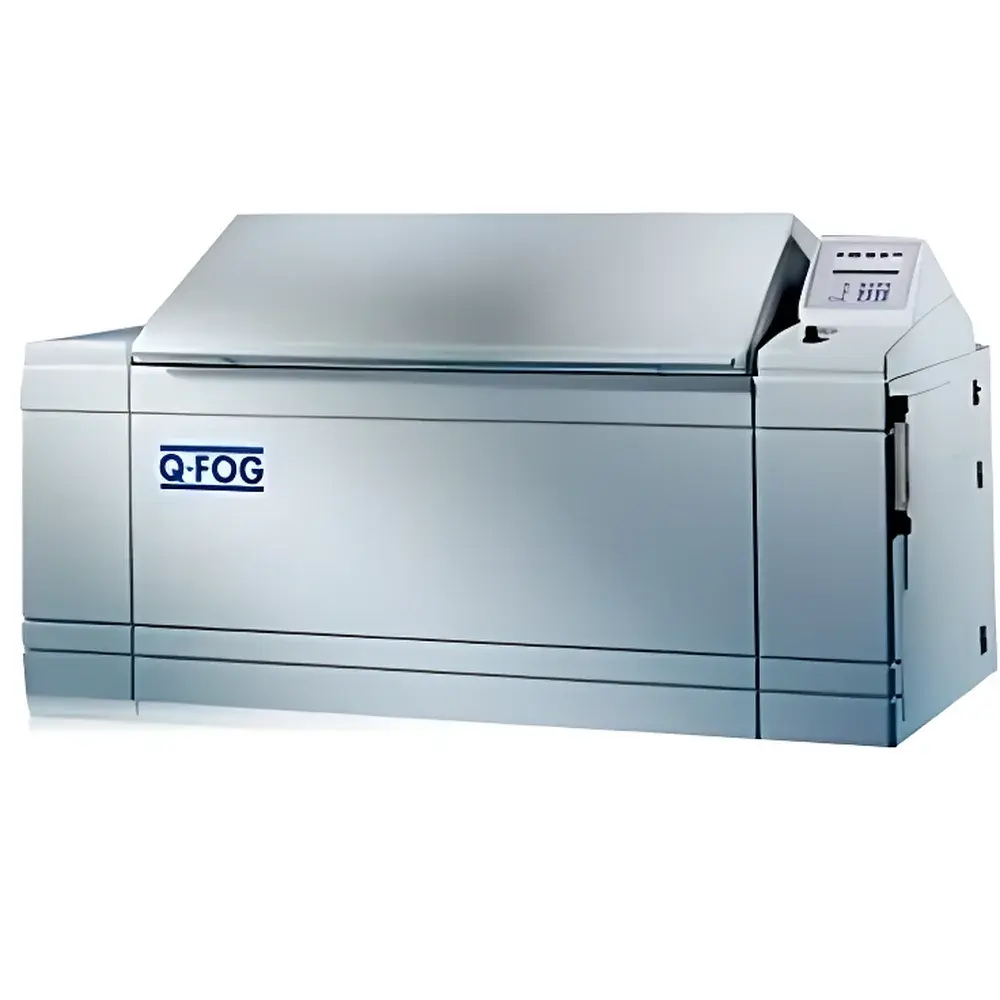
Q-Lab Q-FOG SSP Series Salt Spray Corrosion Test Chamber
| Brand | Q-Lab |
|---|---|
| Origin | USA |
| Model | Q-FOG SSP |
| Compliance | ASTM B117, ASTM G85 (Prohesion), ISO 9227, BS 3900 F4/F9, DIN 50021 |
| Chamber Volume | 640 L (SSP-600) or 1103 L (SSP-1100) |
| Temperature Range | Ambient to 50 °C (operational during salt fog cycle) |
| Salt Solution Delivery | Precision metered pneumatic spray system with adjustable nozzle pressure and calibrated collection rate (1.0–2.0 mL/80 cm²/h per ASTM B117) |
| Control System | Touchscreen programmable controller with multi-step cycling capability, real-time logging, and audit-trail-ready event history |
Overview
The Q-Lab Q-FOG SSP Series Salt Spray Corrosion Test Chamber is an engineered environmental simulation platform designed for accelerated corrosion testing of metallic substrates, coated components, and electroplated surfaces under rigorously controlled conditions. It operates on the principle of continuous or cyclic exposure to atomized sodium chloride (NaCl) aerosol—generated via compressed air-assisted nebulization—within a thermally regulated chamber. Unlike static environmental chambers, the Q-FOG SSP supports programmable multi-phase test sequences, enabling precise replication of field-relevant degradation mechanisms including salt deposition, drying, and ambient conditioning. Its architecture conforms to internationally recognized corrosion testing standards, making it suitable for qualification, comparative benchmarking, and regulatory compliance validation in industrial R&D, quality assurance, and third-party certification laboratories.
Key Features
- Programmable multi-cycle controller supporting up to 99 distinct steps per test sequence—including salt fog, dry-off, and ambient rest phases—with independent temperature and humidity setpoints per phase (where applicable)
- Dual-mode operation: certified for both traditional continuous salt spray (per ASTM B117) and Prohesion cycling (per ASTM G85 Annex A5), featuring rapid thermal transitions between wet and dry states
- Corrosion-resistant chamber construction using fiber-reinforced polymer (FRP) with stainless steel solution reservoirs and PTFE-coated internal plumbing to prevent cross-contamination and ensure long-term chemical stability
- Calibrated salt solution delivery system compliant with ASTM B117 requirements: uniform spray distribution verified via six-collection-funnel kit (included), with deposition rate adjustable between 1.0–2.0 mL per 80 cm² per hour
- Integrated temperature control across operational range: 25–50 °C during fog cycles; up to 70 °C during dry-off phases—maintained via PID-regulated heating elements and insulated chamber walls
- Modular sample mounting options: standardized 15° tilt test panels (102 × 304 mm, 38 mm center spacing), 20 mm diameter hanging rods for 3D parts, and optional accessories kits (F-9008-K, F-9011-K, F-9014-K, F-9017-K) for scalable fixture configurations
Sample Compatibility & Compliance
The Q-FOG SSP accommodates a broad spectrum of specimen geometries—from flat-coated coupons and printed circuit boards to complex aerospace fasteners and automotive trim components. Its open interior layout and configurable fixtures support ISO-standardized sample positioning while maintaining unobstructed fog dispersion. The system meets full technical alignment with ASTM B117 (Standard Practice for Operating Salt Spray (Fog) Apparatus), ASTM G85 (Standard Practice for Modified Salt Spray (Fog) Testing), ISO 9227 (Corrosion tests in artificial atmospheres — Salt spray tests), BS 3900 F4/F9, and DIN 50021. All calibration procedures, maintenance logs, and operational parameters are traceable to NIST-traceable references, supporting GLP/GMP documentation workflows and FDA 21 CFR Part 11-compliant data integrity requirements when paired with Q-Lab’s optional software modules.
Software & Data Management
The built-in touchscreen controller provides local test programming, real-time parameter monitoring (chamber temperature, spray duration, elapsed time), and event-based alarm logging. Optional Q-Lab LogWare IV software enables remote supervision, automated report generation (PDF/CSV), and secure export of time-stamped test records with user authentication and electronic signature support. Audit trails capture all configuration changes, start/stop events, and calibration interventions—ensuring full compliance with ISO/IEC 17025 and ICH Q5C analytical method validation frameworks. Data export formats include XML and CSV for integration into LIMS and enterprise QA databases.
Applications
This instrument serves critical roles across multiple sectors: evaluation of primer adhesion and topcoat durability in automotive OEM supply chains; qualification of passivation layers on surgical stainless steel per ASTM F86; verification of conformal coating integrity on military-grade PCB assemblies (MIL-STD-810H Method 509.6); comparative corrosion resistance assessment of galvanized vs. aluminum-zinc alloy coatings in infrastructure materials; and accelerated aging studies for marine hardware exposed to coastal environments. Its reproducibility and inter-laboratory correlation performance have been validated through round-robin studies published in Materials Performance and CORROSION journals.
FAQ
What standards does the Q-FOG SSP model support?
ASTM B117, ASTM G85 (including Prohesion Annex A5), ISO 9227, BS 3900 F4/F9, and DIN 50021.
Can the Q-FOG SSP perform humidity-controlled cycles?
No—the SSP model is optimized for salt fog + dry-off cycling only; humidity control requires the CCT-series chamber.
Is the salt solution delivery rate adjustable and verifiable?
Yes—rate is pneumatically regulated and validated using the included six-bottle collection kit per ASTM B117 Section 7.4.
What maintenance intervals are recommended?
Daily visual inspection of nozzles and reservoirs; quarterly replacement of pump tubing and filters; annual preventive maintenance service recommended.
Are test reports generated by the Q-FOG SSP compliant with regulatory submissions?
When used with LogWare IV and configured for audit trail logging, outputs meet FDA 21 CFR Part 11 and ISO/IEC 17025 record retention requirements.



