
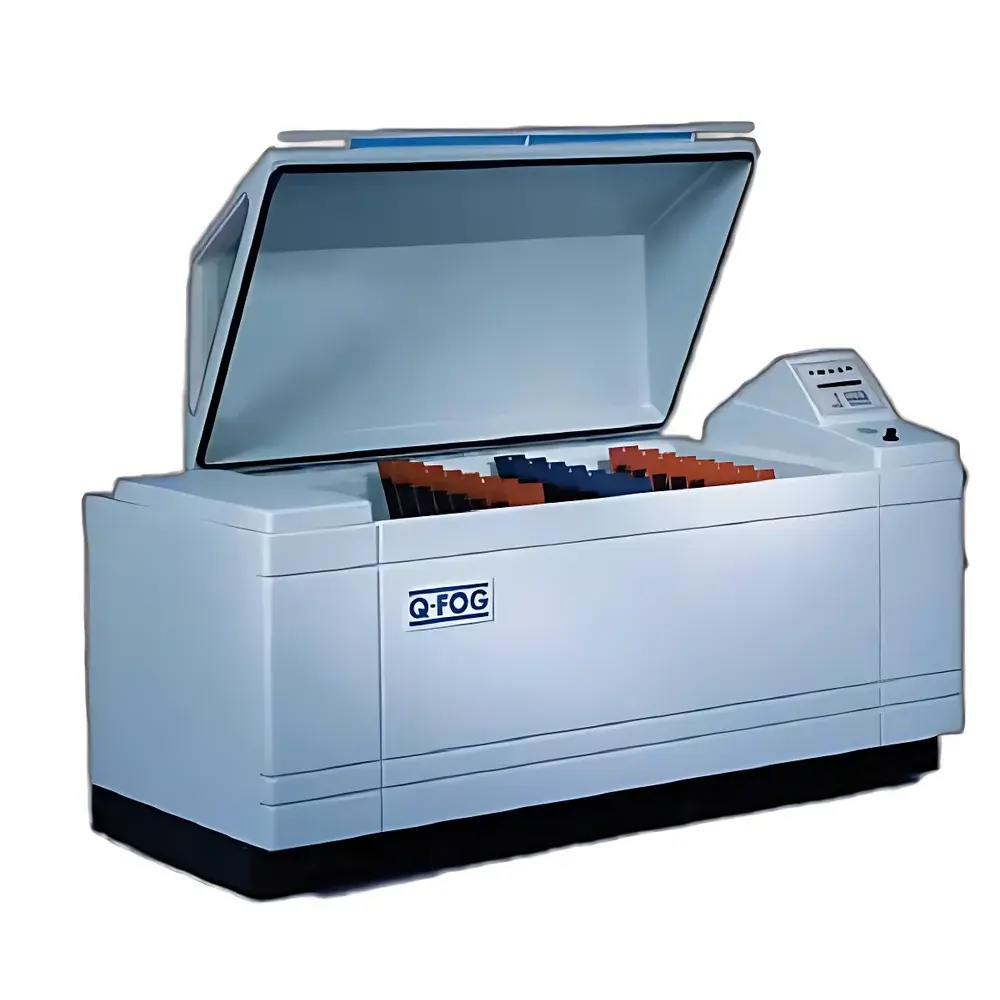
Q-LAB Q-FOG SSP Series Salt Spray and Cyclic Corrosion Test Chamber
| Brand | Q-LAB |
|---|---|
| Origin | USA |
| Model | SSP |
| Salt Fog Deposition Rate | 0.5–3 mL/h·80 cm² |
| Temperature Range | Ambient to 70°C |
Overview
The Q-LAB Q-FOG SSP Series is a precision-engineered cyclic corrosion test chamber designed for accelerated evaluation of material and coating durability under rigorously controlled, multi-phase environmental stress conditions. Unlike conventional static salt spray chambers operating solely per ASTM B117, the SSP platform implements dynamic cycling between salt fog, dry-off, and optional high-humidity or condensation phases—mimicking real-world atmospheric exposure sequences where wet/dry transitions critically influence corrosion kinetics. Its core architecture leverages Couette-flow nozzle technology, regulated compressed air supply, and variable-speed peristaltic dosing to ensure reproducible fog generation with independent control over deposition rate and droplet distribution uniformity across the test volume. Engineered for long-term stability in ISO 17025-accredited laboratories and industrial QA/QC environments, the SSP series complies with key international standards including ASTM B117, ASTM G85 (Annexes A1–A5), ISO 9227, BS 3900 F4/F9, and DIN EN ISO 50021.
Key Features
- Two standard chamber volumes: SSP-600 (640 L internal capacity) and SSP-1100 (1103 L), both supporting identical test protocols and controller functionality
- Independent regulation of salt fog deposition rate (0.5–3 mL/h·80 cm²) via programmable peristaltic pump and precision air pressure control
- Temperature range from ambient to 70°C, enabled by high-power resistive heaters and forced-air cooling/drying system for rapid thermal transitions (typical ramp rates >3°C/min)
- Integrated 120 L solution reservoir with inline saltwater filtration, low-level sensor, and audible/visual alert for maintenance scheduling
- Microprocessor-based Q-FOG Controller with intuitive touchscreen interface, preloaded test method library, and full audit trail capability compliant with FDA 21 CFR Part 11 requirements
- Front-access low-profile loading rail and wide-opening lid for ergonomic sample placement—accommodates up to 160 panels (75 mm × 150 mm) in SSP-600 and 240 panels in SSP-1100
- Self-diagnostic firmware with predictive service alerts, error logging, and automatic safety shutdown during abnormal operational states
Sample Compatibility & Compliance
The SSP chamber accommodates flat panels, small components, and assembled subassemblies up to 150 mm in height. Its uniform fog distribution and precisely timed phase transitions ensure consistent exposure across heterogeneous sample geometries—critical for evaluating electroplated surfaces, organic coatings, aerospace fasteners, and printed circuit board assemblies. All SSP models are factory-validated to meet ASTM E744 (Standard Practice for Calibration of Fog Generators) and support GLP/GMP-compliant documentation workflows. Optional humidity control modules enable compliance with automotive OEM specifications such as GMW14872, Ford CETP 00.00-L-467, and VW PV1210 when configured with auxiliary humidification hardware.
Software & Data Management
The embedded Q-FOG Controller runs proprietary firmware with secure user authentication, role-based access control, and encrypted data storage. Test programs—including multi-step Prohesion cycles (e.g., 2 h salt fog / 2 h dry at 23°C / 2 h dry at 60°C), ASTM G85 Annex A3 (acidified salt fog), or custom sequences—are defined via graphical step editor. Real-time monitoring displays current phase, elapsed time, chamber temperature, and solution level. All parameter changes, operator logins, and alarm events are timestamped and stored locally for ≥30 days; data export is supported via USB or Ethernet to external LIMS or ELN systems. Full electronic records meet traceability requirements under ISO/IEC 17025:2017 Clause 7.5 and USP .
Applications
The SSP series serves as a primary tool for corrosion resistance validation across multiple sectors: automotive OEMs use it for qualification of zinc-nickel plating and e-coat systems; defense contractors apply it to assess anodized aluminum housings and marine-grade stainless steel fasteners; electronics manufacturers rely on it for IPC-J-STD-006-compliant solder finish testing; and R&D labs employ Prohesion cycling to rank waterborne acrylic primers versus solvent-borne epoxies under accelerated aging. Its ability to replicate field-relevant corrosion morphologies—including pitting, filiform, and crevice initiation—makes it indispensable for correlating lab data with outdoor exposure results per ISO 11474.
FAQ
What standards does the Q-FOG SSP series support out-of-the-box?
ASTM B117, ASTM G85 (Annexes A1–A5), ISO 9227, BS 3900 F4/F9, DIN EN ISO 50021, and JIS Z2371.
Is purified water mandatory for operation?
Yes—deionized or distilled water with conductivity ≤5 µS/cm is required to prevent nozzle clogging and ensure consistent fog chemistry.
Can the SSP model perform humidity-controlled cycles?
No—the SSP series supports only salt fog, dry-off, and ambient soak phases. For full humidity/condensation capability, the CCT series is recommended.
What is the maximum sample height clearance inside the chamber?
150 mm vertical clearance above the sample rack plane, accommodating most coated panels and small mechanical parts.
How often does the internal solution filter require replacement?
Under typical usage (7-day continuous operation), replacement is recommended every 6 months or after 500 test hours—whichever occurs first.



