
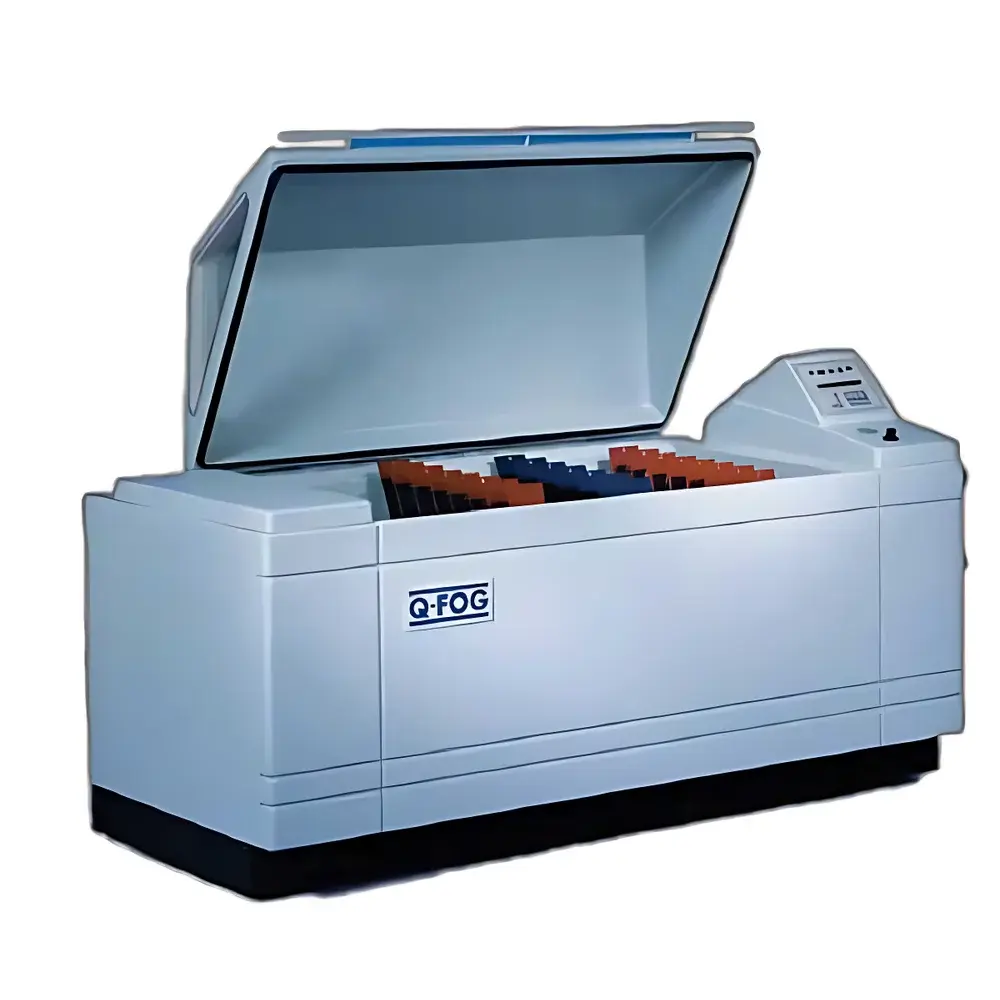
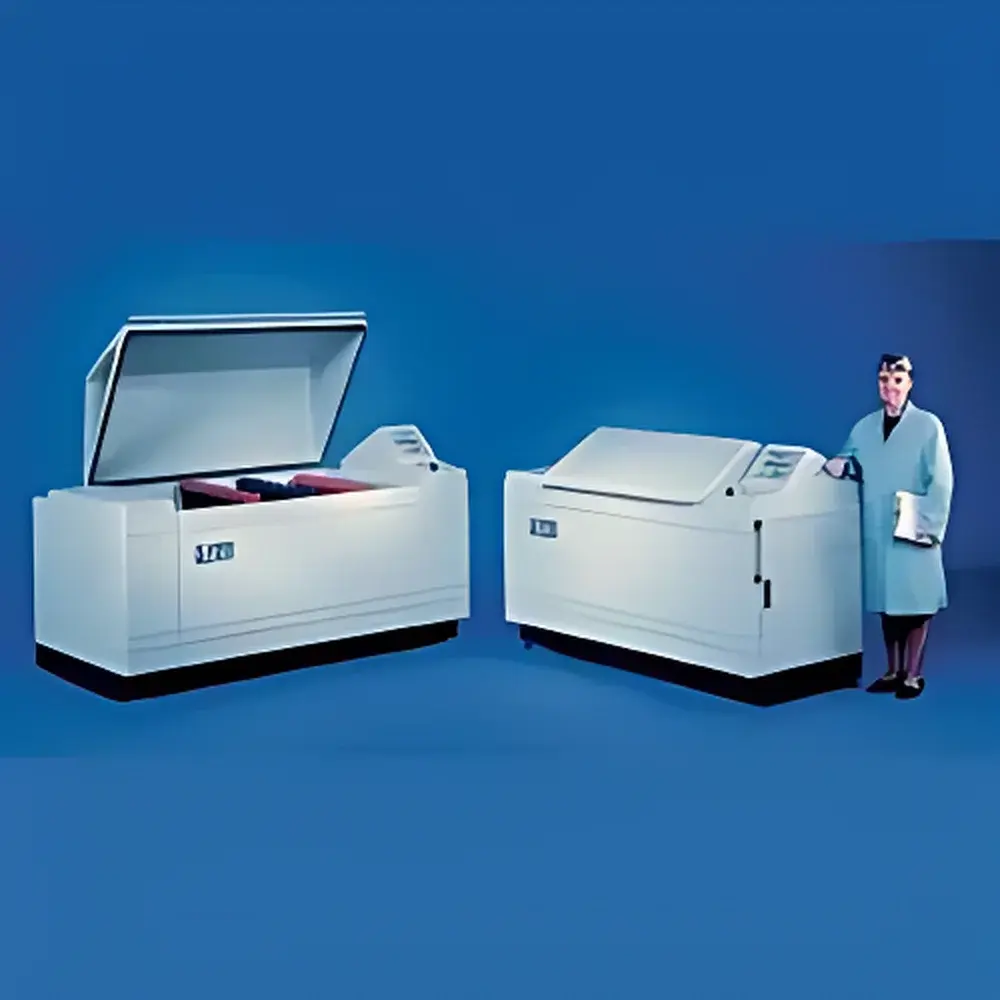
Q-Lab Q-FOG SSP1100 Salt Spray Test Chamber
| Brand | Q-Lab |
|---|---|
| Origin | USA |
| Model | Q-FOG SSP1100 |
| Salt Spray Deposition Rate | 0.5–3 mL/h·80 cm² |
| Temperature Range | Ambient to 70 °C |
| Chamber Capacity | 1103 L |
| Compliance Standards | ASTM B117, ASTM G85 (Prohesion), ISO 9227, BS 3900 F4/F9, DIN 50021 |
Overview
The Q-Lab Q-FOG SSP1100 Salt Spray Test Chamber is an engineered solution for accelerated corrosion testing in industrial R&D, quality assurance, and regulatory compliance laboratories. It operates on the principle of controlled electrochemical corrosion acceleration through precisely regulated salt fog exposure, alternating humidity cycles, and thermal transitions—mimicking key degradation mechanisms observed in real-world atmospheric environments. Unlike static salt spray systems governed solely by ASTM B117, the SSP1100 supports dynamic multi-phase cycling—including Prohesion (ASTM G85 Annex A5), cyclic salt/dry, and custom multi-step protocols—enabling correlation with field performance of coated metals, automotive components, aerospace hardware, and electronic enclosures. Its design prioritizes reproducibility, long-term operational stability, and traceable environmental control—critical for GLP-compliant testing and ISO/IEC 17025-accredited laboratories.
Key Features
- Engineered for precision salt fog generation: Variable-speed peristaltic pump and independent air pressure regulation enable independent control of deposition rate (0.5–3 mL/h·80 cm²) and spray distribution uniformity—meeting ISO 9227 and ASTM B117 requirements.
- Wide temperature range: Ambient to +70 °C, achieved via high-capacity internal heating elements and forced-air cooling/drying fans—enabling rapid transitions between wet and dry phases without thermal lag.
- Large chamber volume: 1103 L capacity accommodates up to 240 standard test panels (102 mm × 304 mm at 15° tilt) or complex 3D parts using optional 20 mm diameter hanging rods (F-9017-K kit).
- Integrated 120 L solution reservoir with built-in saline filtration, low-level alarm, and continuous 7+ day unattended operation capability.
- Microprocessor-based controller with intuitive menu-driven interface; supports up to 100 user-defined test cycles, real-time status monitoring, self-diagnostics, service reminders, and automatic safety shutdown.
- Purified water requirement enforced by system architecture—ensuring consistent conductivity, minimizing nozzle clogging, and maintaining compliance with ASTM D1193 Type IV specifications.
Sample Compatibility & Compliance
The Q-FOG SSP1100 accommodates flat-panel specimens, geometrically complex assemblies, and production-grade components across diverse industries. Standard fixtures include the F-9011-K test panel rack (10-piece set) and F-9017-K hanging rod kit (8-piece set). All configurations maintain strict spatial uniformity per ISO 9227 Annex A and ASTM B117 Section 7.2. The chamber is validated for full conformance with internationally recognized corrosion standards—including ASTM B117 (continuous salt fog), ASTM G85 Annex A5 (Prohesion), ISO 9227, BS 3900 F4/F9, and DIN 50021. Its programmable architecture supports audit-ready execution of test sequences required under IATF 16949, AS9100, and MIL-STD-810H. Data integrity aligns with FDA 21 CFR Part 11 expectations when paired with Q-Lab’s optional Q-Support software and electronic log modules.
Software & Data Management
While the SSP1100 operates autonomously via its embedded controller, Q-Lab provides optional Q-Support software for remote monitoring, cycle configuration export/import, and raw environmental parameter logging (temperature, time, phase status). The system records timestamped event logs—including start/stop times, fault codes, and maintenance alerts—for traceability in regulated environments. When integrated with laboratory information management systems (LIMS), test metadata can be exported in CSV or XML formats. Optional data acquisition modules support analog input recording (e.g., external corrosion sensors or potentiometric probes), extending the platform beyond standard chamber control into hybrid corrosion monitoring applications.
Applications
- Qualification and comparative evaluation of electroplated, galvanized, and organic-coated steel substrates.
- Corrosion resistance validation of automotive under-hood components, fasteners, and brake calipers per SAE J2334 and GMW14872.
- Accelerated aging of aerospace aluminum alloys and protective conversion coatings (e.g., chromate, trivalent chromium) per AMS 2400 and MIL-DTL-5541.
- Reliability screening of printed circuit board assemblies (PCBAs), connectors, and conformal coatings under mixed-flowing-gas (MFG)–compatible conditions.
- Development and verification of corrosion inhibitors, sealants, and anti-corrosion greases used in marine and offshore infrastructure.
FAQ
What standards does the Q-FOG SSP1100 support out-of-the-box?
It natively executes ASTM B117, ASTM G85 Annex A5 (Prohesion), ISO 9227, BS 3900 F4/F9, and DIN 50021 without firmware modification.
Is purified water mandatory—and why?
Yes. Conductivity must remain below 10 µS/cm (ASTM D1193 Type IV) to prevent mineral deposition, ensure repeatable fog chemistry, and avoid nozzle erosion.
Can the SSP1100 perform humidity-only or condensation cycles?
No—the SSP series is optimized for salt fog and dry cycles only. For full humidity/condensation capability, the CCT series (e.g., Q-FOG CCT-1100) is required.
How is salt fog deposition verified and calibrated?
Using the included salt fog collection kit (six graduated funnels), users perform quarterly deposition mapping per ASTM B117 Section 7.3 and ISO 9227 Annex B.
What maintenance intervals are recommended for routine operation?
Pump tubing replacement every 6 months, air filter replacement every 3 months, and annual calibration of temperature sensors and pressure regulators per Q-Lab Service Bulletin SB-SSP-001.



