
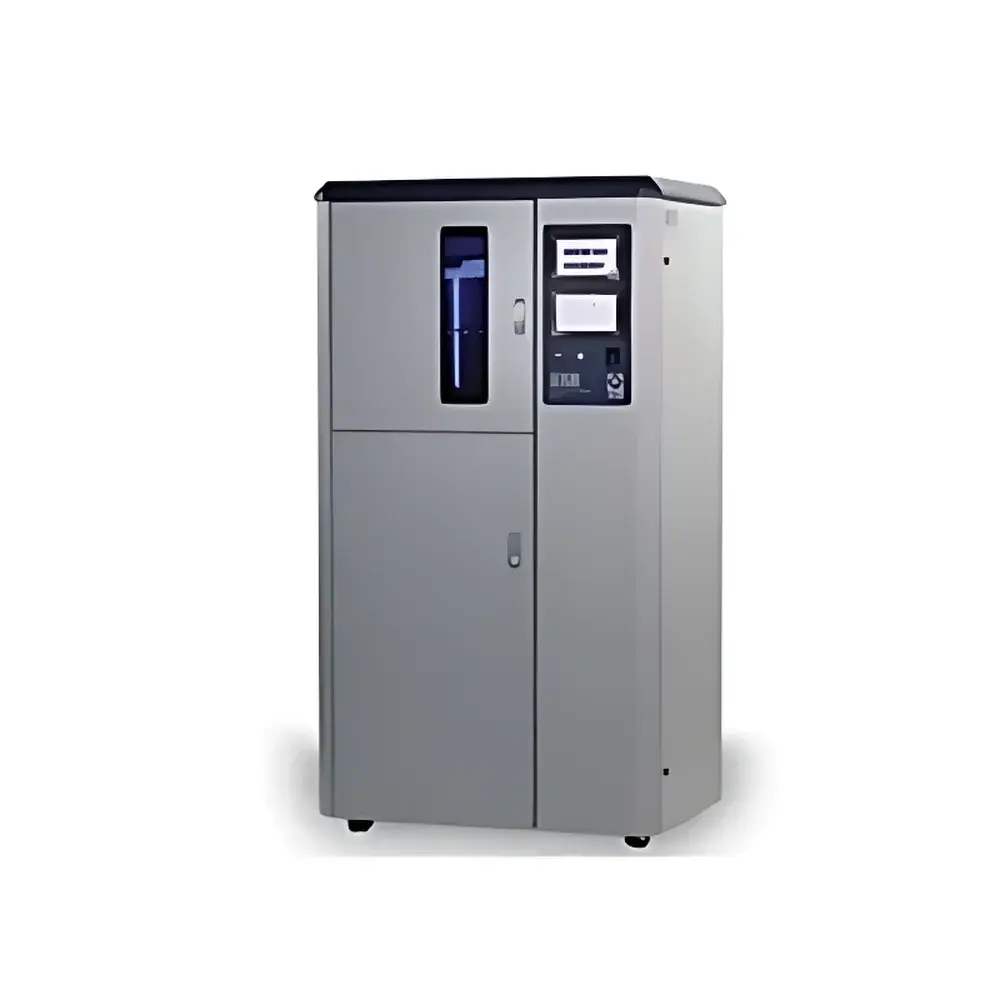
Q-LAB Q-SUN B02-S Xenon Arc Weather-Ometer for Textile Color Fastness Testing
| Brand | Q-LAB |
|---|---|
| Origin | USA |
| Model | Q-SUN B02-S |
| Light Source | 1800 W Air-Cooled Xenon Arc Lamp |
| Spectral Filtering | ISO Window-IR / AATCC Window-B/SL Dual-Filter System |
| Irradiance Control | SOLAR EYE® Sensor at 340 nm, 420 nm, or TUV |
| Humidity Control | Programmable Relative Humidity (RH) with Purified Water Requirement |
| Optional Feature | Purified Water Spray (Top-Mounted Nozzle, Light/Dark Cycle Configurable) |
| Sample Orientation | Vertical Mounting |
| Black Panel Temperature Control | Yes |
| Chamber Air Temperature Control | Yes |
| Compliance | ISO 105-B02, ISO 105-B04, AATCC TM16, AATCC TM169 |
| Lamp Life | ~1500 hours |
| Connectivity | Built-in Ethernet for Data Logging |
| Calibration | PATENTED AUTOCAL® System |
Overview
The Q-LAB Q-SUN B02-S is a precision-engineered xenon arc weather-o-meter specifically designed for textile color fastness evaluation under simulated daylight exposure. It operates on the principle of controlled xenon arc irradiation—filtered to replicate the spectral power distribution of sunlight transmitted through window glass—as defined in ISO 105-B02 and AATCC TM16. Unlike UV fluorescent or metal halide alternatives, the air-cooled 1800 W xenon lamp delivers full-spectrum irradiance (290–800 nm), enabling accurate acceleration of photodegradation mechanisms including fading, chalking, and embrittlement. The instrument replicates not only solar radiation but also critical environmental stressors: regulated relative humidity (RH), black panel temperature (BPT), chamber air temperature, and optional purified water spray—each independently programmable to emulate real-world climatic aging conditions. Its vertical sample mounting configuration ensures uniform exposure geometry and compatibility with standard textile specimen holders per ISO and AATCC protocols.
Key Features
- SOLAR EYE® Irradiance Control: Closed-loop feedback system continuously monitors and adjusts xenon lamp output at user-selectable wavelengths—340 nm (for UV-driven degradation), 420 nm (for visible-light effects), or total UV (TUV)—ensuring reproducible radiant exposure across test runs.
- Programmable Relative Humidity (RH): Integrated RH control maintains precise chamber moisture levels (typically 10–95% RH), essential for evaluating hydrolytic degradation pathways in dyes and fibers; operation requires purified water (≤5 µS/cm conductivity) to prevent mineral deposition.
- Optional Purified Water Spray: Top-mounted single-nozzle spray system delivers controlled wetting events during light or dark cycles, simulating dew, rain, or condensation—critical for assessing moisture-accelerated fading and staining behavior.
- Air-Cooled Xenon Lamp Architecture: Eliminates complex water cooling infrastructure, reducing energy consumption, maintenance frequency, and operational cost; lamp life rated at approximately 1500 hours with stable spectral output throughout service life.
- Dual-Stage Optical Filtration: Comprises an outer high-borosilicate quartz envelope and two nested sets of seven-element internal filters—configured as ISO Window-IR (heat-reducing) or AATCC Window-B/SL—to deliver spectrally matched irradiance per international test method requirements.
- Comprehensive Environmental Monitoring: Simultaneous control and logging of black panel temperature (BPT), chamber air temperature, and RH enables strict adherence to ISO 105-B02 thermal boundary conditions (e.g., BPT ≤ 45 °C).
Sample Compatibility & Compliance
The Q-SUN B02-S accommodates standard textile specimens mounted vertically on removable racks, supporting ISO 105-B02’s 100 mm × 40 mm sample dimensions and multi-layer fabric assemblies. Its design satisfies regulatory and industry-standard test requirements including ISO 105-B02 (Textiles — Tests for colour fastness — Part B02: Colour fastness to artificial light: Xenon arc fading lamp test), ISO 105-B04 (Xenon arc with water spray), AATCC TM16 (Lightfastness of Textiles and Leather), and AATCC TM169 (Weather Resistance of Textiles). All operational parameters—including irradiance setpoint, RH profile, temperature limits, and spray timing—are fully traceable and auditable, supporting GLP-compliant testing environments. The system meets instrumentation validation criteria referenced in ASTM G155 and IEC 60068-2-5, and its data integrity framework aligns with FDA 21 CFR Part 11 principles when configured with appropriate software controls.
Software & Data Management
Equipped with built-in Ethernet connectivity, the Q-SUN B02-S supports seamless integration into laboratory network infrastructures for remote monitoring and automated data capture. Test parameters, real-time sensor readings (irradiance, BPT, RH, chamber temperature), and alarm logs are timestamped and exportable in CSV or XML format. The patented AUTOCAL® system enables rapid, on-site irradiance sensor calibration without external hardware—reducing downtime and ensuring long-term measurement stability. Firmware updates maintain alignment with evolving test standards, and event-driven alerts notify users of deviations from programmed setpoints or maintenance thresholds (e.g., lamp hour counter, filter replacement schedule). Audit trails record all operator actions, parameter changes, and calibration events—essential for quality assurance systems operating under ISO/IEC 17025 or GMP frameworks.
Applications
The Q-SUN B02-S serves as a primary tool for textile manufacturers, dye houses, third-party testing laboratories, and brand compliance teams validating color retention performance across diverse material classes: woven and knitted cotton, polyester blends, nylon, acrylic, and natural fibers such as wool and silk. It is routinely deployed to assess the durability of reactive, disperse, vat, and pigment-based dye systems; evaluate UV absorbers and hindered amine light stabilizers (HALS); qualify new fiber-reactive chemistries; and support R&D efforts in sustainable textile development where accelerated aging data informs lifecycle modeling. In addition to color change (ΔE*), it facilitates assessment of related failure modes including tensile strength loss, surface pilling, and dye migration—particularly when combined with post-exposure mechanical or spectroscopic analysis.
FAQ
What standards does the Q-SUN B02-S directly support?
It is engineered to meet ISO 105-B02, ISO 105-B04, AATCC TM16, and AATCC TM169 requirements out-of-the-box, with optical filtering and environmental controls validated per those methods.
Why is purified water required for RH and spray functions?
Mineral-free water prevents scaling on humidifier elements and spray nozzles, ensuring consistent RH delivery and avoiding clogging or spectral interference from dried deposits.
How does the air-cooled lamp compare to water-cooled alternatives?
Air-cooling eliminates recirculating chillers, plumbing, and associated maintenance—reducing footprint, energy use, and total cost of ownership while maintaining spectral fidelity and irradiance stability.
Can test parameters be logged and exported for audit purposes?
Yes—real-time sensor data, setpoints, alarms, and operator actions are stored locally and exportable via Ethernet; audit trails comply with GLP and 21 CFR Part 11 expectations when paired with validated software configurations.
What is the typical service interval for lamp and filter replacement?
The xenon lamp is rated for ~1500 hours; internal filter sets are recommended for replacement every 1,600–2,000 lamp-hours or per manufacturer’s calibration schedule to maintain spectral accuracy.
Related Products





