
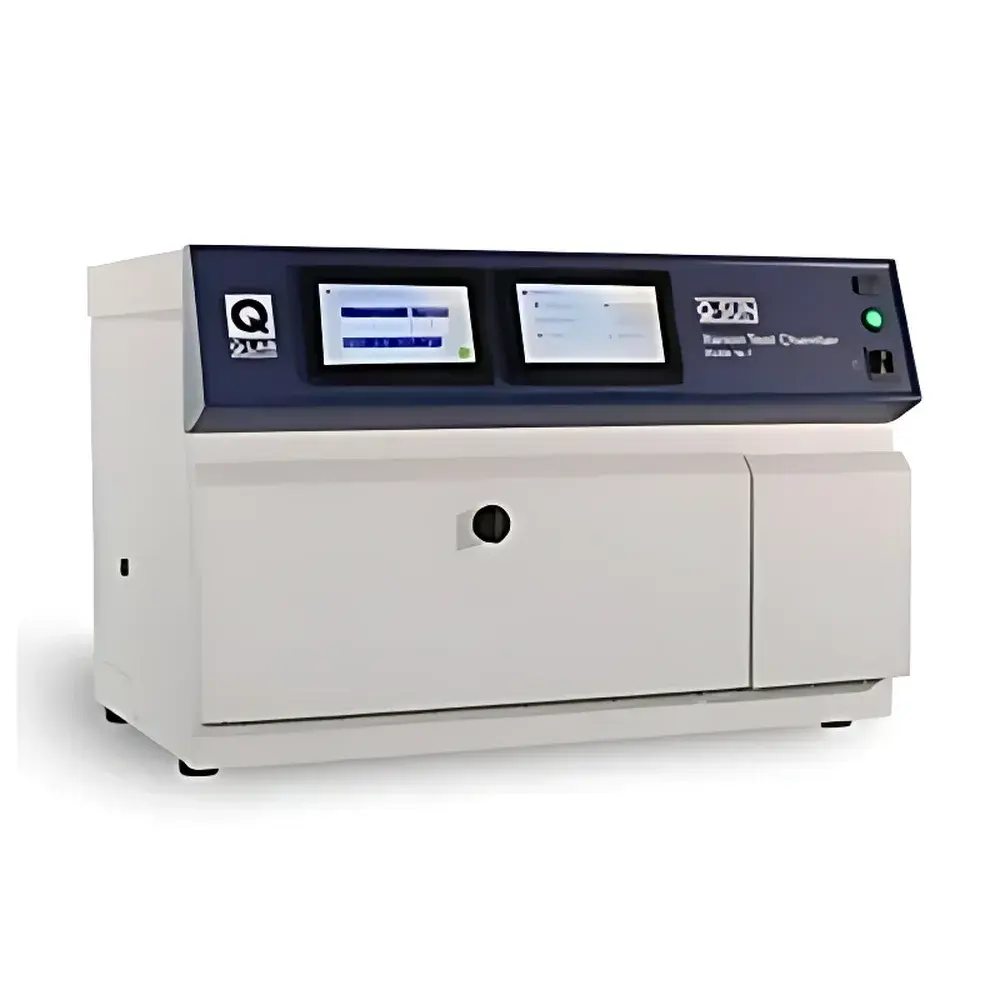
Q-LAB Q-SUN Xe-1 Benchtop Xenon Arc Weathering Test Chamber
| Brand | Q-LAB |
|---|---|
| Origin | USA |
| Model | Q-SUN Xe-1 |
| Radiation Intensity | ≤1800 W/m² |
| Light Exposure Duration | 1–9999 h (continuously adjustable) |
| Sample Tray Dimensions | 251 mm × 457 mm (9.88" × 18") |
| Lamp Configuration | Single air-cooled xenon arc lamp |
| Lamp Lifetime Warranty | 1500 hours |
| Compliance | ASTM G155, ISO 4892-2, SAE J2527, AATCC TM16, ISO 11341, GB/T 16422.2 |
Overview
The Q-LAB Q-SUN Xe-1 is a compact, benchtop xenon arc weathering test chamber engineered for precision simulation of solar radiation exposure under controlled environmental conditions. It employs a single air-cooled xenon arc lamp to reproduce the full solar spectrum—including ultraviolet (UV), visible, and near-infrared (NIR) wavelengths—enabling accelerated evaluation of photodegradation, color shift, gloss loss, chalking, cracking, and other failure modes induced by sunlight, heat, and humidity. Unlike UV fluorescent or metal halide sources, xenon arc technology delivers spectrally accurate irradiance that closely matches terrestrial sunlight (AM1.5), making it the reference method for international standards such as ASTM G155, ISO 4892-2, and SAE J2527. The Xe-1 is specifically designed for laboratories with limited floor space or intermittent testing needs, offering full compliance with regulatory and industry-standard test protocols without requiring dedicated HVAC infrastructure or water cooling.
Key Features
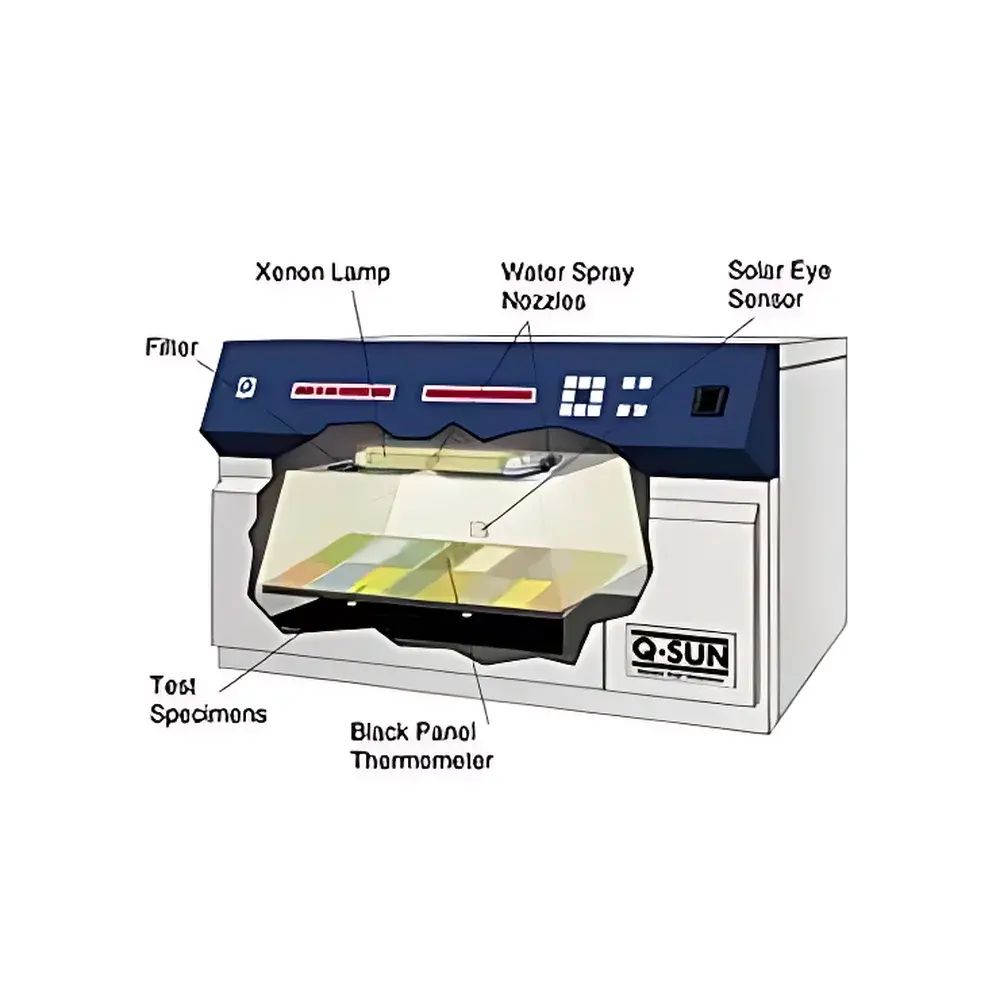
- Single-lamp architecture with integrated air-cooled xenon arc source—minimizes operational complexity and eliminates external chiller dependency.
- Sliding sample tray (251 mm × 457 mm) enabling rapid specimen loading/unloading and direct room-air exhaust capability—no ductwork required.
- Standard optical filtering options (Daylight, Window Glass, Extended UV) to simulate distinct exposure environments; filters are quartz-based and thermally stabilized for long-term spectral fidelity.
- Onboard SOLAR EYE irradiance control system with real-time feedback and closed-loop regulation at user-selected wavelengths (e.g., 340 nm or 420 nm).
- Black panel temperature monitoring (45–90 °C range) with optional black standard sensor; supports simultaneous measurement of chamber air temperature and relative humidity (RH).
- Lamp replacement completed in under 5 minutes via tool-free access—lamp and reflector assembly slides out as a single unit without disturbing ongoing test cycles.
- Robust stainless-steel interior construction with corrosion-resistant finish; front-accessible condensate drain and filter maintenance ports.
Sample Compatibility & Compliance
The Q-SUN Xe-1 accommodates flat, rigid, or low-profile specimens up to 14 kg total load on its removable tray. It is routinely used for evaluating polymers, coatings, textiles, automotive interior materials, packaging films, and architectural finishes. All operational parameters—including irradiance setpoint, light/dark cycling, temperature ramp profiles, and RH modulation—are programmable to meet the procedural requirements of ISO 4892-2 (Method A/B), ASTM G155 (Cycle A–F), AATCC TM16 (Option III), and GB/T 16422.2. The system supports GLP-compliant data integrity through audit-trail-enabled software (optional upgrade), and its irradiance calibration traceability aligns with ISO/IEC 17025-accredited reference standards maintained by Q-LAB’s A2LA- and UKAS-certified calibration laboratory.
Software & Data Management
While the base Xe-1 operates via intuitive front-panel controls, optional Q-SUN software (v5.0+) enables remote scheduling, multi-chamber synchronization, automated report generation (PDF/CSV), and electronic signature support per FDA 21 CFR Part 11. Data logging includes timestamped irradiance (W/m²), black panel temperature (°C), chamber RH (%), and elapsed exposure time (h). Calibration records—including CR20 sensor verification logs and annual traceable recalibration certificates—are stored within the system’s secure archive. Firmware updates preserve backward compatibility and incorporate enhancements validated against NIST-traceable radiometric references.
Applications
The Q-SUN Xe-1 serves critical roles across R&D, QC, and regulatory submission workflows. In polymer formulation development, it quantifies the stabilizing efficacy of HALS, UV absorbers, and pigment systems under simulated window-filtered exposure. Automotive suppliers use it to validate dashboard material resistance to NIR-induced thermal aging. Textile labs apply it per AATCC TM16 to assess dye fastness under indoor lighting conditions. Packaging engineers rely on its reproducible UV dose delivery to predict shelf-life degradation of pharmaceutical blister packs and food-grade laminates. Its compact footprint and low power demand (12A @ 230V) make it suitable for university teaching labs, contract testing facilities, and Tier-2 supplier QA departments requiring ISO/IEC 17025-aligned instrumentation without capital-intensive infrastructure.
FAQ
What standards does the Q-SUN Xe-1 comply with?
It meets the core requirements of ASTM G155, ISO 4892-2, SAE J2527, AATCC TM16, ISO 11341, and GB/T 16422.2—subject to correct filter selection and operational parameter configuration.
Is humidity control available on the Xe-1 model?
Yes—the standard configuration includes programmable relative humidity control (20–95% RH) during light cycles, with independent setpoints for dark periods.
How often must the irradiance sensor be calibrated?
Q-LAB recommends quarterly field verification using the CR20 calibrator; annual return-to-factory recalibration is required for ISO/IEC 17025 traceability.
Can the Xe-1 accommodate three-dimensional parts?
It is optimized for flat or low-relief samples; for complex geometries or larger components, the Q-SUN Xe-3 (with 4× tray area and vertical orientation) is recommended.
Does the system support automated light/dark cycling with temperature ramping?
Yes—predefined or custom cycles can integrate irradiance, black panel temperature, chamber RH, and dwell times into fully synchronized exposure profiles.



