
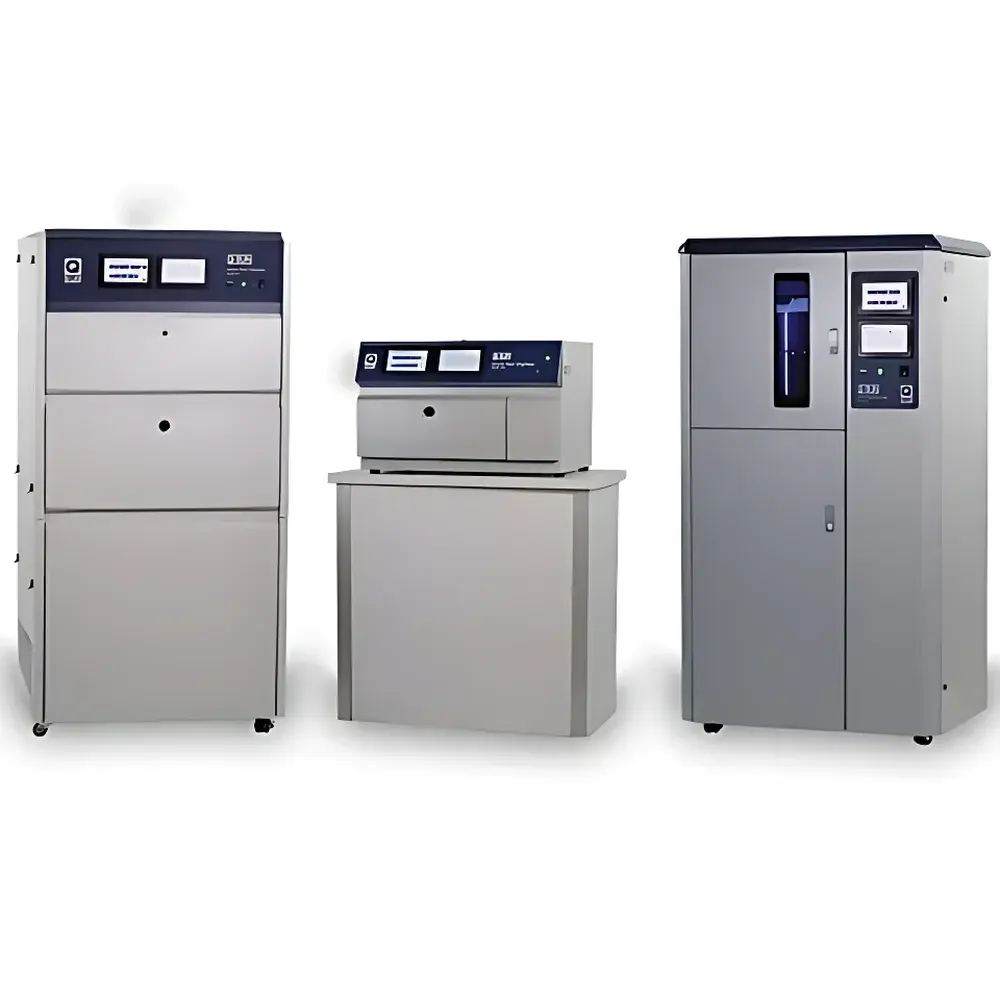
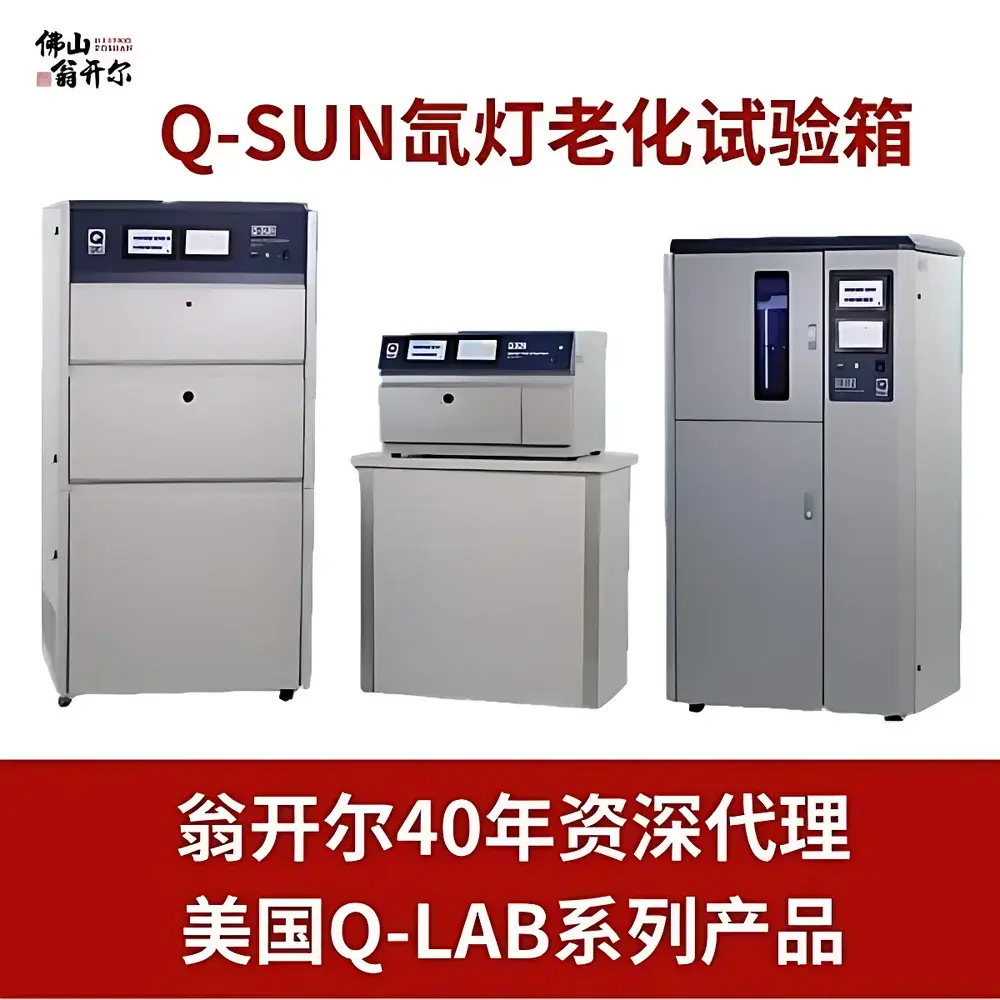
Q-Lab Q-SUN Xe-1 / Xe-2 / Xe-3 Xenon Arc Weathering Test Chamber
| Brand | Q-Lab |
|---|---|
| Origin | USA |
| Model Series | Q-SUN Xe-1, Xe-2, Xe-3 |
| Xenon Lamp Power | 1800 W |
| Irradiance (at 340 nm) | up to 1.30 W/m²/nm |
| Typical Broadband Irradiance | 42 W/m² (with Window-SF5/IR/B04 filters) |
| Lamp Life | up to 3000 h (X-1800+/X-1850+ lamps) |
| Black Panel Temperature Range | 25–120 °C (model-dependent) |
| Relative Humidity Control | 20–95% RH (Xe-2 & Xe-3 only) |
| Water Purity Requirement | >5 MΩ·cm, <0.2 µS/cm, <0.1 ppm TDS (for spray/humidification) |
Overview
The Q-Lab Q-SUN series of xenon arc weathering test chambers are precision-engineered instruments for accelerated simulation of solar radiation, temperature, and moisture exposure—key environmental stressors responsible for photodegradation, thermal aging, and hygrothermal deterioration in polymeric, coated, textile, automotive, and pharmaceutical materials. Based on the fundamental principle of xenon arc irradiation, these chambers replicate the full-spectrum solar output (295–800 nm), including critical UV-B, UV-A, visible, and near-infrared wavelengths, enabling physiologically relevant degradation pathways. Unlike narrow-band UV fluorescent systems, Q-SUN’s broadband xenon source—coupled with interchangeable optical filters—provides spectral fidelity essential for correlating laboratory results with real-world outdoor or indoor service life. The system operates under controlled irradiance (via patented SOLAR EYE® feedback control), black panel or black standard temperature (BPT/ BST), relative humidity (Xe-2/Xe-3), and programmable wet/dry cycles—including water spray and condensation—to emulate natural weathering mechanisms such as photooxidation, hydrolysis, and thermal cycling.
Key Features
- Three scalable platform models: compact benchtop Xe-1 (single lamp), rotary drum Xe-2 (single lamp), and high-capacity flat-bed Xe-3 (triple lamp), each optimized for distinct sample geometries—from textiles and films to 3D automotive components and medical device packaging.
- SOLAR EYE® irradiance control system with automatic, NIST-traceable calibration (AutoCal™); supports user-selectable monitoring at 340 nm, 420 nm, or total UV (TUV) bands.
- Modular optical filtration: Daylight (F/Q/B/B), Window (Q/B/SL/SF5/IR/B04), and Extended UV (Q/B, Quartz) filter sets compliant with ASTM G155, ISO 4892-2, and SAE J2527 spectral requirements.
- Integrated environmental control: independent black panel temperature regulation (25–120 °C), optional chamber air temperature control (Xe-2/Xe-3), and precise RH management (20–95% RH) using high-stability capacitive sensors.
- Automated water spray system with programmable timing (light/dark phases), calibrated flow rates (0.12–1.0 L/min), and ultra-pure water compliance (>5 MΩ·cm) per ISO 4892-2 and ASTM D4355.
- GEN4 touchscreen controller with multilingual UI (English, Chinese, French, German, Spanish), USB data export, Ethernet-based remote monitoring, and built-in self-diagnostic error logging with predictive maintenance alerts.
Sample Compatibility & Compliance
Q-SUN chambers accommodate flat, curved, and three-dimensional specimens—including injection-molded parts, coated panels, flexible packaging, textiles, and biomedical devices—via adjustable sample trays, rotating drums (Xe-2), or sliding flatbeds (Xe-1/Xe-3). All models support standardized specimen mounting per ASTM D6662 and ISO 11341. The system is validated against over 120 international standards, including ASTM G151/G155, ISO 4892-1/2/3, SAE J2412/J2527, AATCC TM16/TM169, GB/T 16422.2, and VW PV 1306/PV 3929. Full compliance documentation—including IQ/OQ protocols, traceable calibration certificates, and 21 CFR Part 11–ready audit trails (via optional software)—supports GLP, GMP, and FDA-regulated product development workflows.
Software & Data Management
The GEN4 controller logs irradiance, temperature, humidity, and cycle status at user-defined intervals (down to 1-second resolution) and stores ≥10,000 hours of operational history. Data export via USB flash drive includes CSV-formatted test reports with timestamps, setpoints, actual values, and alarm events. Optional Q-Lab’s SunTest™ PC software enables advanced scheduling, multi-chamber fleet monitoring, statistical trend analysis, and automated report generation (PDF/Excel). All firmware and calibration routines are version-controlled and backward-compatible; irradiance calibrations are traceable to NIST SRM 2242 through Q-Lab’s CR-20 radiometer system.
Applications
Q-SUN systems serve as primary tools in R&D labs and QC departments across industries where lightfastness, color stability, mechanical integrity, and surface durability under environmental stress are mission-critical. Key applications include: evaluation of automotive interior trim (per SAE J2412), exterior coatings (ASTM D2565), architectural sealants (ASTM C1136), textile dye fastness (AATCC TM16), pharmaceutical packaging UV barrier performance (ICH Q1B), OLED display encapsulation stability, and medical polymer biostability (ISO 10993-12). The ability to decouple spectral distribution, irradiance intensity, thermal load, and moisture exposure enables mechanistic studies of degradation kinetics—not just pass/fail screening.
FAQ
What is the difference between Daylight and Window glass filters?
Daylight filters (e.g., Daylight-Q) simulate unfiltered outdoor sunlight and are used for materials exposed directly to weather (e.g., roofing membranes). Window filters (e.g., Window-B/SL) attenuate UV-B and short UV-A to mimic transmission through standard architectural glass—ideal for indoor-use products like furniture upholstery or electronics housings.
Can Q-SUN perform cyclic tests combining light, dark, spray, and condensation?
Yes. All models support fully programmable sequences per ASTM G155 Cycle 1–10 and ISO 4892-2 Method A–C, including simultaneous irradiance + spray, dark + condensation, and multi-step humidity ramps.
Is relative humidity control available on the Xe-1 model?
No. RH control is standard only on Xe-2 and Xe-3. Xe-1 supports only black panel or chamber air temperature regulation—not both—and lacks integrated humidification.
How often does the xenon lamp require replacement?
Lamp life depends on irradiance setpoint and filter selection: up to 3000 h at low irradiance (e.g., 0.35 W/m²/nm @340 nm with Daylight-Q), down to ~1000 h at maximum output (1.30 W/m²/nm @340 nm with Extended UV-Q/B).
Does Q-SUN comply with FDA 21 CFR Part 11 for electronic records?
When paired with Q-Lab’s SunTest™ software and configured with user access controls, electronic signature, and audit trail modules, the system meets Part 11 requirements for regulated pharmaceutical and medical device testing environments.



