
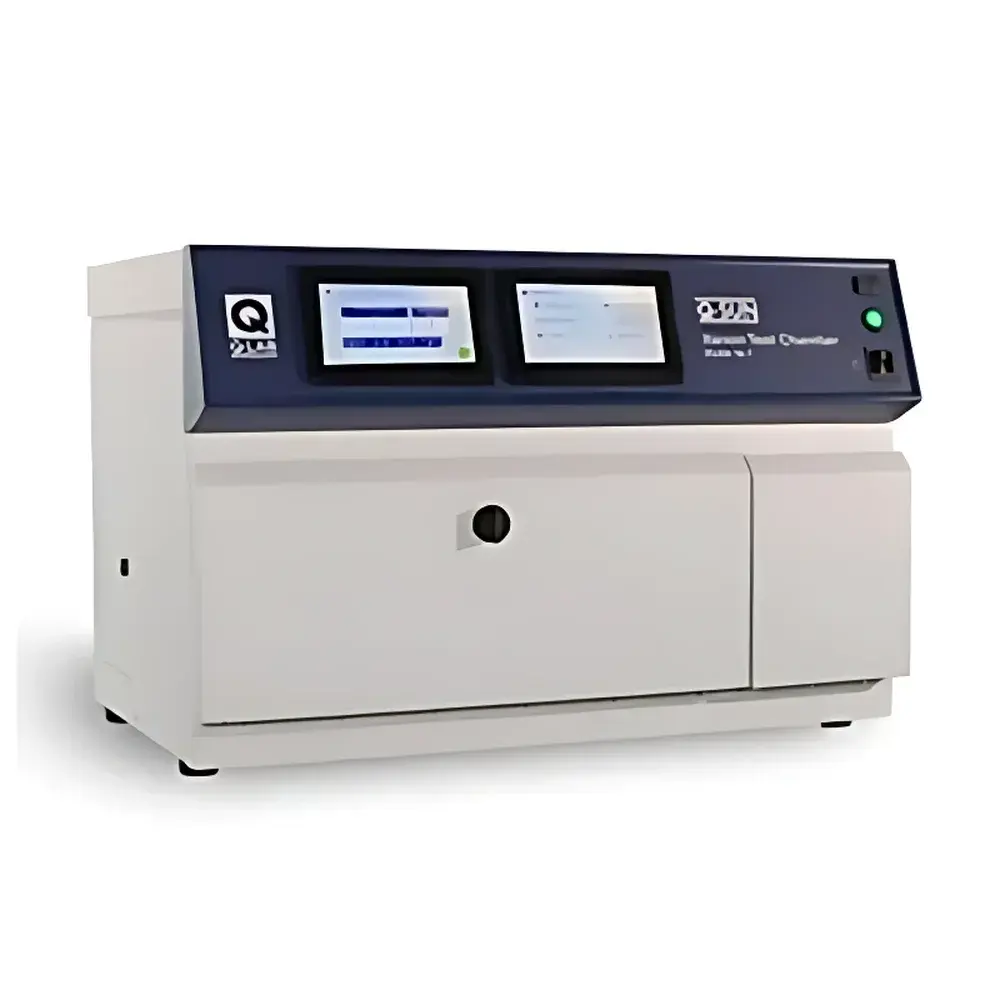
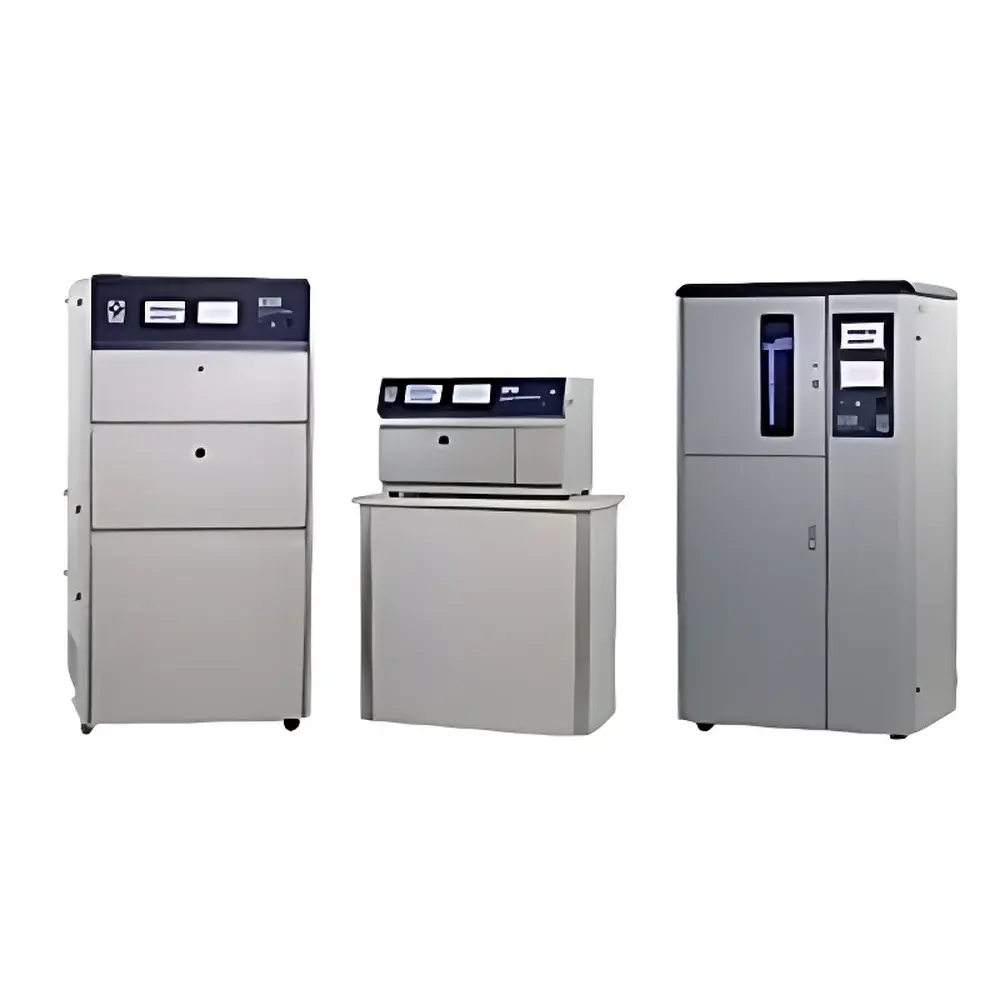
Q-LAB Q-Sun Xe-1-B Xenon Arc Weathering Test Chamber
| Brand | Q-LAB |
|---|---|
| Origin | USA |
| Model | Q-Sun Xe-1-B |
| Xenon Lamp Power | 1800 W |
| Irradiance Range | ≤1800 W/m² |
| Light Exposure Duration | 1–9999 h (continuously adjustable) |
| Humidity Range | up to 95% RH |
Overview
The Q-LAB Q-Sun Xe-1-B Xenon Arc Weathering Test Chamber is an entry-level, benchtop-scale accelerated weathering instrument engineered for precision simulation of solar radiation exposure under controlled environmental conditions. It employs a 1800 W air-cooled xenon arc lamp—optimized to replicate the full solar spectrum (290–800 nm), including critical UV-A, UV-B, visible, and near-infrared wavelengths. Unlike water-cooled systems, the air-cooled lamp architecture reduces infrastructure requirements, lowers operational complexity, and enhances long-term reliability. The chamber integrates a calibrated black panel temperature sensor as standard, enabling accurate specimen surface temperature control between 35 °C and 103 °C—critical for reproducing thermally driven degradation mechanisms such as polymer chain scission, crosslinking, and pigment destabilization. Designed for continuous unattended operation, the Xe-1-B supports 24/7 exposure cycles, delivering irradiance equivalent to peak summer noon sunlight—significantly accelerating failure modes including color fading, chalking, gloss loss, embrittlement, cracking, and tensile strength reduction.
Key Features
- Air-cooled 1800 W xenon arc lamp with ≥1500 h service life—no external cooling water supply required
- Standard black panel temperature control (35–103 °C); optional air temperature sensor for ambient thermal profiling
- SOLAR EYE irradiance monitoring and feedback control at user-selectable wavelengths: 340 nm (UV-B critical), 420 nm (broadband UV-A), or TUV (total ultraviolet)
- Single-filter optical system with field-proven Q-LAB proprietary filters: Daylight-Q/B (direct sunlight), Extended UV-Q/B (accelerated UV stress), and Window-Q/B/SL/IR (through-glass indoor exposure)
- Patented AUTOCAL calibration system enabling rapid, traceable irradiance recalibration without third-party intervention
- Sliding sample tray (251 mm × 457 mm) accommodating up to fifteen 51 mm × 102 mm specimens—or irregular 3D parts using optional fixtures
- Integrated Ethernet port supporting remote monitoring, data logging, and firmware updates via industry-standard protocols
- Comprehensive self-diagnostic suite with real-time fault alerts, lamp hour tracking, and filter life indicators (except Window-IR, which requires scheduled replacement)
Sample Compatibility & Compliance
The Xe-1-B accommodates flat, curved, and three-dimensional specimens—including coatings, plastics, textiles, automotive interior trims, printed graphics, and architectural sealants—without requiring custom mounting hardware. Its vertical exposure geometry ensures uniform irradiance distribution across the sample plane per ASTM G155 and ISO 4892-2. The chamber meets essential regulatory and methodological frameworks: it supports test execution compliant with ASTM D2565 (plastics), ASTM D4329 (paints), ISO 11341 (rubber), SAE J2527 (automotive), and AATCC TM16 (textiles). While not inherently 21 CFR Part 11–compliant, its data export functionality (CSV/Excel) enables integration into validated LIMS or ELN environments under GLP/GMP audit trails when paired with documented SOPs and electronic signature controls.
Software & Data Management
The embedded controller provides a tactile, icon-driven interface with no external PC dependency. All exposure parameters—including irradiance setpoint, temperature setpoint, humidity setpoint (up to 95% RH), cycle duration, and ramp profiles—are programmable and stored with timestamped version history. Real-time irradiance, black panel temperature, chamber humidity, and lamp operating hours are continuously logged to internal memory (≥30 days at 1-min intervals) and exportable via Ethernet to networked storage or SCADA systems. Raw data files conform to ISO/IEC 17025–recommended metadata structures, including instrument ID, calibration certificate number, operator ID, and environmental deviation flags. Optional Q-LAB’s SunTest™ software (Windows-based) enables advanced scheduling, multi-chamber fleet management, statistical trend analysis, and automated report generation aligned with ISO/IEC 17025 documentation requirements.
Applications
The Q-Sun Xe-1-B serves laboratories where budget-conscious yet metrologically sound weathering validation is required—particularly R&D screening, QC release testing, supplier qualification, and comparative material benchmarking. Typical use cases include: evaluating UV stabilizer efficacy in polyolefins; assessing colorfastness of inkjet-printed signage under simulated storefront lighting; validating fade resistance of automotive dashboard materials exposed to filtered daylight; verifying weatherability claims of exterior architectural coatings per ASTM D4587; and qualifying packaging film integrity after prolonged indoor fluorescent exposure. Its compact footprint and plug-and-play installation make it suitable for university research labs, contract testing facilities, and corporate quality departments lacking dedicated environmental test suites.
FAQ
What spectral filters are compatible with the Q-Sun Xe-1-B?
The Xe-1-B accepts three filter families: Daylight-Q/B (for outdoor direct-sun correlation), Extended UV-Q/B (for accelerated UV-driven degradation), and Window-Q/B/SL/IR (for indoor/glass-filtered exposure). Only Window-IR requires periodic replacement; all others maintain spectral stability over lifetime.
Is black panel temperature measurement mandatory?
Yes—black panel temperature control is standard and non-removable. Air temperature sensing is available as an optional secondary control parameter but does not replace black panel regulation for ISO/ASTM-compliant testing.
How often must the xenon lamp be replaced?
Lamp replacement is recommended after 1500 hours of operation or upon SOLAR EYE diagnostic alert indicating >10% irradiance drift at setpoint wavelength—whichever occurs first.
Does the Xe-1-B support humidity cycling?
It maintains static humidity up to 95% RH during light exposure phases but does not implement programmed humidity ramping or condensation cycles (e.g., wet/dry transitions per ISO 4892-2 Annex A).
Can test data be exported for regulatory submission?
Yes—time-stamped irradiance, temperature, and humidity logs export in CSV format with embedded calibration traceability metadata, facilitating inclusion in FDA, EPA, or notified body technical dossiers when supported by lab-specific validation documentation.



