
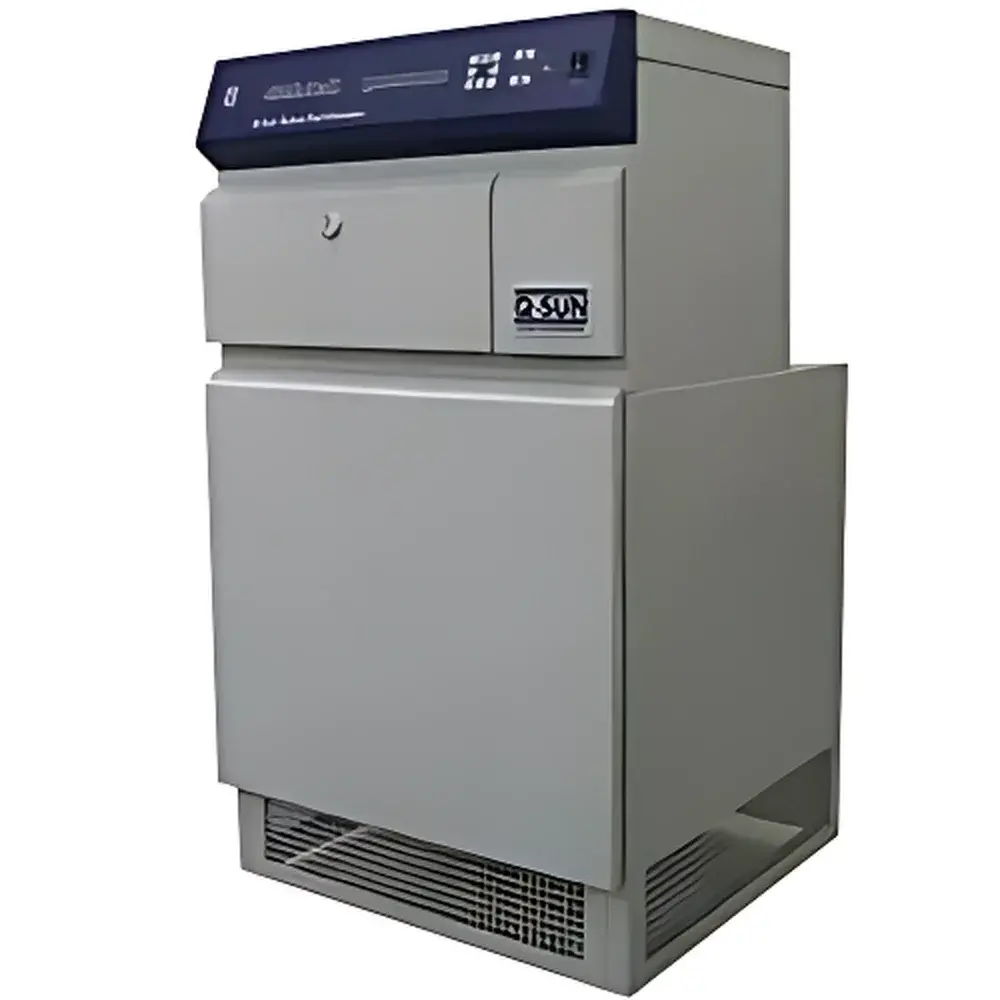
Q-LAB Q-SUN Xe-2-H Air-Cooled Xenon Arc Weathering Test Chamber
| Brand | Q-LAB |
|---|---|
| Origin | USA |
| Model | Q-SUN Xe-2-H |
| Cooling Method | Air-Cooled |
| Humidity Control | Yes (Electronic RH Sensor) |
| Light Source | 1800 W Xenon Arc Lamp |
| Filter System | Outer Borosilicate or Quartz Glass + 14 Inner Filter Discs |
| Compliance | ASTM, AATCC, ISO, and Other International Weathering Standards |
| Data Connectivity | Ethernet |
| Calibration | AUTO-CAL Patented System |
| User Interface | Multilingual (English, French, Spanish, Italian, German) |
| Sample Mounting | Rotating Drum Rack |
| Measured Parameters | Spectral Irradiance, Radiant Exposure, Relative Humidity, Chamber Temperature, Black Panel/Black Standard Temperature |
Overview
The Q-LAB Q-SUN Xe-2-H Air-Cooled Xenon Arc Weathering Test Chamber is an engineered solution for accelerated material aging under controlled solar-simulated irradiation, temperature, and humidity conditions. Based on the well-established Q-SUN platform, the Xe-2-H variant integrates precise relative humidity control—enabled by a high-stability electronic RH sensor—into the proven air-cooled xenon arc architecture. This configuration enables reproducible simulation of outdoor and indoor weathering environments where moisture cycling plays a critical role in degradation mechanisms such as hydrolysis, pigment fading, polymer chain scission, and coating delamination. The system employs a 1800 W xenon arc lamp with full-spectrum output (290–800 nm), closely matching terrestrial sunlight after spectral filtering. Its optical train includes a customizable dual-stage filter assembly: an outer borosilicate or fused quartz envelope paired with up to fourteen interchangeable inner filter discs, allowing users to tailor spectral distribution to match specific standards—including ISO 11341, ASTM G155, AATCC TM16, and ASTM D4459 for indoor applications.
Key Features
- Integrated electronic relative humidity control with ±2% RH accuracy across the operational range (10–95% RH), enabling synchronized wet/dry cycles essential for realistic weathering protocols.
- Patented AUTO-CAL calibration system—fully automated irradiance calibration using NIST-traceable reference sensors—reducing manual intervention and ensuring long-term measurement traceability.
- Rotating drum sample rack providing uniform exposure across all specimens, minimizing edge effects and improving inter-sample comparability.
- Intuitive multilingual touchscreen interface supporting English, French, Spanish, Italian, and German—designed for global laboratory environments and compliant with ISO/IEC 17025 documentation requirements.
- Ethernet-based data logging with real-time monitoring, timestamped parameter recording (irradiance, RH, chamber temperature, black panel temperature), and export-compatible CSV outputs for audit-ready reporting.
- Robust mechanical architecture featuring corrosion-resistant stainless steel construction, sealed lamp housing, and thermal management optimized for continuous operation at elevated irradiance levels.
Sample Compatibility & Compliance
The Q-SUN Xe-2-H accommodates flat, rigid, or flexible specimens up to 76 mm × 152 mm per position, with standard capacity for 48 samples per test cycle. It supports diverse material classes including textiles, coatings, plastics, elastomers, adhesives, sealants, roofing membranes, and graphic arts media. The chamber meets or exceeds performance criteria defined in over 40 international standards, including ASTM C1257, C1442, C1519, D2565, D4459, D5071, D6695; AATCC TM16 and TM169; ISO 4892-2; and JIS D0205. Its design facilitates GLP-compliant operation through configurable audit trails, user access levels, and electronic signature support—fully aligned with FDA 21 CFR Part 11 requirements when deployed with validated software configurations.
Software & Data Management
The embedded firmware provides real-time control of irradiance setpoints (W/m² @ 340 nm or 420 nm), RH ramp profiles, temperature ramps, and cycle sequencing (e.g., light-only, light+RH, dark+RH). All parameters are logged at user-defined intervals (minimum 1-second resolution) and stored internally with battery-backed memory. Data export via Ethernet enables seamless integration into LIMS or ELN platforms. Optional Q-LAB’s SunTest® Software extends functionality with remote monitoring, multi-chamber fleet management, statistical trend analysis, and automated report generation compliant with ISO/IEC 17025 Clause 7.8.2.
Applications
This instrument is routinely deployed in R&D laboratories, quality assurance departments, and contract testing facilities for evaluating photostability, colorfastness, gloss retention, chalking resistance, and mechanical property decay. Key application domains include textile dye migration assessment per AATCC TM16, architectural sealant durability per ASTM C1519, automotive interior material fade resistance per SAE J2412, and UV-curable ink stability per ISO 105-B02. Its humidity capability makes it especially suited for studying moisture-accelerated degradation pathways in polyolefins, polyurethanes, and waterborne coatings.
FAQ
What standards does the Q-SUN Xe-2-H support for textile colorfastness testing?
It fully complies with AATCC TM16 and TM169, enabling both accelerated and comparative weathering assessments of dyed and printed fabrics.
Does the system support automated calibration without external equipment?
Yes—the built-in AUTO-CAL system performs end-to-end irradiance calibration using factory-calibrated reference sensors, eliminating the need for handheld meters or third-party services.
Can the humidity function be disabled for dry-only exposure tests?
Yes—humidity control is fully programmable and can be deactivated or held constant at any setpoint within the 10–95% RH range.
Is the lamp spectral output adjustable?
Spectral distribution is modified exclusively via physical filter combinations; no electronic spectral tuning is available, ensuring metrological stability and regulatory acceptance.
How is data integrity ensured during extended unattended runs?
Internal non-volatile memory retains all logged data even during power interruption, and Ethernet transmission includes CRC error checking and configurable retry logic.



