
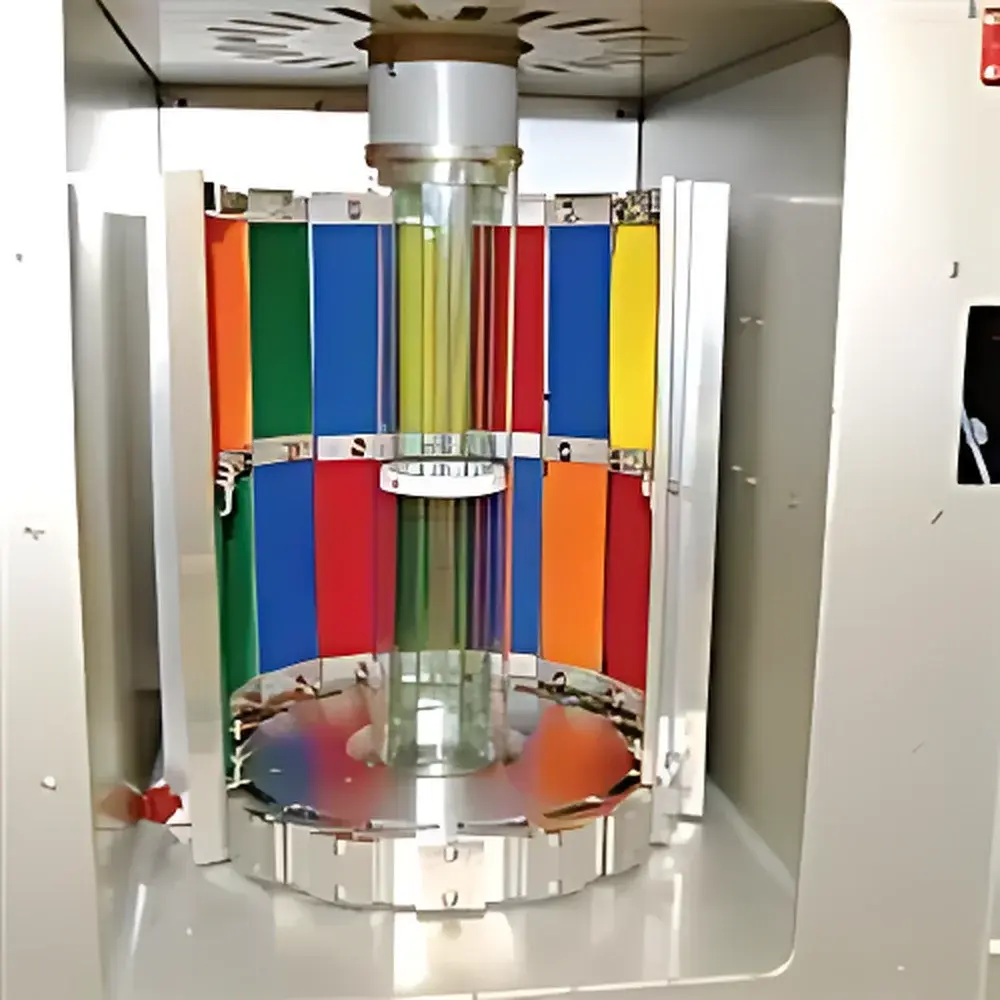
Q-LAB Q-SUN XE-2 Xenon Arc Weathering Test Chamber (Air-Cooled)
| Brand | Q-LAB |
|---|---|
| Origin | USA |
| Model | Q-SUN XE-2 X |
| Xenon Lamp Power | 1800 W |
| Cooling Method | Air-Cooled |
| Sample Capacity | 31 specimens (46 mm × 122 mm) |
| Optical System | Dual-filtered borosilicate/quartz lantern assembly |
| Compliance | ASTM G155, ISO 4892-2, AATCC TM16, SAE J2527, Ford PV3930, GMW14124, VW PV 1303, ISO 105-B02, ISO 105-B04 |
| Calibration Traceability | NIST-traceable, ISO/IEC 17025-accredited calibration laboratory |
Overview
The Q-LAB Q-SUN XE-2 Xenon Arc Weathering Test Chamber (Air-Cooled) is an engineered solution for accelerated weathering and light stability evaluation of polymeric, textile, automotive, coating, and architectural materials. It employs a 1800 W xenon arc lamp to replicate full-spectrum solar radiation—spanning UV, visible, and near-infrared wavelengths—with spectral fidelity adjustable via interchangeable optical filters. Unlike natural outdoor exposure—where samples receive only ~4–6 hours per day of peak solar irradiance—the XE-2 delivers continuous, controlled irradiation equivalent to midday summer sun intensity for 24 hours daily, enabling high-fidelity acceleration factors (typically 5× to 10× vs. field exposure). Its air-cooled architecture eliminates the need for recirculating water chillers or complex plumbing, reducing infrastructure requirements while maintaining thermal stability across the test chamber’s operating envelope.
Key Features
- 1800 W xenon arc lamp with dual-stage optical filtration: external borosilicate or fused quartz cylindrical envelope plus two internal filter sets (e.g., Daylight, Window Glass, Extended UV), enabling compliance with ASTM G155 Cycle 1–4, ISO 4892-2, AATCC TM16, and OEM-specific protocols.
- Integrated black panel temperature control (BPT) and chamber air temperature regulation, supporting precise thermal profiling from 30 °C to 80 °C (BPT) and 25 °C to 70 °C (chamber air).
- Programmable relative humidity control (10–80% RH) with condensation capability via humidification system; optional water spray function (XE-2-HS and XE-2-HBS variants) enables wet/dry cycling per ISO 4892-2 Annex A and ASTM D4329.
- Rotating drum sample holder accommodating 31 standard specimens (46 mm × 122 mm); quick-release mechanism allows tool-free loading/unloading.
- NIST-traceable, ISO/IEC 17025-accredited calibration support for both black panel temperature sensors (CT202 series) and irradiance sensors (CR20 series), with annual recalibration service available under LW-6008 protocol.
- Compliance-ready architecture: supports audit trails, user access levels, and data integrity features aligned with GLP and GMP expectations; firmware logs all critical parameters—including irradiance setpoint deviation, BPT drift, RH excursions, and lamp hours—with timestamped records exportable in CSV format.
Sample Compatibility & Compliance
The Q-SUN XE-2 accommodates diverse specimen geometries and material classes through a modular sample rack system. Standard fixtures include ISO 105-B02 face masks (full- and half-height, Method 1 & 2), AATCC TM16 paper masks (XR-11229-K), photographic frames (XR-11315-K), blue wool references (ISO 105-B04, XR-11368-K), and textile frame assemblies (XR-11273-K, XR-11291-K). All configurations maintain uniform irradiance distribution per ASTM G155 Section 7.2. The chamber meets the spectral power distribution (SPD) requirements of ISO 4892-2:2013 Table 1 (Daylight and Window Glass filters), ASTM G155-22 Annex A, and automotive standards including SAE J2527, Ford PV3930, and VW PV 1303. Filter selection directly governs degradation kinetics—e.g., Window Glass filtration emphasizes polymer yellowing and chalking, while Daylight filtration accelerates UV-driven embrittlement and pigment fading.
Software & Data Management
The XE-2 operates via embedded microprocessor-based controller with intuitive menu navigation and real-time parameter display. All test cycles—including irradiance ramping, temperature/humidity ramps, spray timing, and dark periods—are programmable via front-panel interface or optional PC-based Q-Lab Software (not included). Raw sensor data (irradiance, BPT, chamber air T/RH, spray status) are logged at user-defined intervals (1–60 min) with automatic timestamping. Exported CSV files retain metadata (operator ID, cycle name, filter type, lamp serial number) for traceability. Calibration events—including CT202 and CR20 sensor verification—are recorded with date, technician ID, and deviation values, satisfying FDA 21 CFR Part 11 electronic record requirements when used with validated SOPs.
Applications
The Q-SUN XE-2 is deployed across R&D, QC, and regulatory testing laboratories to evaluate photostability, colorfastness, gloss retention, mechanical property loss, and surface morphology changes. Key use cases include: validation of automotive interior trim against UV-induced cracking (GMW14124); assessment of architectural sealants per ASTM C1135; textile lightfastness per ISO 105-B02 and AATCC TM16-3; coating durability for aerospace composites (SAE AMS 3670); and packaging film UV transmission stability (ISO 11664-3). Its reproducibility (±3% irradiance uniformity across sample plane, per ASTM G155 Section 8.3) ensures inter-laboratory comparability for multi-site studies.
FAQ
What filter types are supported, and how do they affect test outcomes?
The XE-2 accepts Daylight, Window Glass, and Extended UV filter combinations. Daylight filters simulate unfiltered terrestrial sunlight (290–800 nm); Window Glass filters emulate indoor exposure behind glass (cutting off <320 nm UV), slowing degradation but increasing relevance for interior applications.
Is humidity control mandatory for all test standards?
No—humidity is required only for standards specifying wet/dry cycles (e.g., ISO 4892-2 Annex A, ASTM D4329). The XE-2-H variant provides RH control without spray; XE-2-HS adds front/back spray nozzles per ISO 105-B02 Method 2.
How often must sensors be calibrated?
Black panel temperature sensors (CT202/BP or CT202/IBP) and irradiance sensors (CR20 with matched TUV filter) require annual recalibration at Q-Lab’s ISO/IEC 17025-accredited lab, traceable to NIST standards.
Can the XE-2 accommodate non-standard specimen sizes?
Yes—custom racks (e.g., XR-11291-K backplate holders) and auxiliary mounting hardware allow secure placement of irregular shapes, provided total surface area does not exceed 31 × 46 mm × 122 mm and airflow remains unobstructed.
What maintenance is required beyond calibration?
Lamp replacement every 1,500–2,000 hours; quarterly inspection of filter integrity and spray nozzle clearance; biannual cleaning of air intake filters and chamber interior with non-abrasive, pH-neutral cleaner.



