
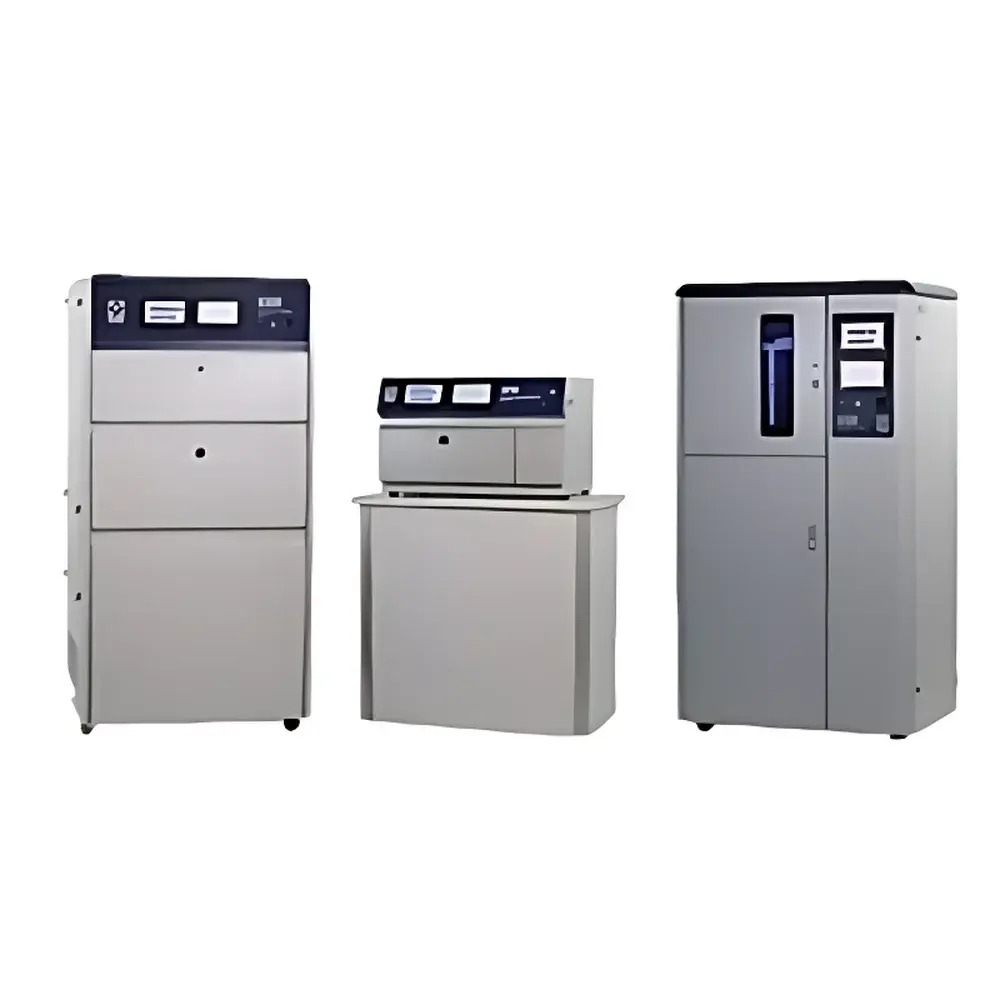
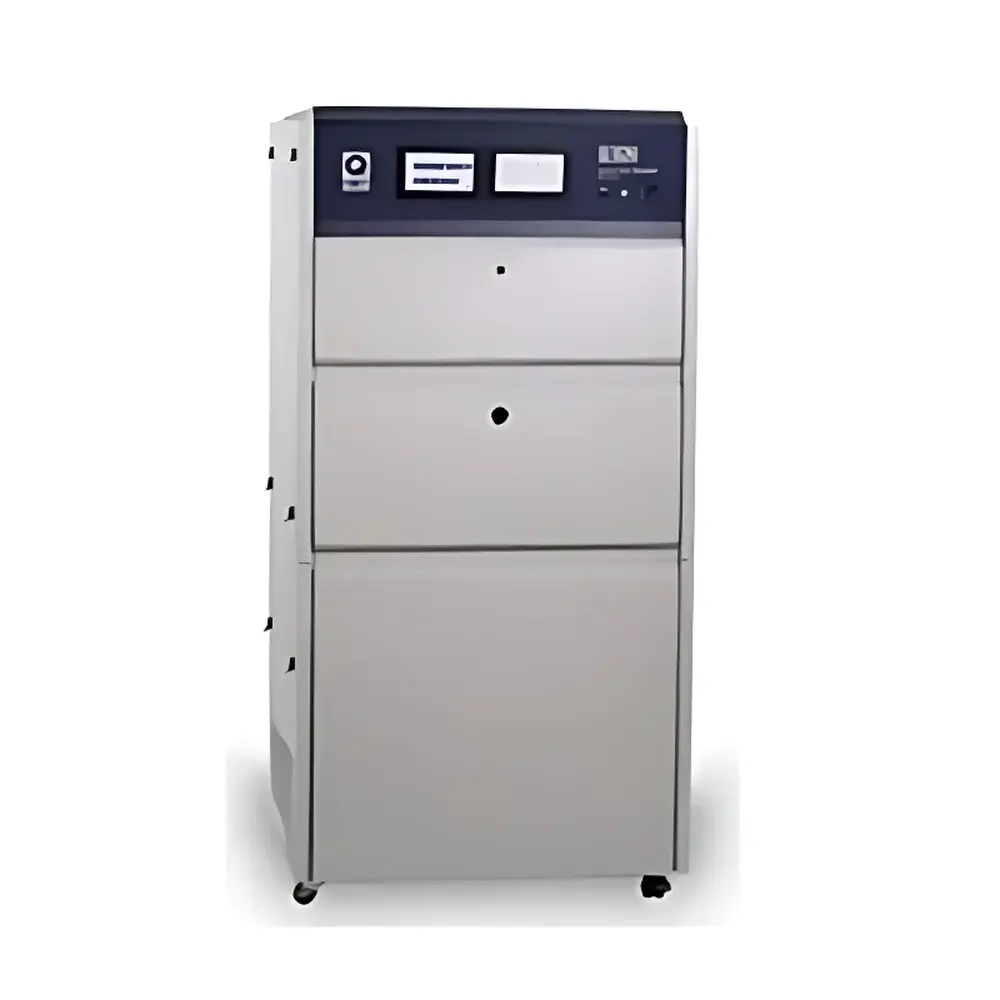
Q-LAB Q-SUN Xe-3-HDS Xenon Arc Weathering Test Chamber
| Brand | Q-LAB |
|---|---|
| Origin | USA |
| Model | Q-SUN Xe-3-HDS |
| Xenon Lamp Power | 1800 W |
| Irradiance Range | ≤1800 W/m² |
| Light Exposure Duration | 1–9999 h (continuously adjustable) |
| Humidity Range | Up to 95% RH |
| Cooling Method | Air-Cooled Lamps |
| Lamp Life | ~1500 hours |
Overview
The Q-LAB Q-SUN Xe-3-HDS Xenon Arc Weathering Test Chamber is an advanced, air-cooled xenon arc exposure system engineered for high-fidelity simulation of full-spectrum solar radiation, humidity, and multi-phase liquid exposure under controlled laboratory conditions. Based on the fundamental principle of xenon arc irradiation—where a high-intensity xenon lamp emits light closely matching terrestrial sunlight across UV, visible, and near-infrared wavelengths (290–800 nm)—the Xe-3-HDS enables reproducible, quantitative assessment of material degradation mechanisms including photolysis, oxidation, chalking, color shift, gloss loss, and mechanical embrittlement. Its defining capability lies in dual-spray functionality: unlike standard single-spray or humidity-only configurations, the HDS variant supports simultaneous, independent delivery of two distinct aqueous solutions—such as simulated acid rain (pH 3.0–4.5) and alkaline detergent solution—to replicate complex real-world environmental attack scenarios. This feature is critical for evaluating automotive exterior trim, architectural coatings, textile finishes, and medical device packaging subjected to sequential or co-occurring chemical-moisture stressors.
Key Features
- Air-cooled 1800 W xenon arc lamps (3-lamp configuration) eliminate the need for external chillers or recirculating water systems, reducing operational complexity, energy consumption, and maintenance overhead.
- Dual independent spray manifold with precision solenoid valves and dedicated reservoirs permits concurrent application of two chemically distinct liquids without cross-contamination—ideal for accelerated corrosion testing and multi-agent soiling studies.
- Integrated humidity control system maintains relative humidity from 10% to 95% RH with ±3% RH accuracy, continuously monitored and logged alongside black panel temperature (BPT) and chamber air temperature.
- Patented AUTOCAL calibration system enables rapid, user-performed verification and adjustment of irradiance, temperature, and humidity sensors; all calibrations are traceable to NIST standards and support ISO/IEC 17025-compliant quality management systems.
- Modular sample mounting architecture accommodates flat, 3D, and irregular geometries—including bottles, cosmetic containers, textiles, and molded plastic components—via interchangeable fixtures (X-10114-K, X-10476-K, X-10255-X, etc.) with height-adjustable supports ensuring uniform irradiance exposure across specimen surfaces.
- Standard solar spectral filtering options include Daylight (Daylight-Q/B), Window Glass (Window-Q, Window-B/SL, Window-IR), and Extended UV (UV-Q/B), each certified for spectral stability and compliant with ASTM G155 and ISO 4892-2 spectral requirements.
Sample Compatibility & Compliance
The Q-SUN Xe-3-HDS supports a broad range of substrate types and industry-specific test formats. Flat-panel specimens (e.g., painted metal panels per ASTM D2244, ISO 2813) mount directly onto the 76 × 152 mm or 102 × 203 mm fixture arrays. Three-dimensional objects—including PET bottles (ASTM D4332), golf balls (SAE J2412), and respirator face masks (ASTM F2100)—are secured using height-adjustable 203 × 203 mm 3D brackets (X-10476-K). Textile swatches conform to AATCC TM16 via the X-10255-X and X-10609-K textile-specific holders. All configurations ensure consistent specimen-to-lamp distance and angular orientation per ISO 4892-2 Annex A. The system meets essential regulatory and methodological requirements for GLP-compliant testing environments, including audit-ready data logging, electronic signature support (when paired with Q-LAB’s SOLAR EYE software), and alignment with FDA 21 CFR Part 11 data integrity provisions when configured with appropriate IT controls.
Software & Data Management
Control and monitoring are executed via Q-LAB’s proprietary SOLAR EYE software suite, which provides real-time graphical display of irradiance (W/m² at 340 nm or 420 nm), BPT, chamber RH, and elapsed exposure time. Data is logged at user-defined intervals (minimum 1-second resolution) and exported in CSV or XML format for integration into LIMS or statistical analysis platforms (e.g., JMP, Minitab). The system supports automated test sequencing—including ramped irradiance profiles, cyclic humidity steps, and timed spray events—with password-protected user roles (Operator, Supervisor, Administrator) to enforce procedural compliance. Optional CR20 handheld irradiance calibrators—equipped with NIST-traceable 340 nm, 420 nm, or TUV (300–400 nm) sensors—enable field verification of sensor drift without interrupting ongoing tests. All calibration records, instrument logs, and test reports are timestamped, digitally signed, and archived with immutable audit trails.
Applications
This chamber is routinely deployed in R&D and QC laboratories across automotive OEMs (e.g., Ford PV-1211, GMW14872), aerospace suppliers (SAE AMS 14523), paint and coating manufacturers (ISO 11341, ASTM D4587), textile producers (AATCC TM16, ISO 105-B02), and medical device packaging validation (ISO 11607-1). Typical use cases include: quantifying UV-induced yellowing of polycarbonate headlamp lenses; evaluating adhesion retention of elastomeric sealants under wet-dry cycling; benchmarking fade resistance of pigment dispersions in architectural acrylics; validating hydrophobic coating durability against acid rain simulation; and assessing microbial growth inhibition on antimicrobial fabrics exposed to combined UV/humidity/stressor regimes.
FAQ
What is the recommended maintenance interval for the xenon lamps?
Lamps should be replaced after approximately 1500 hours of operation or when irradiance output falls below 90% of initial calibration—whichever occurs first. Replacement requires no tools and takes less than five minutes per lamp.
Is purified water mandatory for humidity and spray functions?
Yes. Deionized or distilled water (conductivity 90%.
Can the Xe-3-HDS operate without the dual-spray option enabled?
Yes. The dual-spray manifold can be deactivated, allowing operation in standard humidity-only (H), humidity + single-spray (HS), or humidity + back-spray (HBS) modes depending on firmware configuration and installed hardware modules.
How is spectral fidelity maintained over time?
Q-LAB flat-type filters (e.g., Daylight-Q/B, Window-Q) exhibit minimal spectral shift over 5,000+ hours of use. Filter replacement is recommended every 1,500–2,000 lamp hours or when irradiance uniformity deviates beyond ±5% across the sample plane.
Does the system support remote monitoring and alarm notification?
When connected to a local network and configured with Q-LAB’s optional WebConnect module, users can access live status, receive SMS/email alerts for fault conditions (e.g., lamp failure, low water, temperature excursion), and initiate emergency shutdown remotely.



