
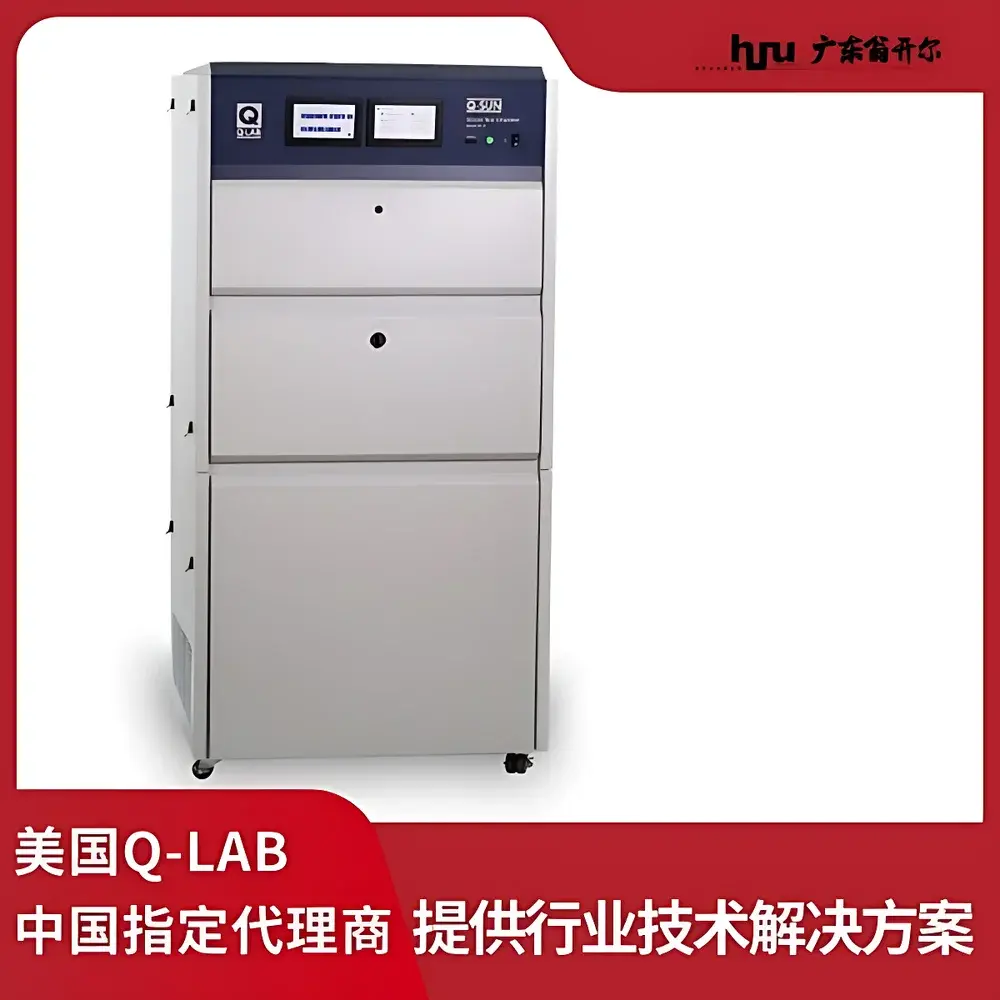
Q-LAB Q-SUN Xe-3-HS Xenon Arc Weathering Test Chamber
| Brand | Q-LAB |
|---|---|
| Origin | USA |
| Model | Xe-3-HS |
| Irradiance | up to 1.30 W/m²/nm @ 340 nm, 2.40 W/m²/nm @ 420 nm |
| Filter Options | Daylight, Extended UV (UV-Q/B), Window Glass (Window-Q, Window-B/SL, Window-IR) |
| Water Spray Option | Integrated dual-nozzle purified water spray system |
| Humidity Control | Programmable RH range (typical 10–95% RH, non-condensing) |
| Light Cycle | Fully programmable irradiation/dark cycles |
| Calibration | Patented AUTOCAL radiometric calibration system |
| Connectivity | Built-in Ethernet interface for remote monitoring and data logging |
Overview
The Q-LAB Q-SUN Xe-3-HS Xenon Arc Weathering Test Chamber is an engineered solution for accelerated weathering and light stability evaluation of materials under controlled, reproducible solar-spectrum simulation. Utilizing a high-intensity xenon arc lamp as its radiation source, the chamber replicates full-spectrum sunlight—including critical UV, visible, and near-infrared wavelengths—enabling correlation with real-world outdoor and indoor exposure conditions. Unlike UV fluorescent or metal halide systems, xenon arc technology delivers spectrally accurate irradiance profiles essential for evaluating photodegradation mechanisms such as polymer chain scission, pigment fading, coating chalking, and textile colorfastness. The Xe-3-HS platform is designed for laboratories requiring regulatory-compliant, repeatable testing without compromising on spectral fidelity or operational efficiency. Its compact footprint and optimized energy architecture make it suitable for academic labs, R&D centers, and QC facilities where space and budget constraints previously limited access to xenon-based weathering validation.
Key Features
- Patented AUTOCAL radiometric calibration system ensures traceable, operator-independent irradiance verification—reducing calibration time by >70% versus manual methods and supporting ISO 17025-compliant quality systems.
- Triple-filter compatibility: Pre-installed daylight filters (for outdoor correlation per ASTM G155 and ISO 4892-2), extended UV-Q/B filters (for accelerated automotive interior testing per SAE J2412 and GMW14124), and three window-glass variants (Window-Q, Window-B/SL, Window-IR) for indoor lighting simulation per ISO 105-B02 and AATCC TM16.
- Integrated purified water spray system with dual top-mounted nozzles enables realistic wet/dry cycling; programmable activation during light or dark phases supports IEC 60068-2-52 salt mist + UV protocols and ASTM D4329 condensation simulation.
- Intuitive touchscreen interface with multi-language support (English, Chinese, Japanese, German) and embedded Ethernet connectivity for secure HTTP/HTTPS data export, remote diagnostics, and integration into LIMS or MES environments.
- Robust thermal and humidity control architecture maintains stable chamber conditions across 10–95% RH (non-condensing) and black panel temperatures from 35°C to 100°C—fully compliant with ASTM D7869 and ISO 11341 humidity ramping requirements.
Sample Compatibility & Compliance
The Xe-3-HS accommodates flat-panel specimens up to 127 mm × 127 mm (5″ × 5″) or multiple smaller samples on standard specimen trays. Its uniform irradiance field (±15% across test area per ASTM G151) ensures statistical validity for comparative studies. The system meets essential regulatory frameworks including FDA 21 CFR Part 11 (with optional audit trail and electronic signature modules), ISO/IEC 17025 calibration traceability, and GLP/GMP documentation readiness. It supports method validation per ICH Q1B (photostability testing of pharmaceuticals), ASTM D4329 (plastics), ASTM D7869 (automotive coatings), and ISO 4892-2 (general plastics). All filter sets are NIST-traceable and supplied with spectral emission certificates.
Software & Data Management
The built-in Q-LAB TestSuite™ firmware provides real-time irradiance monitoring, cycle logging, and event-triggered alerts (e.g., lamp end-of-life, filter replacement, humidity deviation). Export formats include CSV, XML, and PDF reports compatible with JMP, Minitab, and LabWare LIMS. Optional Q-LAB’s SunTest Cloud service enables encrypted cloud backup, cross-site test comparison dashboards, and automated compliance reporting for internal audits or regulatory submissions. All data logs retain full metadata—including operator ID, calibration history, environmental setpoints, and hardware status—for full 21 CFR Part 11 compliance when configured with user authentication and electronic signatures.
Applications
This chamber is routinely deployed in polymer formulation development, automotive OEM supply chain qualification, architectural coating durability assessment, textile colorfastness certification, and pharmaceutical photostability screening. Typical use cases include: predicting 5-year exterior fade resistance of automotive clearcoats under South Florida exposure; validating UV resistance of medical device packaging per ISO 11607; assessing inkjet print permanence on museum-grade archival papers; and qualifying adhesives for solar panel backsheet lamination under cyclic UV/humidity stress.
FAQ
What spectral filters are included standard with the Xe-3-HS?
The system ships with one daylight filter (for outdoor correlation) and one Window-Q filter (for general indoor simulation). Additional filters—including UV-Q/B, Window-B/SL, and Window-IR—are available as configurable options.
Is purified water required for the spray function?
Yes. Resistivity ≥1 MΩ·cm (equivalent to ASTM D1193 Type IV water) is mandatory to prevent nozzle clogging and mineral deposition on specimens or optics.
Can the Xe-3-HS be integrated into an existing laboratory network?
Yes. Its native Ethernet port supports static IP assignment, DHCP, and TLS 1.2-secured data transmission. No proprietary gateway hardware is required.
Does the AUTOCAL system eliminate the need for external radiometers?
AUTOCAL replaces routine manual calibration but does not replace periodic third-party verification per ISO/IEC 17025. Annual external calibration using a NIST-traceable reference radiometer is recommended for accredited labs.
What is the typical lamp lifetime under standard operation?
Xenon lamps operate for approximately 1,500–2,000 hours at nominal irradiance (1.10 W/m²/nm @ 340 nm); lifetime varies with spectral filter selection and intensity setpoint.



