
Q-LAB Q-SUN Xe-3 Xenon Arc Weathering Test Chamber
| Brand | Q-LAB |
|---|---|
| Origin | USA |
| Manufacturer Type | Authorized Distributor |
| Product Origin | Imported |
| Model | Q-SUN Xe-3 |
| Xenon Lamp Power | 1800 W |
| Temperature Control Range | 31–120 °C (dependent on sensor type, irradiance level, filter selection, lamp age, and ambient conditions) |
| Humidity Control Range | 10–95% RH (standard with purified water supply) |
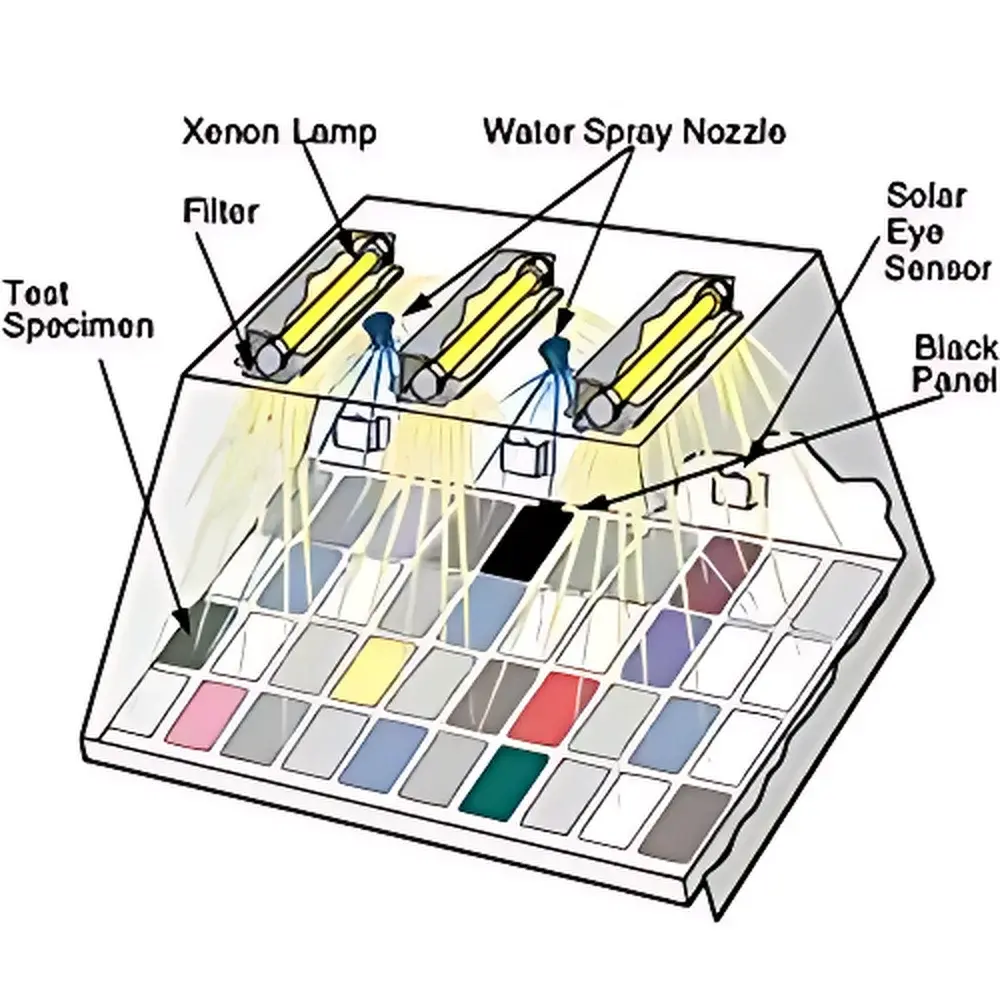
| Lamp Configuration | 3 air-cooled xenon lamps |
| Lamp Lifetime | 1500 hours |
| Filter Assembly | 3 interchangeable optical filters per unit |
| Irradiance Control | SOLAR EYE broadband or narrowband (340 nm, 420 nm, or TUV 300–400 nm) |
| Sample Tray Dimensions | 451 mm × 718 mm |
| Max. Sample Capacity | 55 pieces of 51 mm × 102 mm |
| Optional Accessories | Water spray (Xe-3-HS/DS/BS/HSC), back-spray (Xe-3-BS), dual-spray (Xe-3-DS), refrigerated cooling system (Xe-3-HSC), Ethernet connectivity, virtual strip chart software |
Overview
The Q-LAB Q-SUN Xe-3 Xenon Arc Weathering Test Chamber is an ISO-compliant, ASTM-validated accelerated weathering instrument engineered for precision simulation of full-spectrum solar radiation under controlled environmental stressors. Utilizing three high-intensity 1800 W air-cooled xenon arc lamps, the Xe-3 replicates the spectral power distribution (SPD) of natural sunlight—spanning UV, visible, and near-infrared wavelengths—with fidelity unmatched by fluorescent or metal halide alternatives. Unlike water-cooled systems, its air-cooled architecture reduces operational complexity, eliminates chilled water infrastructure requirements, and lowers total cost of ownership while maintaining thermal stability and irradiance uniformity across the exposure plane. The chamber operates on the principle of controlled photochemical degradation: photons induce bond cleavage, oxidation, and polymer chain scission in organic materials, enabling predictive assessment of service life, color fade, gloss loss, cracking, chalking, and embrittlement in polymers, coatings, textiles, automotive interiors, and pharmaceutical packaging.
Key Features
- Air-cooled 1800 W xenon lamp array (3 lamps per unit) with 1500-hour rated lifetime and field-replaceable design
- SOLAR EYE irradiance control system with real-time feedback at 340 nm, 420 nm, or TUV (300–400 nm) bands—ensuring ±5% irradiance stability over time
- Black panel temperature (BPT) monitoring and control (42–120 °C range), with optional dual-sensor capability for simultaneous BPT and chamber air temperature regulation
- Integrated relative humidity control (10–95% RH) using deionized or distilled water; humidity sensors calibrated traceable to NIST standards
- Modular optical filter system (3 filters per unit) including Daylight-Q/B, Window Glass-Q/B, and Window-IR—each certified for long-term spectral stability (except Window-IR, which requires scheduled replacement)
- Large-format sample tray (451 mm × 718 mm) supporting flat, contoured, and 3D specimens; accommodates up to 55 standard 51 mm × 102 mm coupons
- Refrigerated cooling option (Xe-3-HSC) enabling low-temperature operation down to 31 °C at 50% RH—critical for thermally sensitive materials such as cosmetics and biopharmaceuticals
- Ethernet-enabled controller with five-language UI (English, French, Spanish, Italian, German), built-in self-diagnostics, and alarm logging compliant with GLP/GMP audit trails
Sample Compatibility & Compliance
The Q-SUN Xe-3 supports heterogeneous sample geometries—including rigid panels, flexible films, molded components, and irregularly shaped parts—via adjustable mounting fixtures and custom jigs. Its exposure methodology aligns with key international standards including ASTM G155 (Standard Practice for Operating Xenon Arc Light Apparatus for Exposure of Non-Metallic Materials), ISO 4892-2 (Plastics — Methods of Exposure to Laboratory Light Sources — Part 2: Xenon-Arc Methods), SAE J2527 (Surface Vehicle Recommended Practice for Accelerated Exposure of Automotive Exterior Materials Using a Controlled Irradiance Xenon-Arc Apparatus), and AATCC TM16 (Colorfastness to Light). All irradiance and temperature measurements are traceable to NIST-certified reference standards, and Q-Lab’s calibration laboratory maintains A2LA accreditation to ISO/IEC 17025:2017 (Certificate Nos. 2382-01, 2383-02, 2383-03). The system meets FDA 21 CFR Part 11 requirements when configured with optional audit-trail software and electronic signature modules.
Software & Data Management
The embedded controller provides continuous logging of irradiance (W/m²), black panel temperature (°C), chamber air temperature (°C), and relative humidity (%RH) at user-defined intervals. Optional “Virtual Strip Chart” PC software enables automated acquisition, time-stamped export (CSV/Excel), and remote visualization of exposure parameters via Ethernet connection. Data files include metadata such as filter ID, lamp hours, calibration dates, and operator credentials—supporting full traceability in regulated environments. Diagnostic logs and error codes can be emailed directly to Q-Lab Technical Support for rapid resolution. Firmware updates and calibration certificate management are accessible through the web-based interface, ensuring ongoing compliance with evolving quality system requirements.
Applications
The Q-SUN Xe-3 serves laboratories conducting durability validation for automotive OEMs (interior trim, headlamp lenses, sealants), aerospace suppliers (composite laminates, cockpit displays), consumer electronics (display overlays, housing resins), medical device manufacturers (polymer enclosures, drug delivery packaging), and regulatory testing labs performing USP , ICH Q1B, and ISO 10993-12 assessments. It is widely deployed in R&D screening, QC release testing, supplier qualification, and failure analysis workflows where correlation to real-world outdoor exposure (e.g., Florida or Arizona field sites) is essential. Its ability to decouple UV dose from thermal load—via independent control of irradiance, BPT, and RH—enables mechanistic studies of degradation pathways, including hydrolytic, oxidative, and photolytic mechanisms.
FAQ
What lamp cooling method does the Q-SUN Xe-3 use, and why is it advantageous?
The Xe-3 employs air-cooled xenon lamps, eliminating dependency on external chillers or deionized water recirculation loops. This design improves energy efficiency, simplifies facility integration, and reduces maintenance frequency compared to water-cooled alternatives.
How often must optical filters be replaced?
Daylight-Q/B and Window Glass-Q/B filters exhibit no measurable spectral drift over service life and require no scheduled replacement. The Window-IR filter, however, degrades due to IR absorption and must be replaced per Q-Lab’s maintenance schedule (typically every 1,000–1,200 lamp hours).
Is purified water mandatory for operation?
Yes—both humidity control and all water spray options (front spray, back spray, dual spray, refrigerated spray) require deionized or distilled water to prevent mineral deposition on optics, sensors, and spray nozzles.
Can the Xe-3 meet FDA 21 CFR Part 11 requirements?
When equipped with the optional audit-trail software package, electronic signature module, and validated calibration procedures, the Xe-3 supports Part 11 compliance for electronic records and signatures in pharmaceutical and medical device applications.
What is the recommended recalibration interval for sensors?
SOLAR EYE irradiance sensors and black panel temperature sensors should be verified annually using CR20 and CT202 field calibrators, respectively. These calibrators are then returned to Q-Lab’s ISO/IEC 17025-accredited lab for NIST-traceable recalibration. Relative humidity sensors are consumable and replaced annually without recalibration.



