
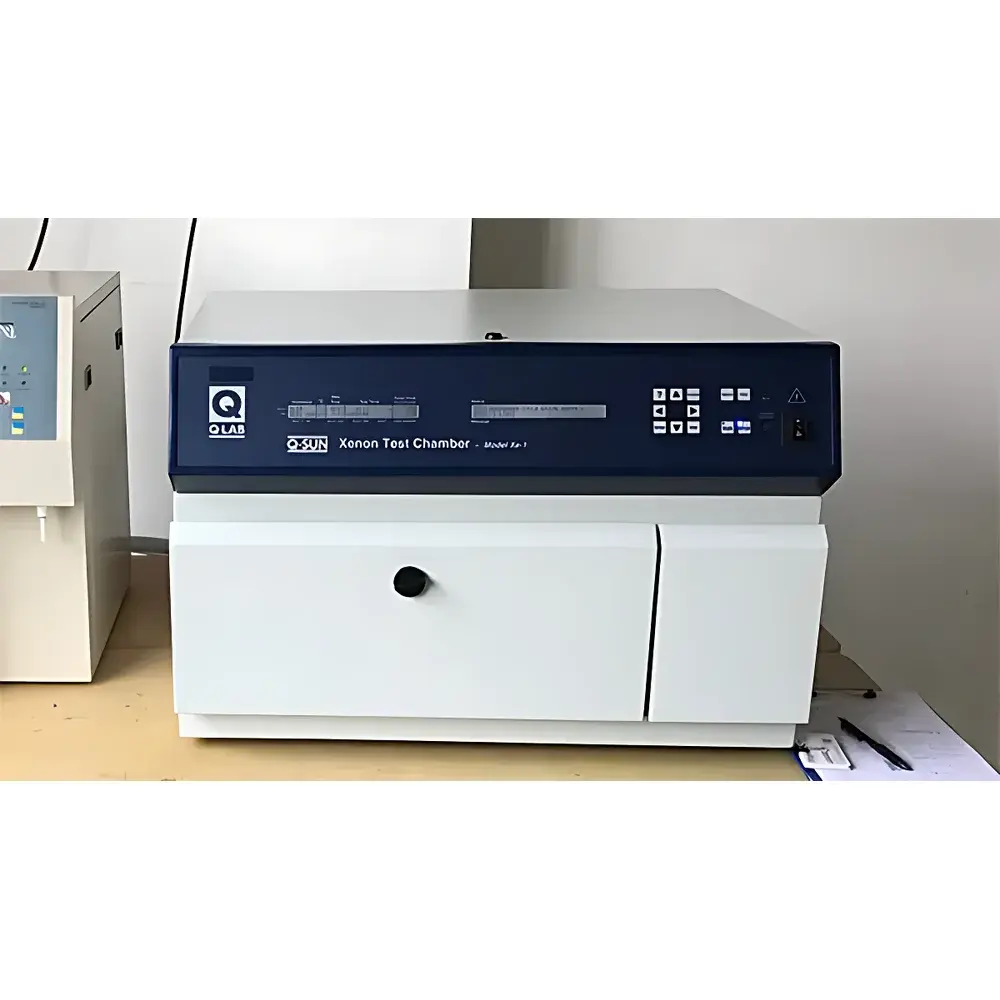
Q-Lab Xe-1-SC Xenon Arc Weathering Test Chamber
| Brand | Q-Lab |
|---|---|
| Origin | USA |
| Model | Xe-1-SC |
| Lamp Type | Air-Cooled Single Xenon Arc Lamp |
| Lamp Life | 1500 hours |
| Irradiance Control | SOLAR EYE® Spectral Radiometer (340 nm, 420 nm, or TUV) |
| Filter Options | Daylight-Q / Daylight-B/B, Extended UV-Q/B, Window-Q / Window-B/SL / Window-IR |
| Sample Tray Dimensions | 251 mm × 457 mm |
| Max Sample Capacity | 15 pcs of 51 mm × 102 mm specimens |
| Black Panel Temperature Range | 35–103 °C |
| Optional Chiller | Integrated refrigeration unit enabling operation down to 19 °C |
| Water Spray System | Dual-nozzle, programmable during light/dark cycles, requires purified water |
Overview
The Q-Lab Xe-1-SC Xenon Arc Weathering Test Chamber is a compact, single-lamp benchtop instrument engineered for accelerated weathering simulation under controlled laboratory conditions. It employs a vertically oriented air-cooled xenon arc lamp to reproduce the full solar spectrum — spanning ultraviolet (UV), visible, and near-infrared (NIR) wavelengths — with spectral fidelity critical for evaluating photodegradation, color shift, gloss loss, cracking, and chalking in polymeric, coating, textile, and pharmaceutical materials. Unlike UV fluorescent or metal halide systems, xenon arc technology provides the most physically accurate representation of natural sunlight, making it the reference method for ASTM G155, ISO 4892-2, SAE J2527, and AATCC TM16. The Xe-1-SC integrates black panel temperature sensing as standard, enabling precise thermal control of specimen surface conditions — a key determinant of degradation kinetics. Its modular design supports optional chiller integration and programmable water spray, allowing users to replicate complex outdoor or indoor exposure profiles including dew, rain, and low-temperature irradiation.
Key Features
- Air-cooled single xenon arc lamp with 1500-hour service life — eliminates water cooling infrastructure, reduces maintenance complexity and operational cost.
- SOLAR EYE® real-time irradiance monitoring and feedback control at user-selectable wavelengths: 340 nm (UV-B dominant), 420 nm (visible edge), or Total UV (TUV) — ensuring test repeatability across instruments and over time.
- Three standardized filter families: Daylight-Q and Daylight-B/B for direct terrestrial sunlight simulation; Extended UV-Q/B for accelerated automotive and aerospace testing; and Window-Q, Window-B/SL, and Window-IR for interior exposure (e.g., through architectural glazing or office lighting).
- Integrated chiller option enables stable black panel temperature control from 19 °C to 103 °C — essential for thermally sensitive products such as cosmetics, pharmaceuticals, and electronics encapsulants where non-photochemical thermal stress must be decoupled from UV dose.
- Dual-nozzle water spray system mounted above the sample tray — fully programmable to activate during light or dark cycles, using only purified water (≥1 MΩ·cm resistivity) to prevent mineral deposition on optics or specimens.
- Vertical sample mounting on a 251 mm × 457 mm tray — accommodates flat panels, 3D components, and standardized test coupons (up to 15 pieces of 51 mm × 102 mm); compatible with Q-Lab’s range of universal and application-specific fixtures.
Sample Compatibility & Compliance
The Xe-1-SC supports diverse material geometries and substrate types without requiring custom tooling. Its open-tray architecture accepts rigid, flexible, or textured specimens up to 25 mm thick. All Q-Lab filters are manufactured from high-transmission, thermally stable optical glass with proprietary coatings that resist spectral drift — verified per ISO 17025-accredited calibration protocols. Filter lifetime is indefinite for Daylight and Extended UV types; Window-IR filters require scheduled replacement per Q-Lab Technical Bulletin TB-011 due to IR-absorbing layer saturation. The chamber complies with the environmental control requirements of ISO 17025, ASTM D7869 (automotive exterior), and USP for light stability testing of drug products. When configured with audit-trail-enabled software (e.g., Q-Lab’s Q-Support Suite), the system meets FDA 21 CFR Part 11 data integrity requirements for regulated laboratories.
Software & Data Management
While the Xe-1-SC operates via intuitive front-panel controls, optional connectivity enables integration into centralized lab management systems. Q-Lab’s Q-Support Suite (v5.2+) provides remote monitoring, automated report generation (PDF/CSV), and electronic signature-capable audit trails. All irradiance, temperature, and humidity (when equipped with optional RH sensor) data are timestamped and stored with metadata including lamp hours, filter ID, and calibration certificate expiry. Data export conforms to ASTM E2912 and ISO/IEC 17025 traceability standards. For GLP/GMP environments, role-based access control, password-protected parameter locking, and electronic logbook functionality ensure compliance during regulatory inspections.
Applications
The Xe-1-SC is widely deployed in R&D, quality assurance, and regulatory submission labs across industries. In coatings and plastics, it validates resistance to chalking, fading, and embrittlement per ISO 4892-2 and ASTM D4329. Automotive suppliers use Extended UV-Q/B filters to meet GMW15272 and Ford CETP specifications for interior trim. Textile and printing manufacturers rely on Window-B/SL filters to assess colorfastness under retail lighting per AATCC TM16 and ISO 105-B02. Pharmaceutical developers apply the chiller-equipped configuration to conduct ICH Q1B photostability studies, maintaining sample temperatures below 25 °C while delivering defined UV doses. Its compact footprint and low power demand make it suitable for space-constrained labs requiring Class I or II environmental simulation capability.
FAQ
What is the difference between black panel temperature and chamber air temperature?
Black panel temperature measures the surface temperature of an insulated black metal sensor placed adjacent to the specimen — it approximates the thermal load experienced by dark-colored materials under irradiation. Air temperature reflects ambient chamber conditions and is less representative of actual specimen heating.
Can the Xe-1-SC operate without purified water for the spray function?
No. Unpurified water introduces mineral deposits on quartz filters and specimen surfaces, causing spectral deviation and inconsistent wetting behavior. Q-Lab mandates ≥1 MΩ·cm resistivity water per TB-007.
How often must the xenon lamp be replaced?
Lamp replacement is recommended after 1500 hours of operation or when irradiance output falls below 90% of initial calibrated value — verified via SOLAR EYE® diagnostics and annual recalibration.
Is filter replacement required during normal operation?
Daylight and Extended UV filters require no scheduled replacement; Window-IR filters must be replaced every 1,200 hours per Q-Lab TB-011 to maintain spectral accuracy in the infrared region.
Does the Xe-1-SC support humidity control?
Standard configuration does not include active humidity control. Optional relative humidity sensors can be installed for monitoring, but humidification/dehumidification functions are not available on this model — users requiring RH control should consider the Xe-3 series.



