
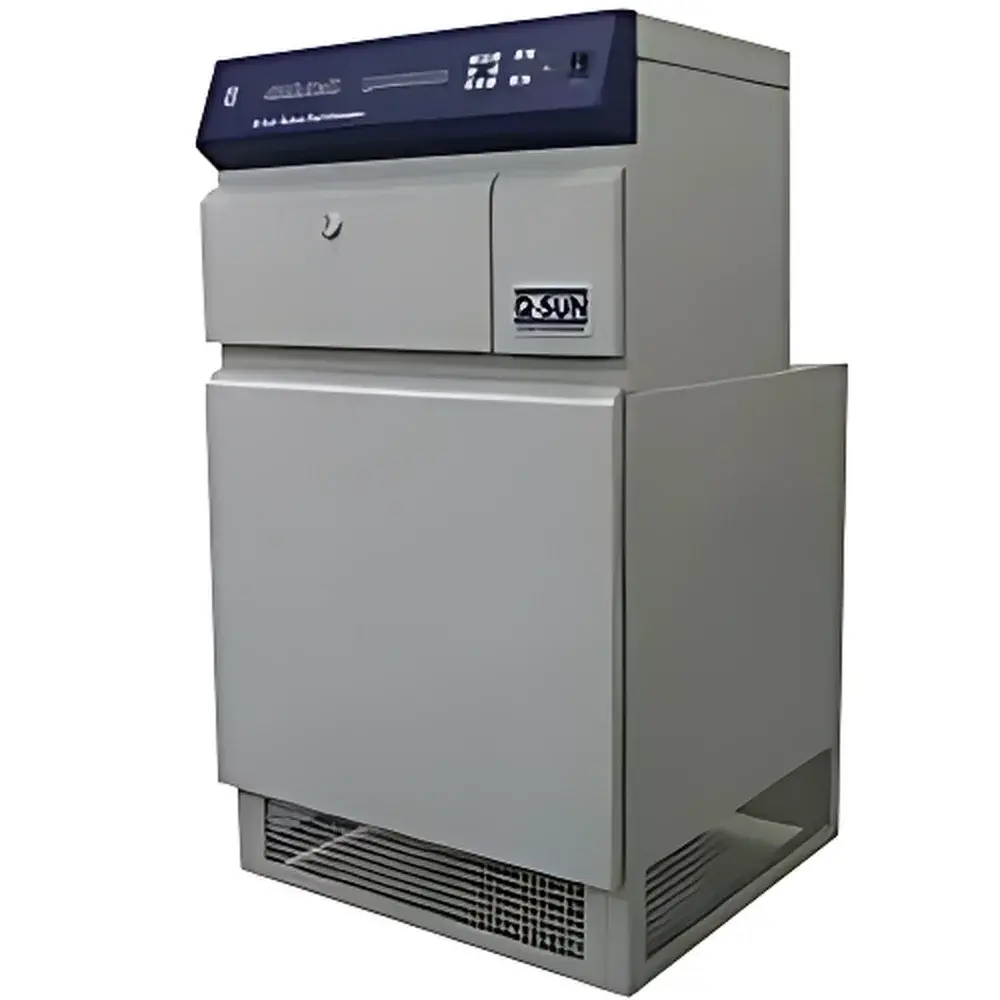
Q-LAB Xe-1-SC Xenon Arc Weathering Test Chamber
| Brand | Q-LAB |
|---|---|
| Origin | USA |
| Model | Q-LAB Xe-1-SC |
| Xenon Lamp Power | 1800 W |
| Temperature Range | 19–103 °C (with chiller option) |
| Humidity Control | Optional |
| Water Spray System | Integrated dual-nozzle spray, programmable in light/dark cycles |
| Lamp Type | Air-cooled single xenon arc lamp |
| Lamp Lifetime | ~1500 hours |
| Spectral Output | Full-spectrum solar simulation (UV–VIS–NIR) |
| Compliance | ASTM G155, ISO 4892-2, SAE J2527, AATCC TM16, ISO 11341 |
Overview
The Q-LAB Xe-1-SC Xenon Arc Weathering Test Chamber is an entry-level, benchtop-scale accelerated weathering instrument engineered for reproducible simulation of natural sunlight exposure—including ultraviolet (UV), visible (VIS), and near-infrared (NIR) radiation—under controlled temperature, humidity, and moisture conditions. Based on the fundamental principle of xenon arc irradiation, the system employs a single air-cooled 1800 W xenon lamp to deliver spectrally accurate solar energy output, closely matching terrestrial AM1.5 global solar irradiance. Unlike UV fluorescent or metal halide sources, xenon arc technology enables full-spectrum photodegradation assessment critical for evaluating color shift, gloss loss, chalking, cracking, and polymer embrittlement in coatings, plastics, textiles, automotive interiors, and pharmaceutical packaging. The Xe-1-SC variant integrates two key functional modules: a programmable water spray system for cyclic wetting simulation and an optional refrigerated cooling unit to extend operational temperature down to 19 °C—essential for thermally sensitive samples such as topical cosmetics, ophthalmic formulations, and biopolymer-based medical devices.
Key Features
- Air-cooled single xenon arc lamp (1800 W) with typical service life of 1500 hours; lamp replacement requires no tools and takes under 90 seconds via top-access design
- Solar Eye irradiance control system providing closed-loop feedback regulation of UV (340 nm) or broadband (300–400 nm) irradiance setpoints
- Integrated dual-nozzle water spray system positioned at chamber ceiling; spray timing fully programmable within light or dark segments of exposure cycles
- Optional chiller module enabling stable operation from 19 °C to 103 °C—critical for low-temperature photostability testing per ICH Q1B and USP <1151>
- Black panel or black standard thermometer (BPT/BST) temperature monitoring and control, compliant with ASTM G151 requirements
- Interchangeable optical filters (Daylight-Q, Window Glass-Q, Extended UV-Q) to tailor spectral distribution for specific application standards
- Three-dimensional sample mounting configuration allowing simultaneous exposure of vertically and horizontally oriented specimens
Sample Compatibility & Compliance
The Xe-1-SC accommodates flat-panel, curved, and irregularly shaped specimens up to 150 mm × 150 mm × 50 mm per test position, with support for multi-angle orientation to assess directional degradation effects. It meets core international weathering standards including ASTM G155 (practice for operating xenon arc exposure apparatus), ISO 4892-2 (plastics—methods of exposure to laboratory light sources—xenon-arc), SAE J2527 (automotive interior materials), and AATCC TM16 (colorfastness to light). For regulated industries, the system supports GLP-compliant data logging when paired with Q-Lab’s QUASAR software, and its hardware architecture permits validation against FDA 21 CFR Part 11 requirements through audit-trail-enabled user access controls and electronic signature integration.
Software & Data Management
Control and monitoring are executed via Q-Lab’s proprietary QUASAR software (Windows-based), which provides intuitive cycle programming, real-time parameter visualization (irradiance, chamber temperature, BST/BPT, spray status), and automated data export in CSV or PDF formats. All operational events—including lamp ignition, filter changes, spray activation, and temperature deviations—are timestamped and logged with user ID attribution. Raw sensor data is stored locally with optional cloud backup; historical datasets can be cross-referenced across instruments using standardized metadata tags aligned with ASTM E2042 and ISO/IEC 17025 traceability frameworks.
Applications
- Photostability evaluation of pharmaceutical dosage forms per ICH Q5C and Q1B guidelines
- Colorfastness and fading resistance testing of textile dyes, automotive trim, and architectural coatings
- Weathering performance validation of polymeric packaging films used in food and medical device applications
- Accelerated corrosion testing of painted metal substrates under combined UV/water spray conditions
- Validation of UV stabilizers and HALS additives in thermoplastics and elastomers
- Outdoor durability benchmarking for consumer electronics housings and solar panel encapsulants
FAQ
What type of water must be used for the spray system?
Deionized or distilled water with conductivity ≤1 µS/cm is mandatory to prevent nozzle clogging and mineral deposits on specimens.
Can the Xe-1-SC operate without the chiller option?
Yes—the base configuration operates from ambient +10 °C to 103 °C; the chiller extends the lower limit to 19 °C for cold-light stability protocols.
Is calibration traceable to NIST standards?
Irradiance sensors are factory-calibrated against NIST-traceable reference detectors; annual recalibration services are available through Q-Lab’s global network of accredited labs.
How does the Solar Eye system maintain irradiance stability?
It continuously measures actual spectral irradiance via a dedicated UV photodiode, dynamically adjusting lamp power to compensate for lamp aging and filter degradation.
Are test reports generated by QUASAR software compliant with regulatory submissions?
Yes—when configured with electronic signatures and audit trail logging, QUASAR-generated reports satisfy documentation requirements for FDA, EMA, and PMDA submissions under ALCOA+ principles.
Related Products



