
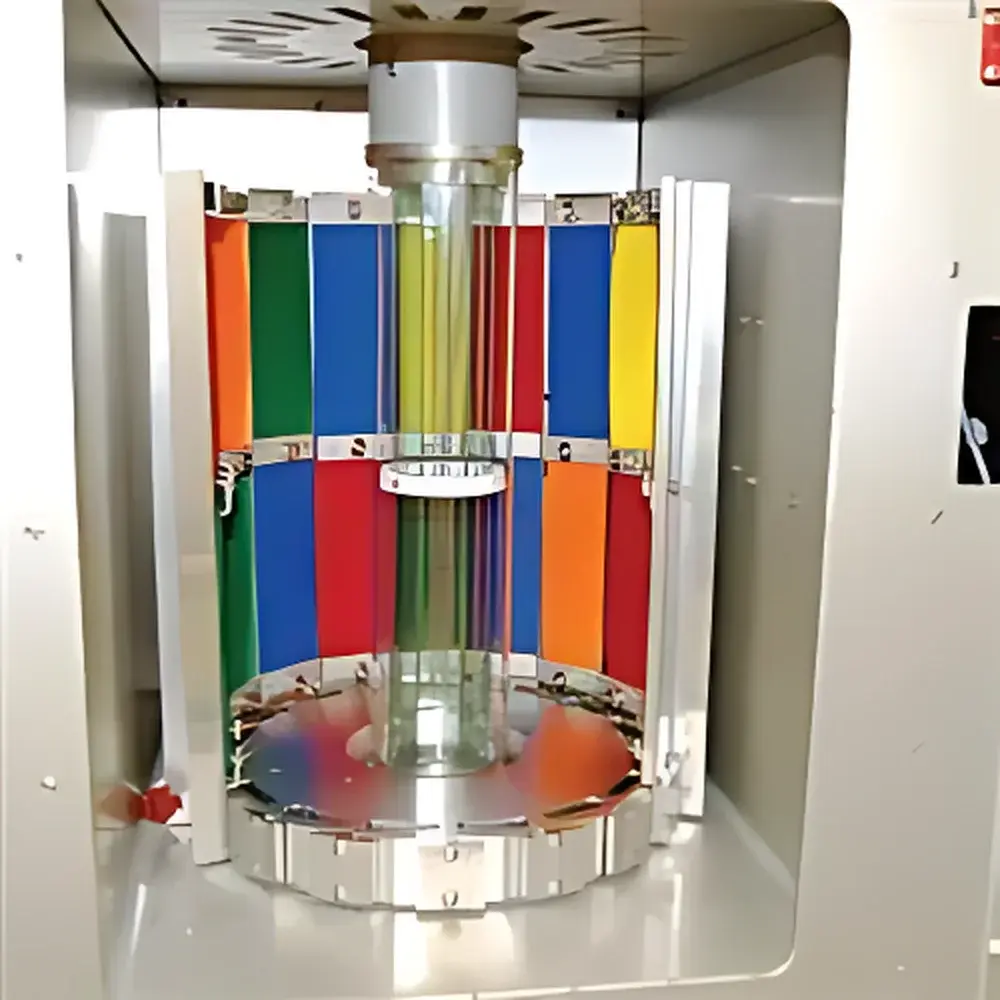
Q-Lab Xe-3-HBS Xenon Arc Weathering Test Chamber
| Brand | Q-Lab |
|---|---|
| Origin | USA |
| Model | Xe-3-HBS |
| Lamp Configuration | 3 x air-cooled xenon arc lamps |
| Spectral Range | Full-spectrum solar simulation (290–800 nm) |
| Irradiance Control | SOLAR EYE broadband or narrowband (340 nm, 420 nm, TUV) |
| Black Panel Temperature Range | 42–120 °C |
| Chamber Air Temperature Range | Ambient to 85 °C |
| Relative Humidity Control | 10–95% RH |
| Water Requirements | Deionized or purified water for spray and humidity systems |
| Spray Options | Front spray (top-mounted dual nozzles), optional rear spray (dual-sided wetting), optional secondary liquid spray (e.g., acid rain simulation) |
| Sample Tray Dimensions | 451 mm × 718 mm |
| Max Sample Capacity | 51 × 51 mm × 102 mm specimens |
| Calibration | Patented AUTOCAL system |
| Compliance Support | ASTM G155, ISO 4892-2, SAE J2527, J2412, AATCC TM16, ISO 11341, GB/T 16422.2, FDA 21 CFR Part 11 (via optional software audit trail) |
Overview
The Q-Lab Xe-3-HBS Xenon Arc Weathering Test Chamber is an engineered solution for accelerated weathering and light stability evaluation of materials under controlled, reproducible full-spectrum solar irradiation. Utilizing three air-cooled xenon arc lamps, the chamber delivers a spectral output closely matching natural sunlight—spanning UV (290–400 nm), visible (400–700 nm), and near-infrared (700–800 nm) regions. This fidelity enables accurate simulation of photodegradation mechanisms critical to polymer degradation, pigment fading, coating chalking, textile colorfastness, and automotive interior material aging. Unlike UV fluorescent or metal halide sources, xenon arc technology provides continuous spectral distribution essential for correlating laboratory exposure with real-world outdoor performance. The Xe-3-HBS integrates precise black panel temperature control, programmable relative humidity regulation, and configurable water spray systems—including front-only, front-and-rear (dual-sided), and secondary liquid delivery—to replicate complex environmental stressors such as diurnal thermal cycling, condensation, rainfall, and acid deposition.
Key Features
- Three high-stability, air-cooled xenon arc lamps with 1500-hour typical service life—eliminating costly water cooling infrastructure and reducing maintenance complexity.
- SOLAR EYE irradiance monitoring and feedback control system ensures stable, traceable output at user-selectable wavelengths: 340 nm (UV-B critical for polymer degradation), 420 nm (broadband UV-A/visible), or total UV (TUV).
- Patented AUTOCAL calibration system enables rapid, in-chamber lamp spectral and irradiance verification without external instrumentation or downtime.
- Standard relative humidity control (10–95% RH) with deionized water supply—critical for simulating hygrothermal aging in coatings, adhesives, and composites.
- Dual-nozzle front spray system operable during light or dark cycles; optional rear spray module satisfies SAE J2527 and other standards requiring simultaneous front-and-back wetting.
- Secondary liquid spray capability allows introduction of acidic or saline solutions—enabling corrosion-accelerated testing per ASTM D7862 or custom formulations.
- Flat, slide-out sample tray (451 mm × 718 mm) accommodates heterogeneous geometries including 3D parts, panels, and textiles—supporting up to 51 standardized 51 mm × 102 mm specimens.
- Integrated Ethernet interface supports remote monitoring, data logging, and firmware updates; compliant with industrial network security protocols.
Sample Compatibility & Compliance
The Xe-3-HBS supports broad material classes—including thermoplastics, elastomers, paints, inks, textiles, automotive trim, aerospace composites, and medical device packaging—without mechanical restraints or rotational fixtures. Its horizontal sample orientation minimizes gravitational runoff artifacts during spray cycles, enhancing correlation with field exposure. The system meets or exceeds requirements of key international standards: ASTM G155 (practice for xenon-arc exposure), ISO 4892-2 (plastics—methods of exposure to laboratory light sources), SAE J2527 (automotive exterior materials), SAE J2412 (interior materials), AATCC TM16 (textile colorfastness), ISO 11341 (paints and varnishes), and GB/T 16422.2 (Chinese national standard). For regulated environments, optional software packages provide 21 CFR Part 11-compliant electronic records, audit trails, and user access controls aligned with GLP and GMP documentation requirements.
Software & Data Management
The embedded controller features an intuitive touchscreen interface with preloaded test methods, customizable exposure profiles (light/dark cycles, temperature ramps, humidity setpoints, spray timing), and real-time parameter visualization. All operational data—including irradiance history, black panel temperature, chamber RH, lamp voltage/current, and fault logs—are timestamped and exportable via USB or Ethernet in CSV or XML format. Optional Q-Lab’s SunTest™ software extends functionality with multi-chamber fleet management, statistical trend analysis, pass/fail threshold reporting, and automated PDF certificate generation. Data integrity safeguards include write-protected memory, cyclic redundancy checks (CRC), and tamper-evident log files—ensuring compliance with quality management systems demanding traceability and reproducibility.
Applications
The Xe-3-HBS serves laboratories conducting R&D, QC, and regulatory validation across industries where long-term durability under solar exposure is mission-critical. In automotive engineering, it validates dashboard materials against SAE J2412 for gloss retention and cracking resistance. In architectural coatings, it quantifies chalk resistance and gloss loss per ASTM D4587. Textile labs use it for ISO 105-B02 colorfastness assessment under window-filtered spectra. Packaging developers assess UV barrier efficacy of pharmaceutical blister foils using Window-IR filtered irradiation. Aerospace suppliers perform qualification testing of composite resins per ASTM D7862 with integrated acid spray. Its ability to decouple irradiance, thermal load, and moisture exposure enables mechanistic studies—such as isolating UV-driven chain scission from hydrolytic degradation—supporting root-cause failure analysis and formulation optimization.
FAQ
What type of water must be used for humidity and spray functions?
Deionized or purified water (conductivity ≤ 5 µS/cm) is mandatory to prevent mineral buildup in humidifiers, spray nozzles, and sensors.
Can the Xe-3-HBS operate without spray or humidity control?
Yes—the chamber supports dry-heat and irradiance-only exposure protocols, though humidity and spray are standard features enabled by default.
How often do filter sets require replacement?
Q-Lab’s daylight and window-glass filters exhibit no spectral drift over time and are designed for lifetime use; only the Window-IR filter requires periodic replacement per manufacturer guidelines.
Is refrigeration available for low-temperature testing?
An optional mechanical refrigeration unit extends the chamber air temperature range down to –10 °C, enabling cold-soak cycling per SAE J2527 Annex C.
Does the system support automated calibration verification?
Yes—the built-in AUTOCAL system performs self-diagnostic spectral and irradiance validation without external hardware or operator intervention.



