
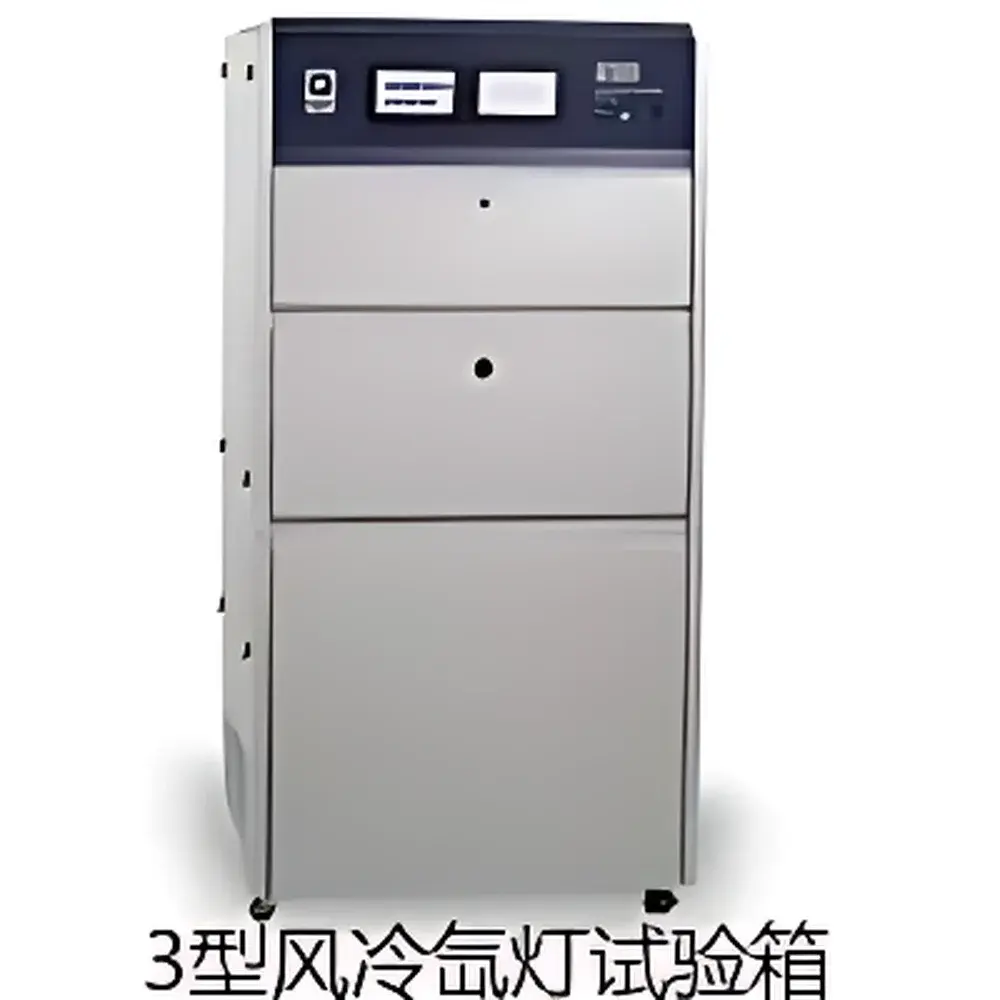
Q-Lab Xe-3HSE Xenon Arc Weathering Test Chamber
| Brand | Q-Lab |
|---|---|
| Origin | USA |
| Manufacturer Status | Authorized Distributor |
| Product Origin | Imported |
| Model | Xe-3HSE |
| Xenon Lamp Power | 1800 W × 3 |
| Irradiance Range | 0.55–1.3 W/m²/nm @ 340 nm |
| Light Exposure Cycle | 1–999 h |
| Humidity Range | 20–95% RH |
Overview
The Q-Lab Xe-3HSE Xenon Arc Weathering Test Chamber is an advanced, full-spectrum accelerated weathering instrument engineered for precise simulation of solar radiation, temperature, and humidity stressors encountered in real-world outdoor and indoor environments. Based on the fundamental principle of xenon arc irradiation—where high-intensity xenon lamps replicate the spectral power distribution (SPD) of natural sunlight across UV (290–400 nm), visible (400–700 nm), and near-infrared (700–800 nm) regions—the Xe-3HSE enables reproducible, standards-compliant material degradation testing. Its triple-lamp, air-cooled architecture eliminates the complexity and operational costs associated with water-cooled systems while maintaining stable irradiance output over extended test durations. Designed for laboratory-scale validation under controlled conditions, the system supports correlation to field performance per ASTM G155, ISO 4892-2, SAE J2527, AATCC TM16, and other internationally recognized weathering protocols.
Key Features
- Triple 1800 W air-cooled xenon arc lamps delivering uniform irradiance across a 451 mm × 718 mm exposure area
- SOLAR EYE irradiance control system with real-time monitoring and closed-loop regulation at 340 nm, 420 nm, or TUV band
- Black panel temperature control (42–120 °C) with optional dual-sensor configuration for simultaneous black panel and chamber air temperature management
- Integrated relative humidity control (20–95% RH) using purified water feed; humidity stability maintained via precision PID algorithm
- Modular filtration system supporting interchangeable Daylight, Window Glass, and Extended UV filter types to emulate diverse exposure spectra
- Multi-mode water delivery: front spray (top-mounted nozzles), back spray (dual-sided wetting), and dual-fluid spray (e.g., acid rain + deionized water)
- Sliding flat sample tray with adjustable-height fixtures accommodating 3D parts, bottles, textiles, and irregular geometries
- Industrial-grade touchscreen controller with multilingual UI (English, French, Spanish, German, Italian), built-in self-diagnostic routines, and Ethernet connectivity
Sample Compatibility & Compliance
The Xe-3HSE accommodates flat, curved, and three-dimensional specimens up to 451 mm × 718 mm footprint without requiring custom mounting hardware. Standard configurations support up to 55 samples of 51 mm × 102 mm size. The horizontal tray orientation ensures prolonged moisture retention—critical for evaluating hydrolytic degradation, pigment migration, or coating blistering. All operational parameters—including irradiance setpoint, temperature ramp profiles, humidity cycles, and spray timing—are fully programmable and auditable, satisfying GLP/GMP documentation requirements. The system complies with ASTM D4329 (plastics), ASTM D4459 (interior materials), ISO 105-B02 (textiles), and FDA 21 CFR Part 11 when paired with validated software and electronic signature modules.
Software & Data Management
The embedded controller logs all critical test parameters—including irradiance, black panel temperature, chamber RH, lamp voltage, and spray activation status—at user-defined intervals (minimum 1-minute resolution). Data export is supported via USB drive or Ethernet transfer to networked PCs. Optional Q-Lab’s “Virtual Strip Chart” PC software provides real-time visualization, automated report generation (PDF/CSV), and alarm-triggered email notifications. Calibration traceability is maintained through NIST-traceable sensors, with annual recalibration services performed at Q-Lab’s ISO/IEC 17025-accredited laboratories (A2LA Cert. Nos. 2382-01, 2383-02, 2383-03). Audit trails record operator actions, parameter changes, and system events to support regulatory inspections.
Applications
The Xe-3HSE serves R&D, QC, and regulatory testing labs across automotive OEMs (paint, trim, interior plastics), aerospace composites, architectural coatings, textile dye houses, pharmaceutical packaging, and consumer electronics. It is routinely deployed to assess UV resistance of polymer blends, colorfastness of dyed fabrics, gloss retention of automotive clearcoats, adhesion failure in laminated safety glass, and hydrolytic stability of biodegradable films. Its ability to decouple spectral quality from thermal load enables method development for low-temperature-sensitive formulations such as cosmetics, ophthalmic lenses, and medical device housings—particularly when configured with the optional refrigerated cooling unit (Xe-3-HSCE variant).
FAQ
What lamp lifetime can be expected under standard operating conditions?
Typical xenon lamp service life is 1500 hours at nominal irradiance settings; lamps are field-replaceable in under 5 minutes without tools.
Is purified water mandatory for all humidification and spray functions?
Yes—deionized or distilled water with conductivity ≤ 5 µS/cm is required to prevent mineral deposits on filters, nozzles, and sensors.
Can the Xe-3HSE meet ISO 4892-2 Class A requirements?
Yes—when equipped with SOLAR EYE irradiance control, calibrated black panel sensor, and certified Daylight-F filter, it satisfies Class A spectral and irradiance tolerances.
How is calibration traceability ensured for long-term data integrity?
All irradiance and temperature sensors are calibrated annually at Q-Lab’s A2LA-accredited labs, with certificates referencing NIST standards and uncertainty budgets.
Does the system support unattended operation for multi-day exposure cycles?
Yes—programmable soak, dark, light, and spray phases enable fully autonomous 999-hour tests with automatic fault shutdown and event logging.



