
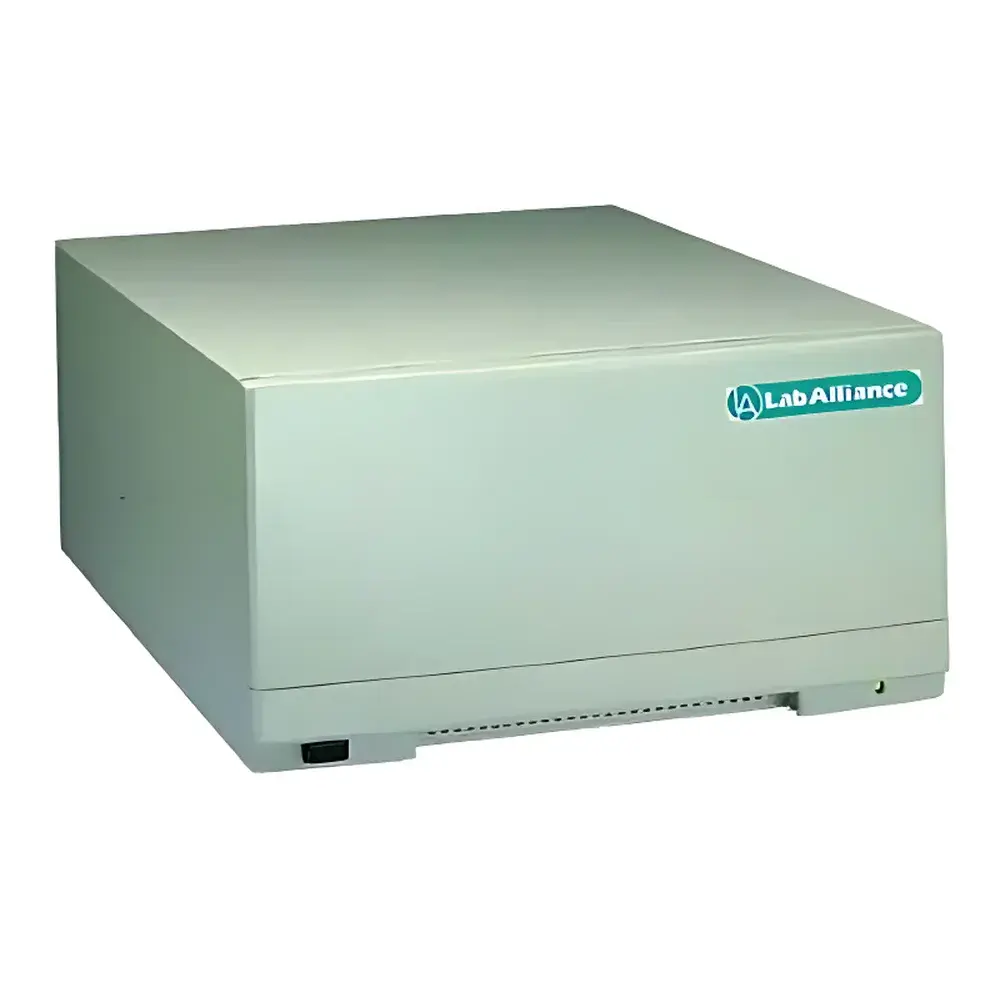
Laballiance Model 6000 Diode Array Detector
| Brand | Laballiance |
|---|---|
| Origin | USA |
| Model | 6000 |
| Wavelength Range | 190–800 nm |
| Optical Path Length | 5 cm |
| Flow Cell Volume | 12 µL (10 mm path) |
| Noise | ±3 × 10⁻⁶ AU/cm |
| Drift | 1 × 10⁻³ AU/hr |
| Linearity | >2.0 AU |
| Scan Rate | ≤20 Hz |
| Spectral Resolution | 1.2 nm |
| Wavelength Accuracy | ±1 nm |
| Light Source | Deuterium + Tungsten-Halogen Lamps |
| A/D Converter | 20-bit |
| Data Acquisition Rate | Configurable up to 20 Hz |
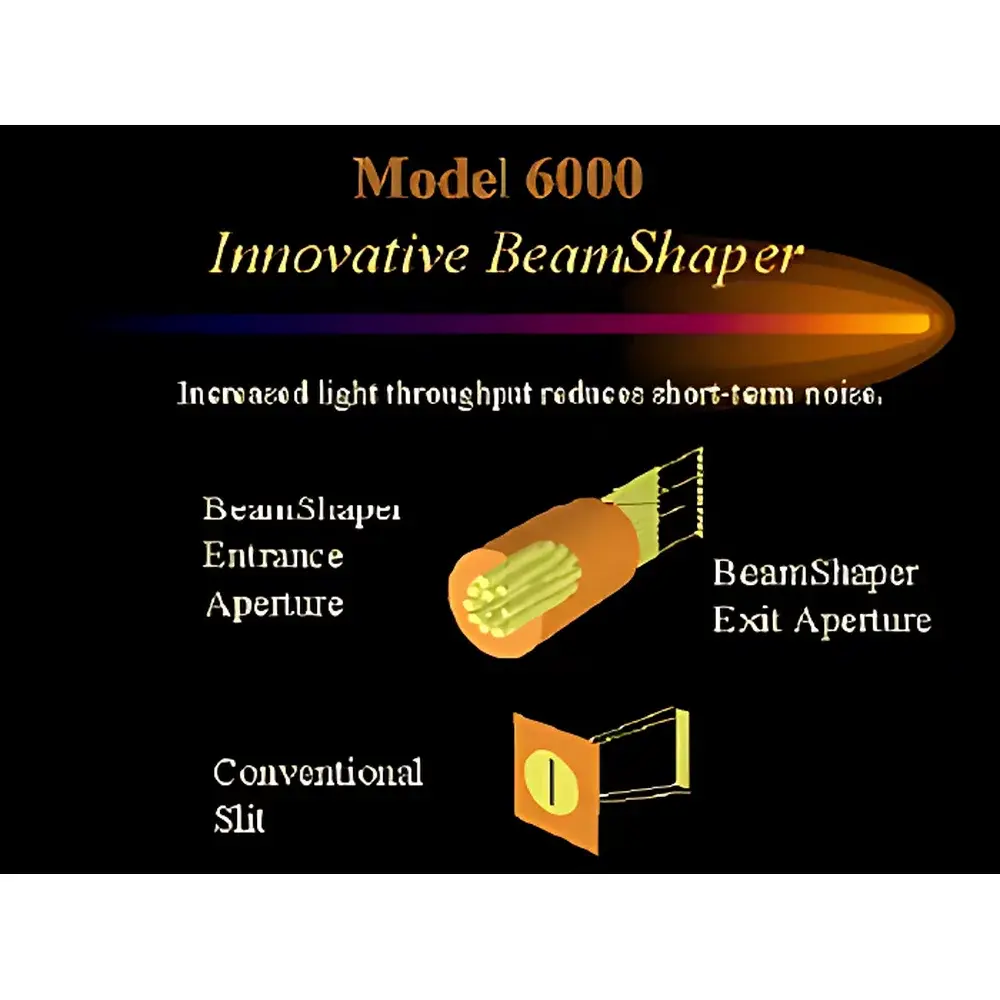
| Beam Delivery | Stacked Optical Fiber Optics |
| Compliance | ASTM E275, USP <857>, ISO/IEC 17025-aligned verification protocols |
Overview
The Laballiance Model 6000 Diode Array Detector (DAD) is a high-performance UV-Vis spectral detector engineered for integration with HPLC and UHPLC systems in regulated and research-grade laboratories. It operates on the principle of simultaneous multi-wavelength absorbance detection using a fixed grating spectrometer coupled with a 1024-element silicon photodiode array. Unlike single-wavelength detectors, the Model 6000 captures full spectra across 190–800 nm in real time, enabling peak purity assessment, spectral library matching, method development support, and post-run wavelength optimization. Its optical architecture centers on a 50-mm-pathlength flow cell with total internal reflection (TIR) surface treatment—minimizing photon loss and delivering up to 5× higher sensitivity than conventional 10-mm-path DADs. The 12-µL cell volume (10 mm path) ensures sharp elution profiles and enhanced signal-to-noise ratios, particularly critical for trace-level analyte quantification and narrow-band chromatographic peaks.
Key Features
- High-sensitivity 50-mm TIR flow cell with 12-µL internal volume and optimized light coupling via stacked optical fiber beam conditioning—eliminating mechanical slit losses and maximizing photon throughput.
- Dual-lamp illumination system: deuterium lamp (190–370 nm) and tungsten-halogen lamp (350–800 nm), thermally stabilized and intensity-monitored in real time for consistent baseline stability and reduced long-term drift.
- 20-Hz maximum scan rate with user-selectable acquisition rates (1–20 Hz), supporting high-resolution spectral capture for sub-second chromatographic peaks without data oversampling or file bloat.
- 20-bit analog-to-digital conversion providing superior dynamic range and baseline noise resolution (±3 × 10⁻⁶ AU/cm), directly reducing integration uncertainty in quantitative applications.
- Onboard self-validation suite: integrated holmium oxide reference cell, automated wavelength accuracy verification (±1 nm), linearity assessment (>2.0 AU), noise/drift profiling, and circuit calibration—all executable without external hardware or software dependencies.
- Robust optical design compliant with ASTM E275 (spectrophotometric performance standards) and aligned with USP requirements for photometric accuracy in pharmaceutical analysis.
Sample Compatibility & Compliance
The Model 6000 is compatible with standard 1/16″ stainless steel or PEEK capillary connections and supports all common HPLC mobile phases—including aqueous buffers, acetonitrile, methanol, and THF—within its pressure-rated flow cell housing. Its optical path length (5 cm) and low-volume cell geometry ensure minimal band broadening while maintaining compatibility with both analytical (4.6 mm ID) and narrow-bore (2.1 mm ID) columns. The detector meets essential regulatory expectations for instrument qualification: wavelength accuracy is verified per NIST-traceable holmium oxide absorption peaks; linearity is confirmed over 0–2.0 AU using neutral density filters; and system suitability testing (SST) parameters—including noise, drift, and peak symmetry—are fully reportable per FDA 21 CFR Part 11-compliant audit trail when paired with validated ChromQuest software. Documentation packages support GLP/GMP environments, including IQ/OQ/PQ templates and electronic signature-ready validation reports.
Software & Data Management
The Model 6000 ships with Laballiance’s native spectral acquisition and processing software, enabling real-time spectral viewing, peak tracking, overlay comparison, and ASCII-exportable spectral libraries. When integrated with Thermo Fisher ChromQuest (货号 TSCHROM64010) or CSChrom platforms, it supports full 21 CFR Part 11 compliance—including electronic signatures, role-based access control, and immutable audit trails for all method changes, calibration events, and spectral acquisitions. All validation outputs—including wavelength scan overlays, noise histograms, and linearity plots—are exportable as PDF or CSV for inclusion in regulatory submissions. Raw spectral data is stored in vendor-neutral formats (e.g., .spc, .jdx) to ensure long-term archival integrity and third-party software interoperability.
Applications
- Pharmaceutical QC/QA: Forced degradation studies, impurity profiling, and peak purity verification per ICH Q2(R2) guidelines.
- Natural product analysis: Multi-component identification in botanical extracts using spectral deconvolution and library search.
- Environmental monitoring: Simultaneous detection of PAHs, phenols, and nitroaromatics in water matrices via multi-wavelength quantitation.
- Food safety: Verification of synthetic dyes (e.g., Tartrazine, Allura Red) and antioxidant stability under thermal/light stress.
- Academic research: Reaction monitoring, kinetic profiling, and method scouting where spectral fidelity and temporal resolution are critical.
FAQ
What is the maximum recommended flow rate for the 50-mm flow cell?
The 50-mm TIR flow cell is rated for continuous operation up to 5 mL/min at pressures ≤300 bar; optimal performance is achieved between 0.5–2.0 mL/min for analytical-scale separations.
Can the Model 6000 be used with UHPLC systems operating above 1000 bar?
Yes—the flow cell housing and optical interface are designed for compatibility with UHPLC backpressures; however, column dead volume and extra-column dispersion must be minimized to preserve the detector’s inherent resolution advantage.
Is wavelength calibration traceable to NIST standards?
Yes—holmium oxide solution provides five certified absorption maxima (241.2, 279.4, 287.5, 333.7, and 360.9 nm) referenced against NIST SRM 2034, and calibration reports include uncertainty budgets per ISO/IEC 17025.
Does the detector support spectral subtraction or real-time peak purity algorithms?
Yes—native software includes spectral angle mapping, correlation coefficient analysis, and threshold-based purity flagging; ChromQuest adds advanced MCR-ALS (Multivariate Curve Resolution–Alternating Least Squares) capabilities.
How often should the holmium oxide reference cell be replaced?
The sealed, temperature-stabilized holmium oxide cell has a service life of ≥24 months under normal lab conditions and requires no routine refilling or maintenance.






