
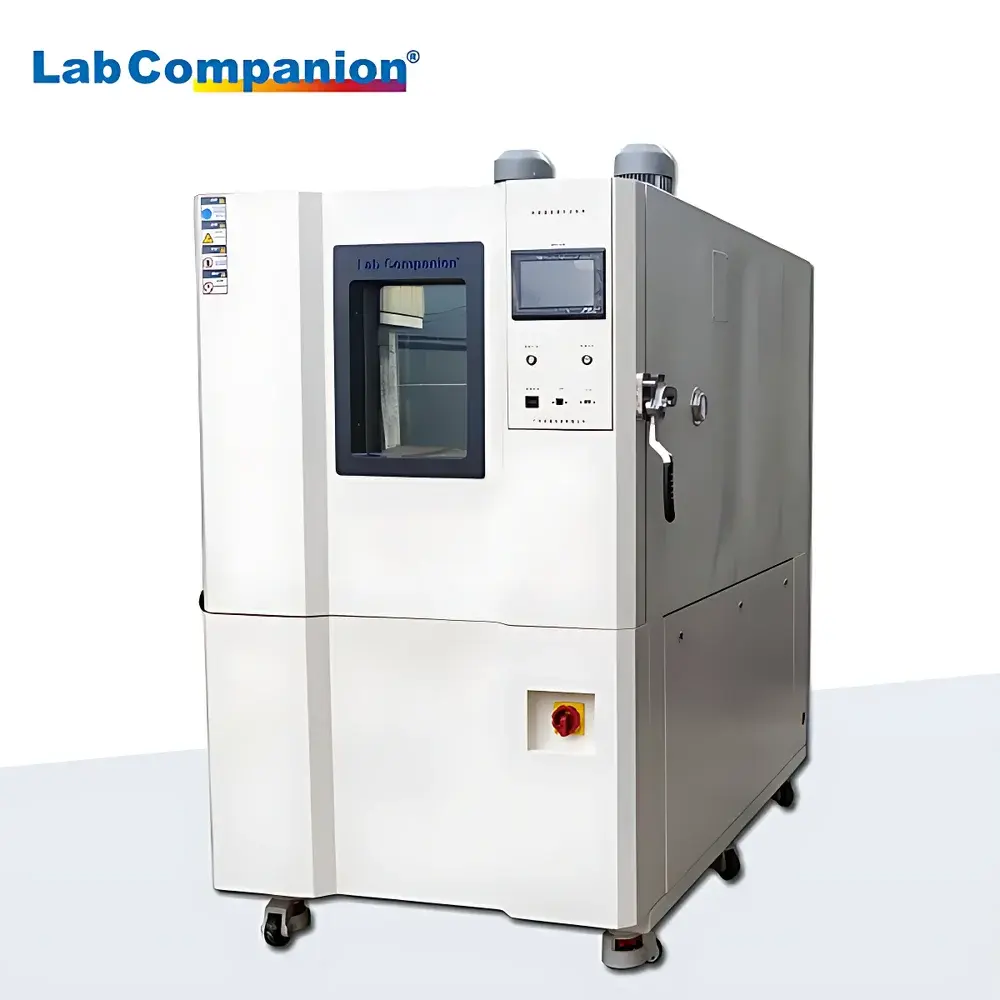
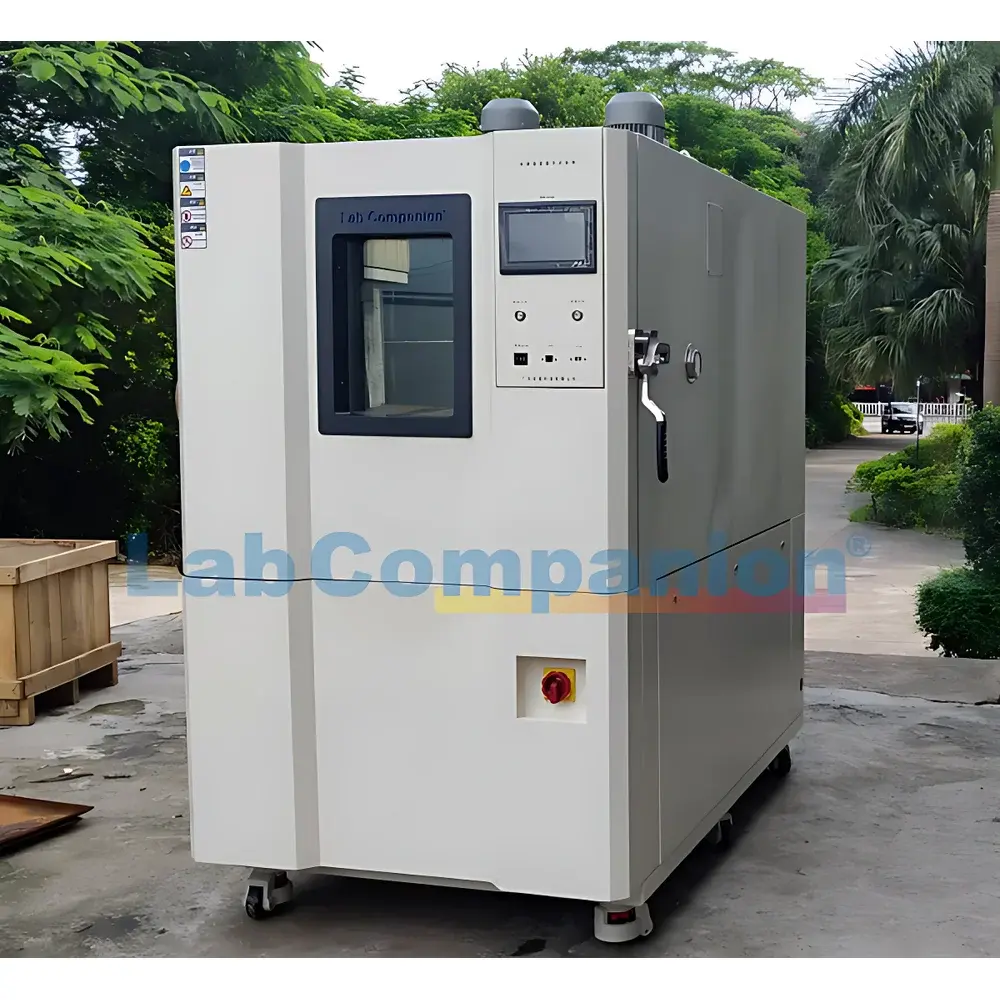
LabCompanion TH-408-9 Rapid Temperature Change Test Chamber
| Brand | LabCompanion |
|---|---|
| Origin | Guangdong, China |
| Manufacturer Type | Original Equipment Manufacturer (OEM) |
| Country of Origin | China |
| Model | TH-408-9 |
| Temperature Range | −70 °C to +150 °C |
| Temperature Fluctuation | ±0.5 °C |
| Temperature Deviation | ±2.0 °C |
| Temperature Uniformity | ≤2.0 °C |
| Heating Rate | 1–25 °C/min (linear or non-linear) |
| Cooling Rate | 1–25 °C/min (linear or non-linear) |
| Internal Chamber Dimensions | 800 × 850 × 600 mm (W × H × D) |
Overview
The LabCompanion TH-408-9 Rapid Temperature Change Test Chamber is an engineered environmental simulation system designed for accelerated thermal stress evaluation of electronic components, automotive modules, aerospace subsystems, and advanced materials. It operates on a dual-refrigeration circuit architecture with independent heating and cooling control loops, enabling precise, repeatable, and programmable temperature transitions across the full operational range of −70 °C to +150 °C. Unlike standard thermal cycling chambers, the TH-408-9 supports both linear and non-linear ramp profiles—critical for replicating real-world thermal transients encountered during power-up/down cycles, altitude changes, or rapid ambient shifts in field operation. Its chamber design complies with fundamental thermal test requirements defined in IEC 60068-2-14 (Test N: Change of Temperature), MIL-STD-810H Method 503.6, and JEDEC JESD22-A104F, ensuring data integrity for qualification and reliability screening.
Key Features
- High-fidelity thermal control system with dual-stage cascade refrigeration and PID-controlled electric heating elements
- Programmable ramp rates from 1 °C/min up to 25 °C/min—adjustable per segment within multi-step test profiles
- Chamber uniformity ≤2.0 °C and stability maintained at ±0.5 °C under steady-state conditions
- Robust stainless-steel inner chamber (SUS304) with insulated double-wall construction and anti-condensation heating on observation window
- Integrated safety interlocks including over-temperature cut-off, compressor high-pressure protection, and door-open alarm
- Compliant with ISO 9001:2015, ISO 14001:2015, and ISO 45001:2018 quality, environmental, and occupational health management systems
Sample Compatibility & Compliance
The TH-408-9 accommodates samples up to 800 mm (W) × 850 mm (H) × 600 mm (D), supporting standard test fixtures, PCB assemblies, battery packs, and small mechanical subassemblies. Optional internal load capacity monitoring (via integrated current/voltage sensors) enables concurrent electrical performance assessment during thermal cycling. The chamber meets essential regulatory expectations for environmental testing laboratories operating under GLP (Good Laboratory Practice) and GMP (Good Manufacturing Practice) frameworks. Its calibration traceability aligns with national metrological standards through collaboration with the China National Institute of Metrology (NIM), and it supports audit-ready documentation for FDA 21 CFR Part 11-compliant validation protocols when paired with optional data logging hardware.
Software & Data Management
Equipped with LabCompanion’s proprietary TC-Studio™ control software, the TH-408-9 provides intuitive graphical programming of complex thermal profiles—including dwell, ramp, and hold segments—with up to 999 steps per program. Real-time plotting of chamber setpoint vs. actual sensor readings (with dual Pt100 probes) ensures immediate deviation detection. All test data—including timestamps, setpoints, measured values, alarm logs, and operator entries—are stored in encrypted CSV and PDF report formats. Audit trail functionality records user login/logout events, parameter modifications, and program execution history—supporting compliance with ISO/IEC 17025 accreditation requirements for testing laboratories.
Applications
- Thermal cycling qualification per AEC-Q200 for passive and active automotive electronics
- Reliability screening of Li-ion battery cells and BMS modules under extreme thermal gradients
- Material coefficient-of-thermal-expansion (CTE) mismatch analysis in multilayer ceramic capacitors (MLCCs)
- Validation of hermetic seal integrity in MEMS devices and optoelectronic packages
- Accelerated life testing of avionics enclosures exposed to rapid stratospheric descent profiles
- Process validation for solder reflow simulation and cold-start behavior in embedded controllers
FAQ
What is the difference between rapid temperature change and temperature shock testing?
Rapid temperature change (RTC) uses a single-chamber design with controlled ramp rates (e.g., 1–25 °C/min), whereas temperature shock employs dual- or triple-zone chambers for instantaneous transfer between extreme temperature baths. RTC better simulates gradual but aggressive thermal environments such as vehicle cabin heating or outdoor equipment exposure.
Can the TH-408-9 be validated for IQ/OQ/PQ protocols?
Yes—the chamber includes factory calibration certificates, sensor mapping reports, and software tools for generating IQ/OQ/PQ documentation aligned with ASTM E2500 and EU Annex 15 guidelines.
Is remote monitoring supported?
Standard Ethernet (TCP/IP) and optional RS-485 interfaces enable integration into facility-wide SCADA or MES platforms. Secure web-based remote viewing is available via optional LabCompanion Cloud Connect module.
Does the system support non-linear ramp profiles?
Yes—TC-Studio™ allows definition of variable ramp rates within a single program, enabling simulation of realistic thermal transients such as engine warm-up curves or solar loading decay profiles.
What maintenance intervals are recommended?
Compressor oil and refrigerant filter replacement every 24 months; chamber seal inspection and sensor verification annually; full system calibration recommended biannually or after 500 operational hours—whichever occurs first.



