
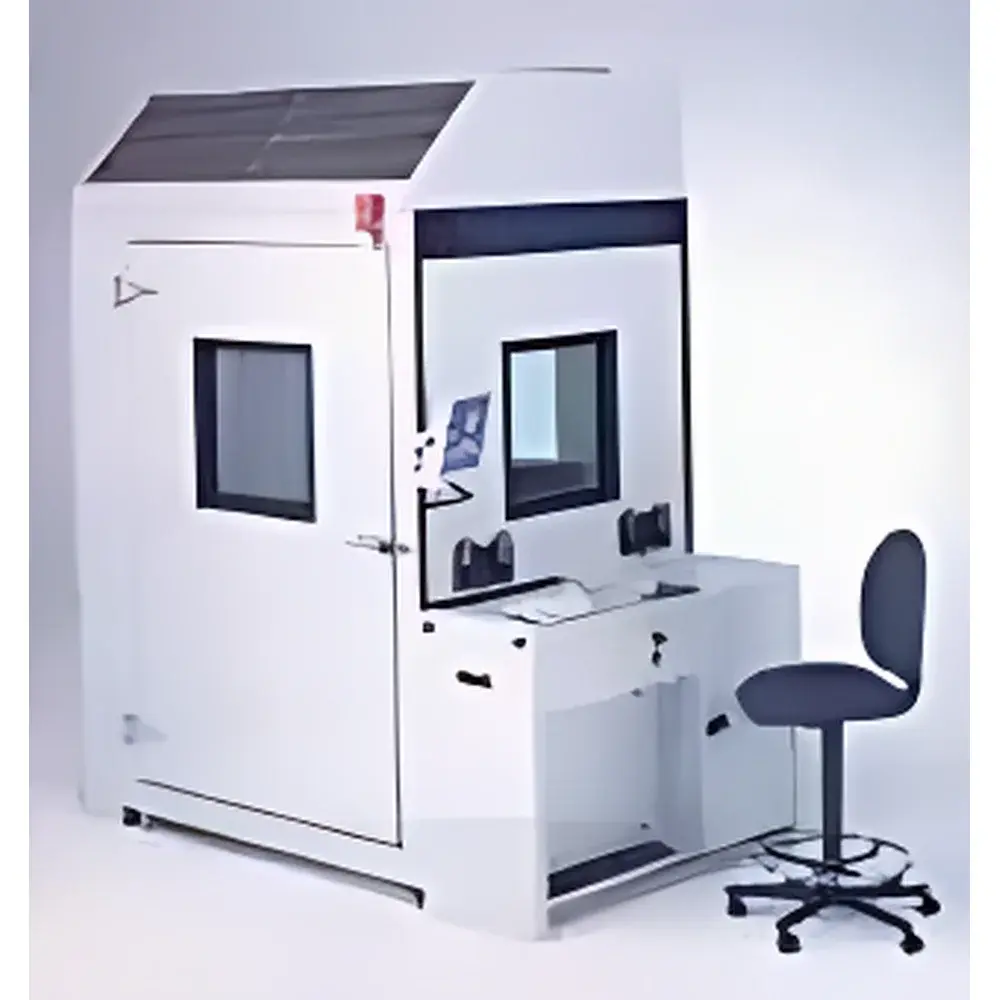
LabCompanion AST-20R Accelerated Stress Test System for HALT and HASS
| Brand | LabCompanion |
|---|---|
| Origin | Guangdong, China |
| Manufacturer Type | Direct Manufacturer |
| Origin Category | Domestic (China) |
| Model | AST-20R |
| Pricing | Upon Request |
| Temperature Range | −73 °C to +200 °C |
| Thermal Ramp Rate | >50 °C/min |
| Vibration Platform | 30″ × 30″ × 40″ (76 cm × 76 cm × 101 cm) |
| Vibration Performance | Up to 50 g<sub>rms</sub> |
| Vibration Axes | Multi-axis electrodynamic shaker with programmable waveform synthesis |
| Monitoring Channels | Up to 16 vibration & 8 thermocouple inputs |
| Cooling Method | Mechanical refrigeration (compressor-based), optional LN₂ assist |
| Compliance | Designed to support ASTM E1820, IEC 61508, MIL-STD-810H, ISO 16750-4, and HALT/HASS protocol development per Telcordia GR-1089-CORE |
Overview
The LabCompanion AST-20R Accelerated Stress Test System is an integrated environmental and mechanical stress platform engineered for High-Accelerated Life Testing (HALT) and High-Accelerated Stress Screening (HASS). It applies controlled, synergistic thermal and vibrational stresses—individually or concurrently—to expose latent design weaknesses, manufacturing defects, and material interface failures that remain undetected under conventional qualification testing. Unlike standard environmental chambers or shaker tables, the AST-20R implements a physics-based acceleration methodology grounded in Coffin–Manson fatigue models and Arrhenius-type thermal degradation kinetics. Its core architecture enables rapid thermal transients (>50 °C/min) combined with broadband multi-axis vibration (up to 50 grms) within a single test chamber, allowing failure mechanisms—including solder joint cracking, conformal coating delamination, PCB trace fatigue, and connector fretting—to manifest in hours rather than years.
Key Features
- Compressor-based cooling system delivering −73 °C to +200 °C operating range without mandatory liquid nitrogen infrastructure—ideal for labs lacking LN₂ supply or safety protocols.
- Patented multi-axis electrodynamic vibration table (76 cm × 76 cm × 101 cm internal volume) with force uniformity maintained across full frequency spectrum (5–10,000 Hz), enabling reproducible modal excitation and resonant overstress.
- High-velocity, adjustable airflow system with directional nozzles and variable-speed centrifugal blowers—optimized to maximize convective heat transfer at component-level hotspots during thermal ramping.
- Integrated PC-based AST Controller running deterministic real-time firmware; synchronizes temperature setpoints, vibration profiles (sine, random, shock, swept-sine), and data acquisition at 10 kHz sampling rate.
- 16-channel vibration input capability with IEPE-compatible signal conditioning, plus 8 independent thermocouple (Type K/J) monitoring channels—enabling spatial stress mapping across DUT geometry for root-cause correlation.
- Fail-safe interlocked access door with stainless steel hinges, dual redundant limit switches, and emergency power cutoff—certified to meet ISO 13857 and EN 60204-1 machinery safety requirements.
- Modular thermal isolation architecture minimizes parasitic heat load on vibration actuators, ensuring stable mechanical performance across extreme thermal cycles.
Sample Compatibility & Compliance
The AST-20R accommodates electronic assemblies up to 45 kg (100 lb) with direct mounting to the vibration table surface via threaded inserts or custom fixtures. Its chamber geometry supports board-level modules, avionics line-replaceable units (LRUs), automotive ECUs, medical device enclosures, and IoT edge nodes. The system is designed to facilitate compliance verification against industry-specific reliability standards including MIL-STD-810H Method 520.5 (HALT), IEC 60068-2-64 (broadband vibration), IEC 60068-2-14 (thermal shock), and Telcordia GR-1089-CORE for telecom equipment. While not pre-certified as a turnkey FDA 21 CFR Part 11 or ISO/IEC 17025-compliant instrument, its audit-ready data logging architecture—featuring time-stamped, tamper-evident binary archives, user-access controls, and electronic signature support—enables integration into GLP/GMP validation workflows when deployed with validated SOPs and IQ/OQ documentation packages.
Software & Data Management
The AST Control Suite provides a deterministic Windows-based interface supporting script-driven test sequencing, live spectral analysis (FFT, PSD, Kurtosis), and synchronized thermal/vibration profile overlay. All raw sensor data—including accelerometer waveforms, thermocouple traces, chamber ambient temperature, and actuator current feedback—is logged in IEEE 1588-compliant timestamped HDF5 format. Export options include CSV, MATLAB .mat, and NI TDMS for post-test failure mode analysis (FMA) using tools such as MATLAB Signal Processing Toolbox or DIAdem. Audit trails record operator login/logout events, parameter changes, emergency stops, and calibration history—fully traceable for regulatory review. Optional add-ons include automated fault detection algorithms trained on historical HALT datasets and REST API integration for enterprise MES/QMS platforms (e.g., Siemens Opcenter, ETQ Reliance).
Applications
- Early-stage design validation of aerospace electronics subjected to launch vibration spectra and thermal vacuum cycling analogs.
- Rapid identification of weak interfaces in automotive ADAS modules exposed to combined thermal gradient and road-induced vibration.
- Qualification of medical device battery packs under accelerated calendar aging conditions with simultaneous mechanical shock loading.
- Supplier qualification audits requiring evidence of robustness margins beyond AEC-Q200 or IEC 60747-17 specifications.
- Root-cause analysis of field return units by replicating failure signatures observed in service—enabling targeted design corrections prior to re-spin.
- Development of product-specific HASS screens derived from HALT results, optimized for production-line throughput and defect escape prevention.
FAQ
Can the AST-20R be upgraded to support liquid nitrogen assist cooling?
Yes—the system features standardized LN₂ inlet ports and thermal interface provisions. Integration requires factory commissioning to ensure pressure regulation, condensate management, and controller firmware updates.
Does the AST-20R support mixed-mode testing (e.g., vibration while ramping temperature)?
Yes. The controller executes fully synchronized thermal and vibrational profiles with sub-second coordination fidelity, enabling true combined stress HALT protocols.
What is the maximum payload weight and center-of-gravity height limitation?
Maximum static load is 45 kg with CoG ≤ 15 cm above table surface; dynamic load limits depend on frequency content and must be verified via modal survey prior to high-g testing.
Is third-party calibration certification available?
LabCompanion offers NIST-traceable calibration services for temperature sensors and vibration transducers, documented per ISO/IEC 17025 requirements upon request.
How does the AST-20R differ from standard thermal shock chambers?
Unlike two-chamber thermal shock systems, the AST-20R achieves rapid ramp rates within a single chamber while simultaneously applying broadband vibration—eliminating thermal lag and enabling true synergistic stress coupling critical for detecting interaction-driven failures.






