
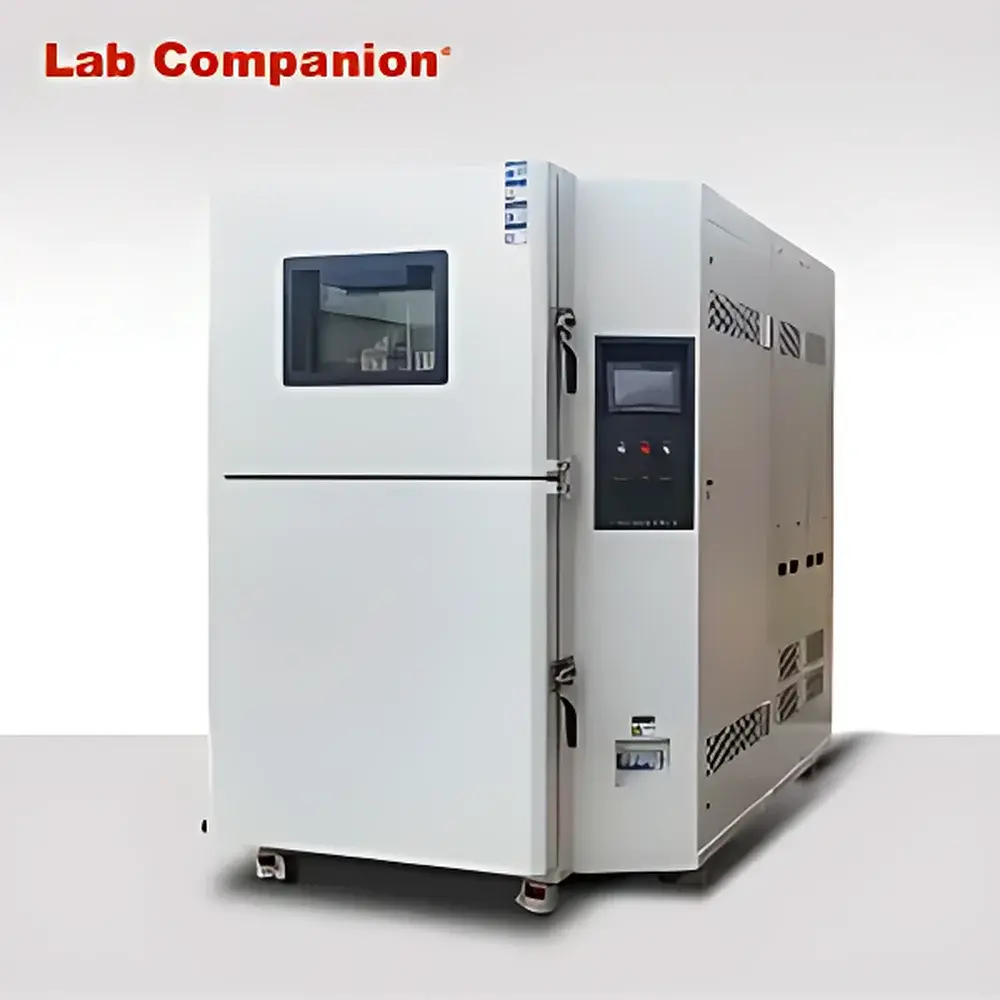
LabCompanion CJ602S3 Three-Zone Thermal Shock Test Chamber
| Brand | LabCompanion |
|---|---|
| Origin | Guangdong, China |
| Manufacturer Type | Direct Manufacturer |
| Country of Origin | China |
| Model | CJ602S3 |
| Price Range | USD 14,000 – 28,000 (FOB Guangdong) |
| High-Temperature Range | +150 °C |
| Low-Temperature Range | −65 °C |
| Thermal Shock Range | −65 °C to +150 °C |
| Heating Rate | +60 °C to +200 °C ≤ 20 min |
| Cooling Rate | +20 °C to −75 °C ≤ 60 min |
Overview
The LabCompanion CJ602S3 Three-Zone Thermal Shock Test Chamber is an engineered environmental test system designed to evaluate the reliability and structural integrity of electronic components, optoelectronic devices, and mechanical assemblies under rapid, repetitive thermal transitions. Operating on the principle of three-chamber (hot / cold / test) air-transfer methodology, it eliminates thermal lag by physically transferring test specimens between independently controlled high-temperature (+150 °C) and low-temperature (−65 °C) zones via a horizontal shuttle mechanism. This architecture ensures precise dwell time control, minimal temperature overshoot, and high reproducibility—critical for qualification testing per IEC 60068-2-14, MIL-STD-810H Method 503.5, and JESD22-A104. Unlike single- or dual-chamber designs, the three-zone configuration maintains stable boundary temperatures during transfer, enabling strict compliance with transition-time specifications required in automotive AEC-Q200 and aerospace DO-160 Section 4.6.
Key Features
- Triple independent chamber architecture: segregated hot zone (+150 °C), cold zone (−65 °C), and ambient test zone for zero cross-contamination and stable thermal baselines
- High-speed pneumatic shuttle transfer system with <2.5 s door switching time and position-verified actuation for repeatable specimen handling
- Stainless-steel interior construction (SUS304) with electrostatically applied epoxy-coated exterior; insulated with 150 mm thick polyurethane foam (λ = 0.022 W/m·K)
- Industrial-grade PID-controlled refrigeration circuit using dual-stage cascade compressors (R404A/R23) and electric heating elements with over-temperature cut-off (OTC) at ±3 °C deviation
- Real-time monitoring of chamber air temperature uniformity (±1.5 °C @ 100 L load) and stability (±0.5 °C over 30 min) per ISO 16750-4 Annex B
- Integrated safety interlocks including door lock during operation, refrigerant pressure monitoring, and emergency power-off (EPO) compliant with IEC 61000-6-2/6-4
Sample Compatibility & Compliance
The CJ602S3 accommodates test specimens up to 450 × 450 × 450 mm (W × D × H) and 30 kg maximum mass. Its chamber geometry and airflow design support standardized mounting fixtures—including DIN 41612, JEDEC trays, and custom PCB carriers—ensuring consistent thermal exposure across LED modules, driver ICs, COB packages, metal-core PCBs, and encapsulated optical components. The system meets traceability requirements for GLP/GMP environments: all temperature setpoints, dwell durations, cycle counts, and alarm events are logged with UTC timestamps and user ID attribution. Calibration certificates (NIST-traceable Pt100 sensors) and IQ/OQ documentation packages are available upon request. Compliant with ASTM E1545-16 (thermal shock classification), USP (pharmaceutical packaging validation), and RoHS/REACH material declarations for chamber internals.
Software & Data Management
Controlled via LabCompanion’s TC-Studio v4.2 software (Windows 10/11 compatible), the system supports fully programmable multi-step profiles with up to 999 cycles, variable dwell times (1–9999 min), and conditional branching (e.g., “pause on alarm”, “repeat last segment on failure”). All operational data—including real-time thermocouple readings (Type K, Class 1), compressor amperage, door status, and error codes—are recorded at user-defined intervals (1–60 s) and exported as CSV or XML. Audit trail functionality satisfies FDA 21 CFR Part 11 requirements: electronic signatures, role-based access control (admin/operator/viewer), and immutable log files with SHA-256 hash verification. Remote monitoring via Ethernet (TCP/IP) or optional Wi-Fi module enables integration into centralized MES/QMS platforms.
Applications
This chamber is routinely deployed in R&D and QA labs for accelerated life testing of LED lighting systems—including drivers, MCPCBs, optics (lenses, reflectors), and thermal interface materials—as well as automotive ECUs, avionics connectors, MEMS sensors, and medical device housings. It validates solder joint fatigue resistance (IPC-9701), conformal coating adhesion (IPC-CC-830B), and polymer housing warpage (ISO 294-4). In LED manufacturing, it replicates field-relevant thermal cycling induced by on/off switching, ambient diurnal shifts, and enclosure heat buildup—enabling correlation with lumen maintenance (IES LM-80) and color shift (CIE 15:2018) data. The −65 °C capability supports cryogenic qualification for outdoor lighting in northern climates and aerospace-grade optoelectronics.
FAQ
What is the minimum dwell time achievable in each temperature zone?
Standard minimum dwell time is 10 minutes per zone; configurable down to 1 minute with optional firmware upgrade and validation report.
Does the system support automated sample loading/unloading?
Not natively; however, the shuttle interface includes RS-485 and dry-contact I/O ports for integration with third-party robotic arms or conveyor-linked handlers.
Can the CJ602S3 be validated per ISO/IEC 17025?
Yes—LabCompanion provides accredited calibration services (CNAS-certified lab) and full uncertainty budgets for temperature uniformity, transition rate, and dwell stability.
Is nitrogen purge capability available?
Optional inert gas purging (N₂ or dry air) can be added via integrated mass flow controller and chamber venting manifold to suppress oxidation during high-temp dwell phases.
What maintenance intervals are recommended for the refrigeration system?
Compressor oil and filter replacement every 12 months or 2000 operating hours; annual leak check and refrigerant charge verification per ASHRAE Standard 15.



