
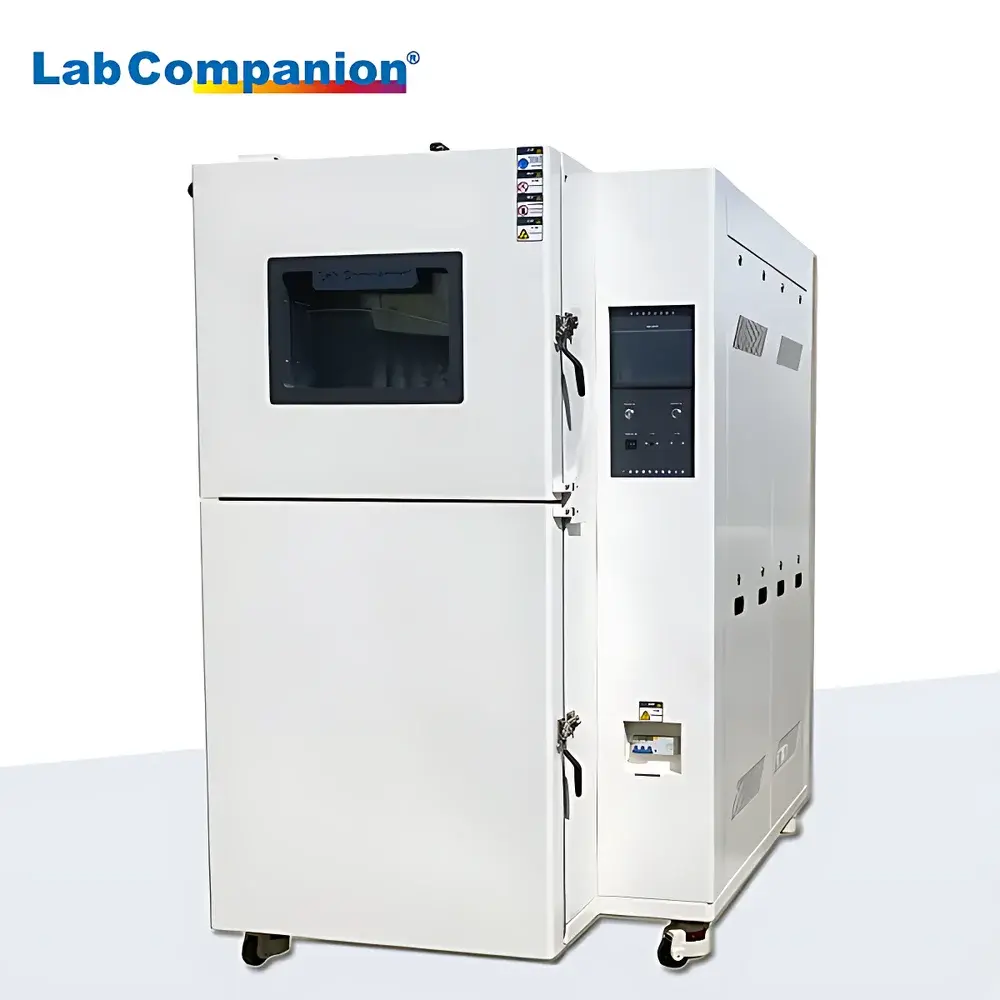
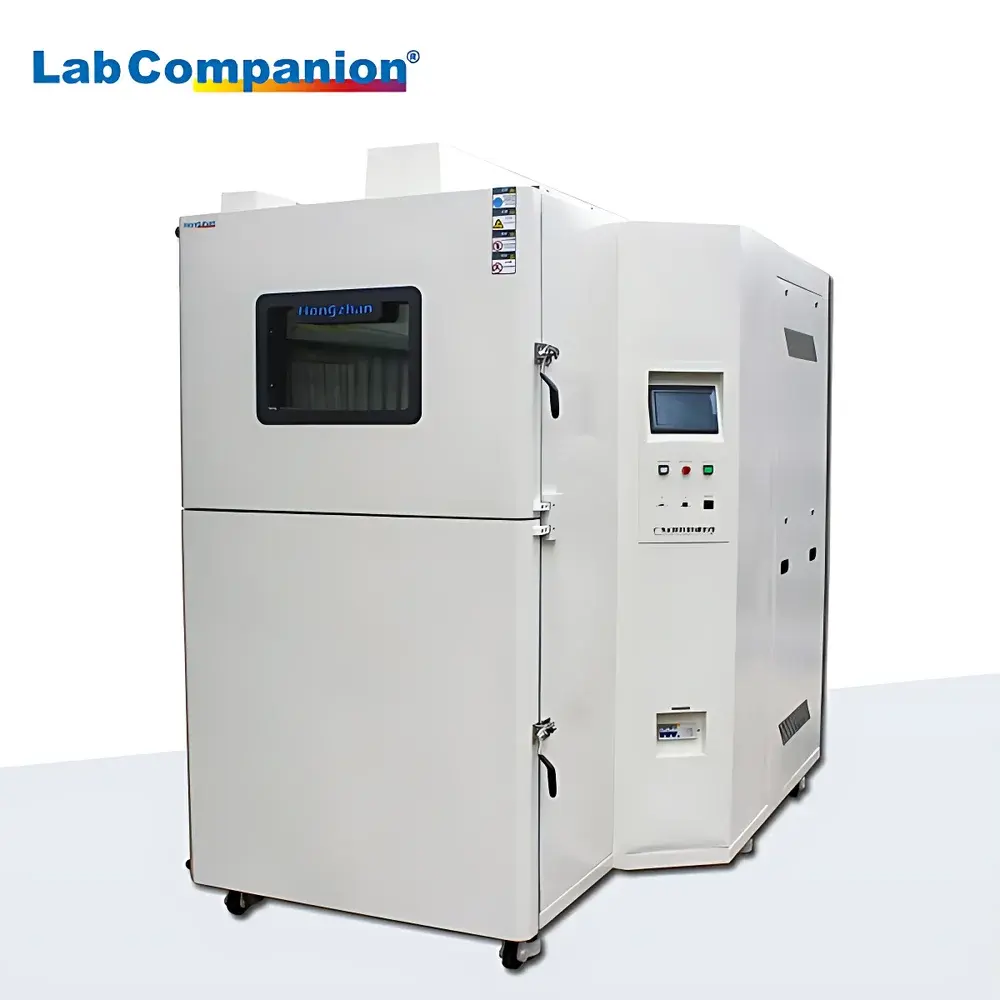
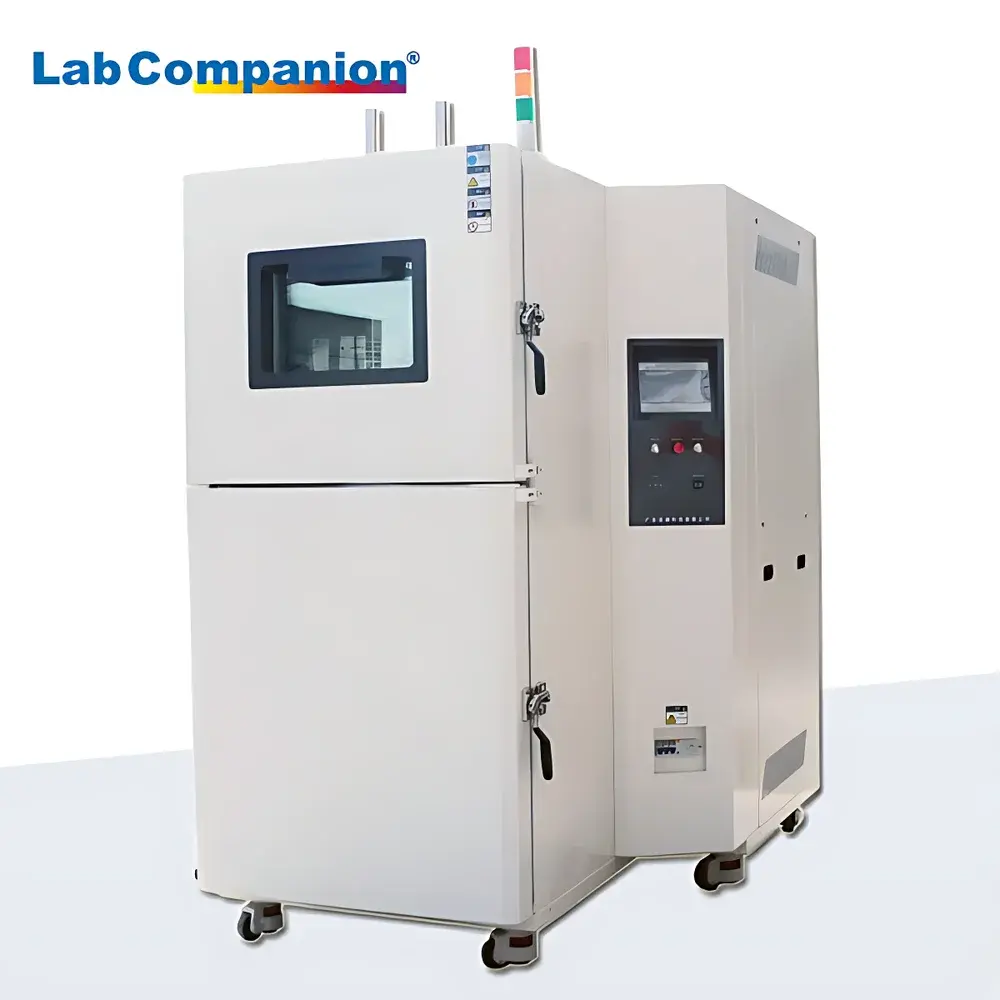
LabCompanion CTL-120A Thermal Shock Test Chamber
| Brand | LabCompanion |
|---|---|
| Origin | Guangdong, China |
| Manufacturer Type | Direct Manufacturer |
| Model | CTL-120A |
| High-Temperature Range | +60 °C to +200 °C |
| Low-Temperature Range | 0 °C to −70 °C |
| Thermal Shock Range | −40 °C to +150 °C |
| Temperature Stability | ±2 °C |
| Heating Rate | R.T. → +200 °C in ~40 min |
| Cooling Rate | R.T. → −70 °C in ~60 min |
| Transfer Time | ≤5 s |
| Temperature Recovery Time | ≤5 min |
| Internal Dimensions (W×H×D) | 500×610×400 mm |
| External Dimensions (W×H×D) | 2720×1050×1950 mm |
| Construction | Cold-Rolled Steel Outer Shell with Powder Coating (Ivory White) / #304 Mirror-Finish Stainless Steel Inner Chamber (1.2 mm) |
| Insulation | Eco-Friendly Glass Fiber (Non-Hazardous Waste Class) |
| Refrigeration | Air-Cooled or Water-Cooled Option |
| Compressor | Imported Hermetic Scroll Compressor |
| Temperature Sensor | Armored Pt100 Platinum Resistance Thermometer |
| Controller | Siemens PLC + Embedded PlatinumV1.0 Control Software |
| Display | 7-inch Color TFT Touchscreen Interface |
| Data Storage | USB 2.0 Port (CSV Format, Non-Hot-Swappable) |
| Communication | RJ45 Ethernet Port (Supports Up to 5 Concurrent Clients |
| Power Supply | AC 380 V, 50 Hz, 3-Phase 4-Wire + Ground |
| Total Installed Capacity | 32 kVA |
| Compliance | GJB 150.3–150.5, GB/T 2423.1–2423.2 |
Overview
The LabCompanion CTL-120A Thermal Shock Test Chamber is an industrial-grade, dual-zone mechanical thermal shock system engineered for accelerated reliability validation of electronic components, aerospace hardware, automotive modules, and high-performance materials under extreme transient temperature conditions. It operates on the two-chamber static method—comprising independent high-temperature (+60 °C to +200 °C) and low-temperature (0 °C to −70 °C) exposure zones—where specimens are rapidly transferred via a motorized lift basket between environments. This architecture ensures minimal thermal inertia interference and enables precise, repeatable shock cycles per MIL-STD-810H Method 503.6, IEC 60068-2-14, and JESD22-A104D protocols. The chamber’s structural integrity, thermal uniformity, and dynamic response meet the stringent spatial and temporal requirements defined in GB/T 2423.22 for functional and failure-mode analysis during thermal cycling stress tests.
Key Features
- Independent dual-zone design with fully isolated hot and cold chambers, eliminating cross-contamination of thermal energy and ensuring stable setpoint maintenance during transfer.
- High-speed pneumatic basket transfer mechanism achieving ≤5 seconds dwell-to-dwell transition time and ≤5 minutes temperature recovery post-transfer—critical for simulating real-world thermal transients in avionics and power electronics.
- Siemens S7-1200 PLC-based control architecture integrated with LabCompanion’s PlatinumV1.0 embedded firmware, delivering deterministic real-time regulation and traceable operational logs compliant with GLP/GMP data integrity principles.
- Armored Pt100 sensors mounted at multiple spatial locations within each zone, providing redundancy and enabling active uniformity compensation across the 500×610×400 mm test volume (±2 °C deviation over full operating range).
- Eco-compliant glass fiber insulation (non-hazardous classification per GB 18580–2017), combined with hermetic scroll compressors and optimized refrigerant circuitry, supports long-term stability without ozone-depleting substances.
- 7-inch capacitive touchscreen interface with multilingual UI (English default), intuitive cycle programming, alarm history logging, and real-time graphing of chamber and specimen thermocouple inputs.
Sample Compatibility & Compliance
The CTL-120A accommodates standard test specimens up to 30 kg load capacity and dimensions compatible with IPC-J-STD-020D reflow profiles and JEDEC JESD22-A106B thermal shock qualification. Its internal stainless-steel chamber (AISI 304, 1.2 mm gauge, mirror finish) resists corrosion from condensate and process residues. The system complies with national and international environmental testing standards including GJB 150.3 (high-temp exposure), GJB 150.4 (low-temp exposure), GJB 150.5 (temperature shock), GB/T 2423.1 (cold), GB/T 2423.2 (dry heat), and IEC 60068-2-14. All control software and data records adhere to audit-ready formats suitable for ISO/IEC 17025-accredited laboratories and FDA 21 CFR Part 11–aligned validation documentation.
Software & Data Management
Data acquisition and management are handled through PlatinumV1.0—the LabCompanion proprietary embedded platform deployed on both the PLC controller and optional Windows-based SCADA host. Operational parameters—including target/actual temperatures, cycle count, dwell times, transfer timestamps, and alarm events—are logged automatically to USB-stored CSV files (non-hot-swap mode). Each record includes ISO 8601 timestamping, user ID tagging, and digital signature metadata. For networked operation, the RJ45 Ethernet port supports TCP/IP communication using Modbus TCP or custom ASCII protocol, enabling integration into centralized lab information management systems (LIMS) and enterprise quality management software (QMS). Up to five concurrent client connections are supported per unit; a single PlatinumV1.0 server instance can monitor and synchronize up to 32 chambers in multi-station thermal shock validation workflows.
Applications
- Qualification testing of printed circuit board assemblies (PCBAs) per IPC-9701 for solder joint fatigue resistance.
- Reliability screening of semiconductor packages (QFN, BGA, CSP) under JEDEC JESD22-A104D-defined shock profiles.
- Material compatibility assessment for encapsulants, conformal coatings, and thermal interface materials (TIMs) exposed to rapid thermal gradients.
- Aerospace component validation against MIL-STD-810H Method 503.6 for airborne electronic enclosures and sensor housings.
- Automotive ECUs subjected to ISO 16750-4 environmental stress screening prior to AEC-Q200 qualification.
- Research applications in polymer phase-transition kinetics, battery cell thermal runaway propagation studies, and MEMS device hysteresis characterization.
FAQ
What is the maximum specimen weight the CTL-120A can accommodate during thermal shock cycling?
The lift basket is rated for continuous operation with loads up to 30 kg. Exceeding this limit may compromise transfer timing accuracy and long-term actuator durability.
Does the system support automated calibration verification per ISO/IEC 17025 requirements?
Yes—PlatinumV1.0 includes built-in calibration check routines for Pt100 sensors and supports external reference thermometer input for periodic verification. Calibration logs are exportable and time-stamped.
Can the chamber be configured for water-cooled operation in high-ambient environments?
Yes—model variants are available with water-cooled condenser options (designated “W” suffix), enabling stable performance in ambient temperatures up to 40 °C and reducing facility HVAC load.
Is the USB data export function compatible with third-party statistical analysis tools?
All exported CSV files follow ANSI X3.4 (ASCII) encoding with comma-separated values and ISO 8601 timestamps, ensuring native compatibility with MATLAB, Python pandas, JMP, and Minitab.
How is temperature uniformity validated across the working volume?
Uniformity is verified per GB/T 5170.2–2017 using nine calibrated Pt100 probes arranged in a 3×3 vertical grid. Results are documented in the factory acceptance test (FAT) report shipped with each unit.
Related Products



