
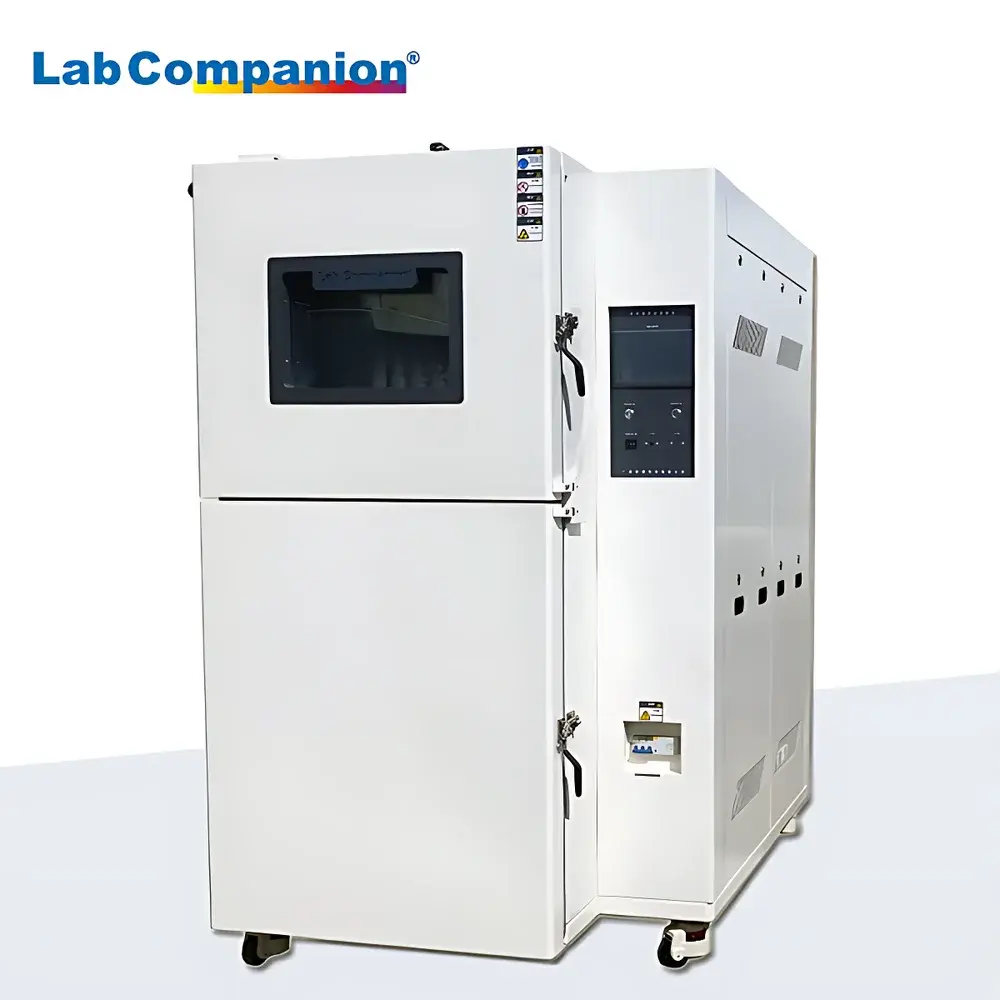
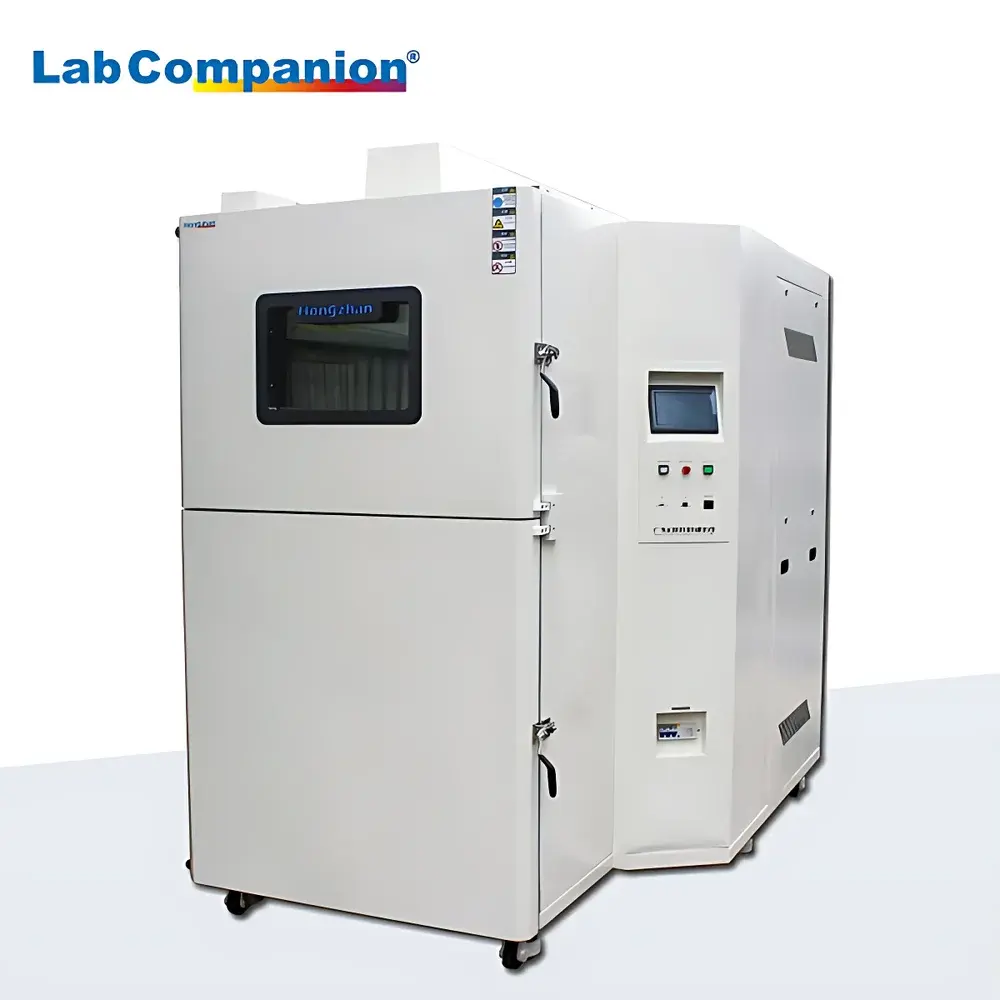
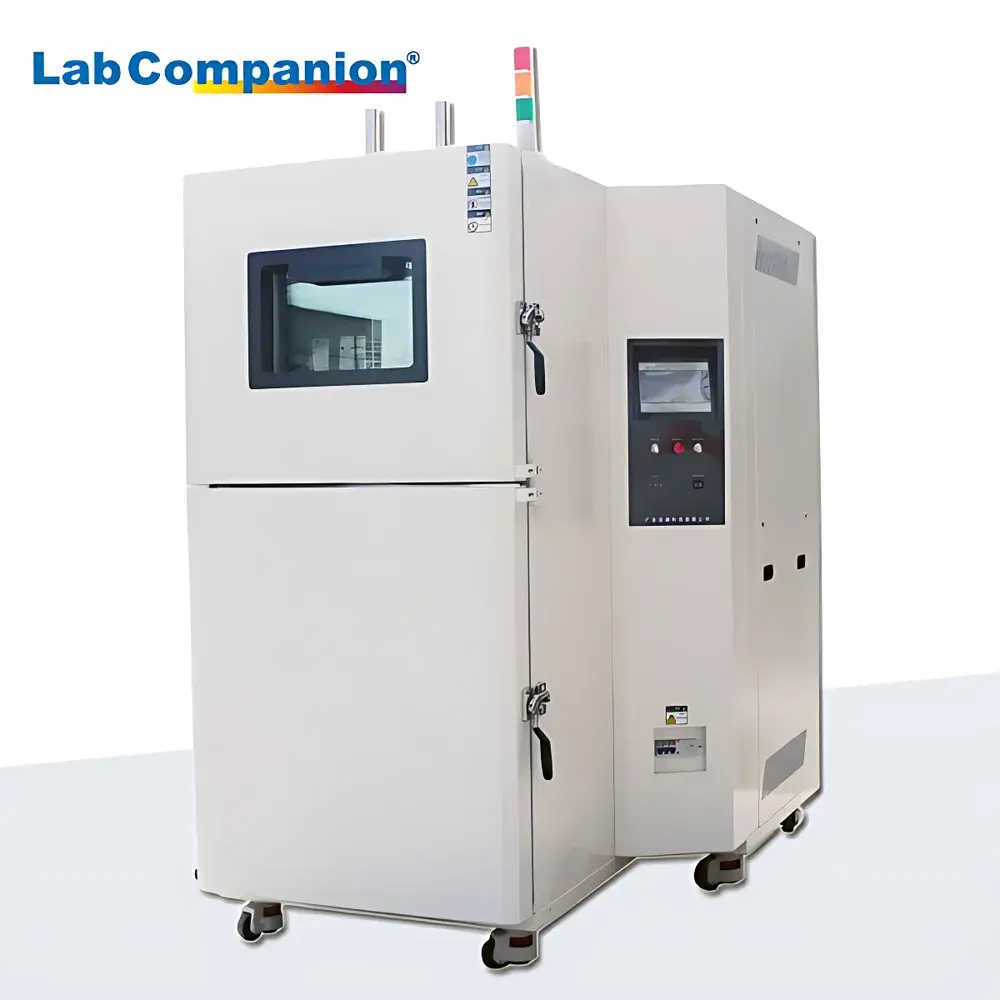
LabCompanion CTU-120A Thermal Shock Test Chamber
| Brand | LabCompanion |
|---|---|
| Model | CTU-120A |
| Origin | Guangdong, China |
| Manufacturer Type | Direct Manufacturer |
| High-Temperature Range | +60 °C to +200 °C |
| Low-Temperature Range | 0 °C to −70 °C |
| Thermal Shock Range | −55 °C to +150 °C |
| Temperature Stability | ±2 °C |
| Ramp-Up Rate | R.T. → +200 °C in ~40 min |
| Ramp-Down Rate | R.T. → −70 °C in ~60 min |
| Transfer Time | ≤5 s |
| Temperature Recovery Time | ≤5 min |
| Internal Dimensions (W×H×D) | 500×610×400 mm |
| External Dimensions (W×H×D) | 2720×1050×1950 mm |
| Construction | Cold-Rolled Steel Exterior (Ivory White Powder Coating) / 304 Mirror-Finish Stainless Steel Interior (1.2 mm) |
| Insulation | Eco-Friendly Glass Fiber (Non-Hazardous Waste Class) |
| Refrigeration | Air-Cooled or Water-Cooled Options |
| Compressor | Imported Hermetic Scroll Compressor |
| Temperature Sensor | Armored Pt100 RTD |
| Controller | Siemens PLC + Embedded PlatinumV1.0 Control Software |
| Display | 7″ Color TFT Touchscreen Interface |
| Data Logging | USB Port (CSV Export, No Hot-Swapping) & RJ45 Ethernet (TCP/IP, Supports Up to 5 Concurrent Clients |
| Power Supply | AC 380 V, 50 Hz, 3-Phase + PE |
| Total Installed Capacity | 32 kVA |
| Compliance | MIL-STD-810G Method 503.5 (Thermal Shock), GJB 150.3–150.5, GB/T 2423.1–2423.2, IEC 60068-2-14 |
Overview
The LabCompanion CTU-120A Thermal Shock Test Chamber is an industrial-grade, dual-zone mechanical thermal shock system engineered for accelerated reliability validation of electronic components, aerospace assemblies, automotive ECUs, and high-performance polymer systems. It operates on the principle of rapid, repeatable temperature transitions between independently controlled high- and low-temperature chambers—enabling deterministic stress application via abrupt thermal gradients rather than gradual cycling. Unlike single-chamber thermal cycling systems, the CTU-120A employs a horizontal three-position basket mechanism with pneumatic actuation to physically transfer test specimens between zones in ≤5 seconds, minimizing dwell time and ensuring true step-change thermal loading. Its calibrated operational envelope spans −55 °C to +150 °C, supporting both extreme low-temperature exposure (down to −70 °C in the cold zone) and high-temperature preconditioning (up to +200 °C in the hot zone), making it suitable for qualification testing per MIL-STD-810G Method 503.5 and GJB 150.3–150.5.
Key Features
- Independent dual-zone architecture with fully segregated hot and cold chambers, each equipped with dedicated refrigeration circuits and heating banks
- High-reproducibility basket transfer system achieving ≤5 s chamber-to-chamber transit and ≤5 min temperature recovery post-transfer (per GB/T 2423.22)
- Siemens S7-1200 PLC-based control platform running embedded PlatinumV1.0 firmware, delivering deterministic real-time sequencing and fault-tolerant operation
- 7-inch capacitive touchscreen interface with multi-language support (English, Chinese, Korean, Japanese), intuitive drag-and-drop test profile editor, and password-protected parameter locking
- Armored Pt100 RTD sensors (Class A tolerance) mounted at chamber center and specimen location points, enabling active compensation for spatial thermal gradients
- Eco-compliant insulation using non-hazardous glass fiber (zero ODP, zero GWP), certified per RoHS Directive 2011/65/EU and REACH Annex XVII
- Modular refrigeration design with imported hermetic scroll compressors and microchannel condensers for stable low-temperature hold performance under continuous duty
Sample Compatibility & Compliance
The CTU-120A accommodates standard test specimens up to 30 kg per cycle and supports fixtures compliant with IPC-TM-650 2.6.7 (printed circuit board thermal shock). Internal dimensions (500 × 610 × 400 mm) allow full insertion of 19″ rack-mounted modules, automotive control units, and encapsulated sensor assemblies. All control logic and data logging functions are designed to meet GLP/GMP audit requirements: event logs include timestamped operator ID, setpoint changes, alarm triggers, and sensor calibration status. The system complies with electromagnetic compatibility standards IEC 61000-6-2 (immunity) and IEC 61000-6-4 (emission), and its software architecture satisfies FDA 21 CFR Part 11 requirements for electronic records and signatures when used with optional PlatinumV1.0 Audit Trail Module. Certification documentation includes traceable calibration certificates (NIST-traceable RTDs), factory acceptance test reports, and compliance matrices aligned with GJB 150.3 (high-temp shock), GJB 150.4 (low-temp shock), and GJB 150.5 (temperature shock).
Software & Data Management
Data integrity and traceability are enforced through dual-channel logging: local USB storage exports comma-separated values (.csv) files containing time-stamped chamber temperatures, basket position status, power consumption, and alarm history—formatted for direct import into MATLAB, Python pandas, or JMP. The embedded controller maintains an internal circular buffer retaining ≥30 days of high-frequency sampling (1 Hz resolution) without external media. Optional Ethernet connectivity enables integration with enterprise-level environmental monitoring platforms via TCP/IP. When paired with PlatinumV1.0 Computer Monitoring Software (sold separately), the CTU-120A supports remote supervision of up to 32 chambers from a single workstation, role-based user access control, automated report generation (PDF/Excel), and synchronized scheduling across multi-chamber test campaigns. All exported datasets include metadata headers compliant with ASTM E2911-21 (Standard Guide for Data Exchange in Environmental Testing).
Applications
- Qualification of solder joint integrity in lead-free PCBAs subjected to JEDEC J-STD-020D moisture sensitivity level (MSL) pre-conditioning followed by thermal shock
- Validation of thermal expansion coefficient (CTE) mismatch failure modes in MEMS packaging and wafer-level chip-scale packages (WLCSP)
- Aerospace component screening per MIL-STD-704F power interruption profiles combined with thermal shock sequences
- Accelerated aging of lithium-ion battery modules under alternating thermal extremes to assess separator shrinkage and electrolyte volatility
- Material compatibility testing of optical adhesives and AR coatings used in infrared imaging systems exposed to desert-night/clear-sky diurnal cycles
- Reliability assessment of automotive ADAS radar housings undergoing ISO 16750-4 environmental stress screening
FAQ
What is the maximum specimen weight the CTU-120A can accommodate during thermal shock transfer?
The horizontal basket mechanism supports specimens up to 30 kg with center-of-gravity alignment within ±25 mm of the basket’s geometric center.
Does the system support programmable dwell times at extreme temperatures?
Yes—dwell duration at either temperature extreme is fully configurable from 1 minute to 999 hours per phase, with independent settings for hot and cold zones.
Is NIST-traceable calibration included with delivery?
Each unit ships with a factory calibration certificate covering all Pt100 sensors and controller input/output channels, referenced to NIST SRM 1750a (Industrial Platinum Resistance Thermometers).
Can the CTU-120A be integrated into a centralized lab automation network?
Yes—via optional PlatinumV1.0 Server Edition software, which provides OPC UA server functionality, RESTful API endpoints, and SCADA-compatible Modbus TCP mapping for LIMS and MES integration.
What refrigerant is used, and does it comply with global phaseout regulations?
The system uses R-513A (GWP = 631), an ASHRAE-approved A1-class low-GWP alternative to R-404A, compliant with EU F-Gas Regulation (EU) No 517/2014 and EPA SNAP Program Acceptance List.



