
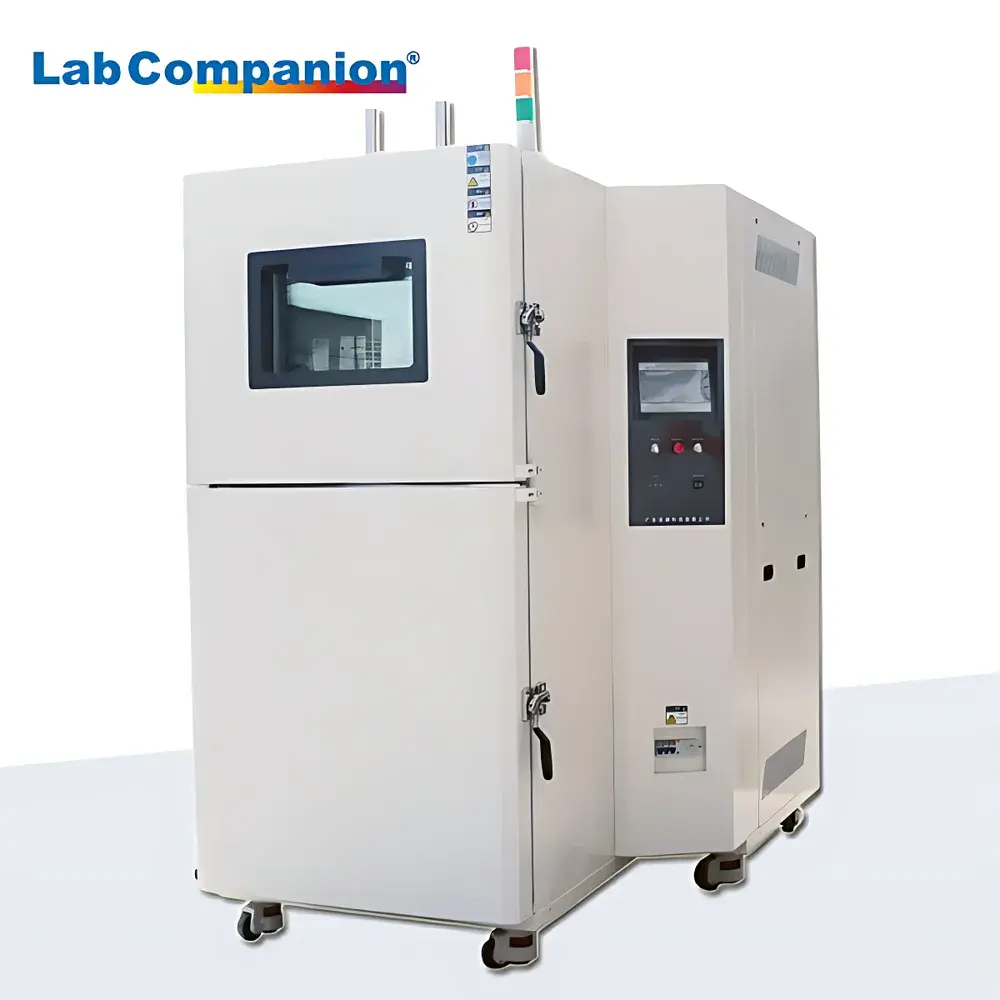
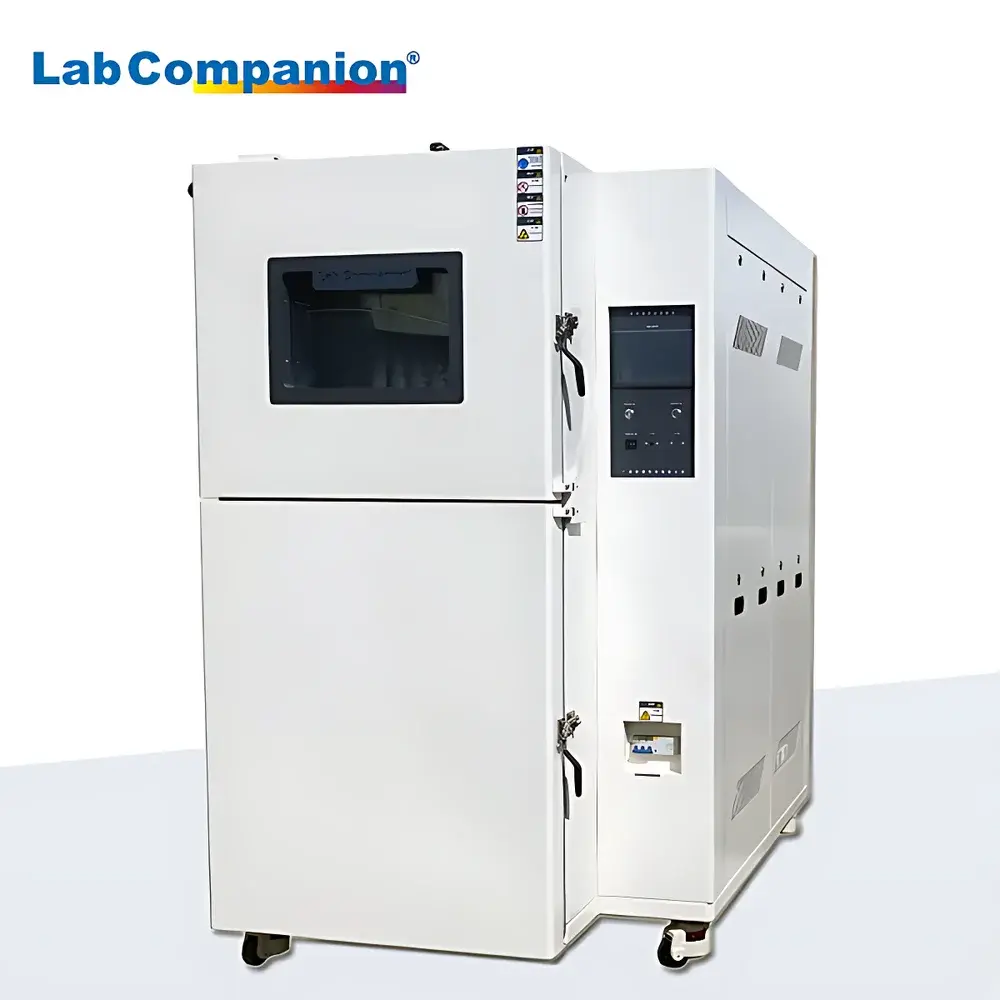
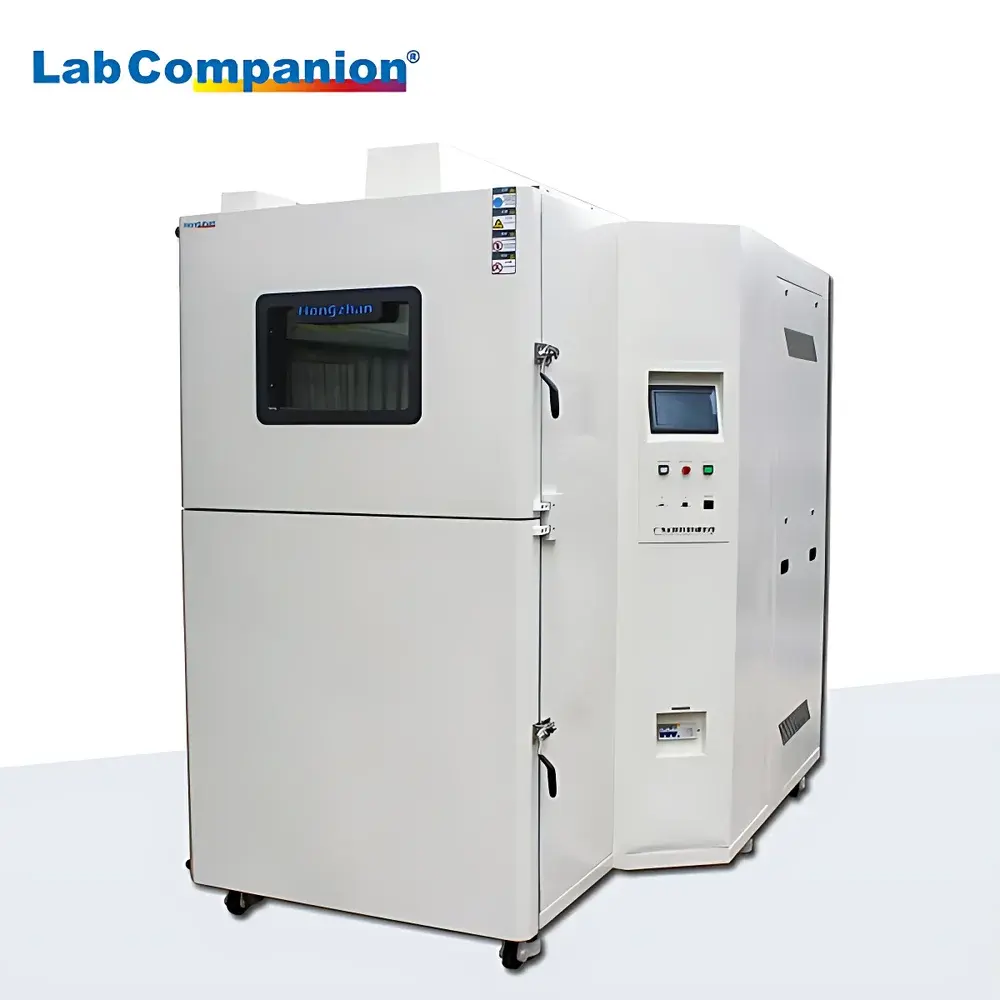
LabCompanion CTU-180A Thermal Shock Test Chamber
| Brand | LabCompanion |
|---|---|
| Model | CTU-180A |
| Origin | Guangdong, China |
| Manufacturer Type | Direct Manufacturer |
| High-Temperature Range | +60 °C to +200 °C |
| Low-Temperature Range | 0 °C to −70 °C |
| Thermal Shock Range | −55 °C to +150 °C |
| Temperature Stability | ±2 °C |
| Heating Rate | R.T. → +200 °C in ~40 min |
| Cooling Rate | R.T. → −70 °C in ~60 min |
| Transfer Time | ≤5 s |
| Temperature Recovery Time | ≤5 min |
| Internal Dimensions (W×H×D) | 600×660×450 mm |
| External Dimensions (W×H×D) | 2920×1100×2150 mm |
| Construction | Cold-Rolled Steel Outer Shell w/ Ivory White Powder Coating |
| Inner Chamber | #304 Mirror-Finish Stainless Steel (1.2 mm) |
| Insulation | Eco-Friendly Glass Fiber (Non-Hazardous Waste Class) |
| Refrigeration | Air-Cooled or Water-Cooled (Optional) |
| Compressor | Imported Scroll Compressor |
| Temperature Sensor | Armored Pt100 RTD |
| Controller | Siemens PLC + Embedded PlatinumV1.0 Control Software |
| Display | 7″ Color TFT Touchscreen Interface |
| Data Storage | USB Port (CSV Format, Non-Hot-Swappable) |
| Communication | RJ45 Ethernet (TCP/IP, Supports Up to 5 Concurrent Clients |
| Power Supply | AC 380 V, 50 Hz, 3-Phase + PE |
| Installed Capacity | 36 kVA |
| Compliance | GJB 150.3–150.5, GB/T 2423.1–2423.2 |
Overview
The LabCompanion CTU-180A Thermal Shock Test Chamber is an industrial-grade, dual-zone horizontal thermal shock system engineered for rapid, repeatable evaluation of material and component reliability under extreme temperature transitions. It operates on the principle of mechanical basket transfer between physically isolated high-temperature and low-temperature chambers—eliminating cross-contamination and enabling precise, independent control of each zone’s thermal environment. Unlike single-chamber ramp-based systems, this design ensures true step-change exposure with minimal thermal inertia, making it suitable for qualification testing per military, aerospace, and automotive standards where thermal cycling integrity directly correlates with field failure modes such as solder joint fatigue, delamination, seal leakage, and coefficient-of-thermal-expansion (CTE) mismatch.
Key Features
- Horizontal three-compartment architecture: Separate high-temp chamber (+60 °C to +200 °C), low-temp chamber (0 °C to −70 °C), and insulated transfer zone—optimized for uniformity and minimized thermal overshoot during transitions.
- High-speed pneumatic basket actuator with ≤5-second transfer time and ≤5-minute temperature recovery, meeting stringent requirements of GJB 150.5A (MIL-STD-810G Method 503.5) for thermal shock dwell and transition phases.
- Siemens S7-1200 PLC core with proprietary PlatinumV1.0 embedded firmware—providing deterministic real-time control, configurable test profiles (up to 99 segments), and built-in alarm logic for over-temperature, refrigerant pressure loss, and door interlock violations.
- Armored Pt100 RTD sensors mounted at chamber center and corners, calibrated to ±0.3 °C accuracy traceable to NIST-equivalent national metrology institutes; temperature uniformity maintained within ±2 °C across full working volume (per GB/T 5170.2–2017).
- Dual cooling configuration option: Air-cooled (standard) or water-cooled (optional) using high-efficiency scroll compressors from internationally certified OEM suppliers—ensuring stable operation under ambient temperatures up to 35 °C and continuous duty cycles.
- 7-inch resistive touchscreen HMI with multi-language support (English, Chinese, Korean, Russian), intuitive drag-and-drop profile editor, and real-time graphical overlay of setpoint vs. measured values.
Sample Compatibility & Compliance
The CTU-180A accommodates samples up to 600 mm (W) × 660 mm (H) × 450 mm (D) internal volume, supporting printed circuit assemblies (PCBAs), electronic enclosures, automotive ECUs, optical modules, and polymer-based housings. Its stainless-steel interior and non-outgassing insulation comply with cleanroom-compatible installation protocols. The system satisfies mandatory environmental stress screening (ESS) requirements defined in GJB 150.3 (high-temperature exposure), GJB 150.4 (low-temperature exposure), and GJB 150.5 (temperature shock). It also aligns with civilian equivalents including IEC 60068-2-14 (Test Nb), GB/T 2423.1 (cold), GB/T 2423.2 (dry heat), and supports optional validation documentation packages compliant with ISO/IEC 17025 and GLP audit trails when paired with PlatinumV1.0 SCADA software.
Software & Data Management
Data acquisition and reporting are governed by PlatinumV1.0’s embedded architecture. All operational parameters—including chamber setpoints, actual temperatures, cycle count, elapsed time, and alarm events—are logged at user-configurable intervals (1–60 seconds) and stored locally in CSV format via a dedicated USB port. This interface is not hot-swappable; persistent U-disk connection is required for uninterrupted logging. For centralized monitoring, the RJ45 Ethernet port enables TCP/IP communication with Windows-based host systems running PlatinumV1.0 SCADA software—supporting up to 5 concurrent operator workstations and scalable supervision of up to 32 chambers in a single networked deployment. Audit-ready features include electronic signatures, timestamped change logs, and exportable PDF test reports with digital signature fields compatible with FDA 21 CFR Part 11–aligned validation frameworks.
Applications
- Qualification testing of avionics components per DO-160 Section 4 (Temperature Shock).
- Accelerated life testing of semiconductor packaging (e.g., QFN, BGA) to assess intermetallic growth and die attach integrity.
- Validation of adhesive bond strength in composite structures subjected to cryogenic-to-ambient transitions.
- Reliability screening of medical device enclosures prior to ISO 13485 certification.
- Material compatibility assessment for battery module housings exposed to rapid charge/discharge thermal transients.
- Failure analysis correlation studies linking lab-induced thermal shock damage to field return root causes.
FAQ
What is the maximum sample weight the CTU-180A can accommodate without compromising thermal performance?
The standard transfer basket supports loads up to 30 kg. Exceeding this limit may affect transfer dynamics and chamber recovery time; load distribution must remain symmetrical to prevent mechanical imbalance.
Does the system support programmable dwell times at intermediate temperatures?
No—the CTU-180A implements discrete two-point shock profiles only (high ↔ low). Intermediate dwell capability requires the CTS-series triple-zone configuration.
Is third-party calibration certification included with delivery?
Factory calibration data (as-built sensor offsets and chamber uniformity maps) is supplied. Full ISO/IEC 17025-accredited calibration requires separate engagement with an accredited metrology provider.
Can the controller be integrated into a plant-wide MES or SCADA infrastructure?
Yes—via Modbus TCP/IP or OPC UA (with optional PlatinumV1.0 Gateway License), enabling bidirectional data exchange with Siemens PCS7, Rockwell FactoryTalk, or custom IIoT platforms.
What maintenance intervals are recommended for the refrigeration system?
Compressor oil and filter dryer replacement every 24 months; refrigerant leak checks quarterly; condenser coil cleaning biannually (more frequently in dusty environments).



