
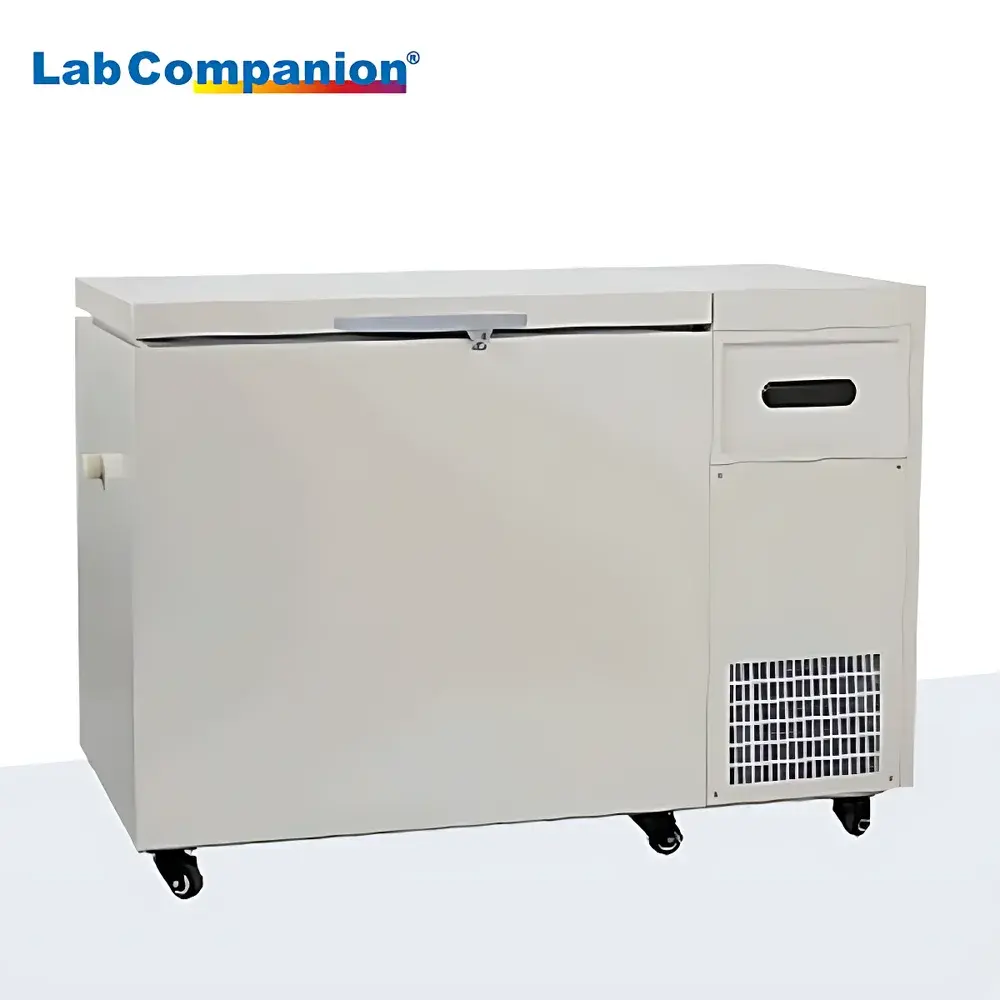
LabCompanion GFLY High-Velocity Rain Test Chamber
| Brand | LabCompanion |
|---|---|
| Origin | Guangdong, China |
| Manufacturer Type | Direct Manufacturer |
| Model | GFLY |
| Power Supply | 380 V ±10%, 50 Hz, 3-phase 4-wire + PE |
| Total Power | 24 kW |
| Interior Dimensions | 1500 × 1500 × 1600 mm (D×W×H) |
| Exterior Dimensions | 2291 × 4200 × 3411 mm (D×W×H) |
| Test Table | Ø800 mm, 1–10 rpm, Load Capacity ≥65 kg |
| Rainfall Intensity | 10–20 cm/h (adjustable) |
| Raindrop Diameter | 0.5–4.5 mm |
| Wind Speed Range | 5–18 m/s (measured at centerline of turntable inlet) |
| Water Pressure (Rain) | 80–100 kPa |
| Water Pressure (Waterjet) | ≥276 kPa |
| Temperature Range | RT+10°C to +55°C |
| Test Duration | 0–999 min (programmable, cyclic capable) |
| Compliance | GJB 150.8-1986 |
Overview
The LabCompanion GFLY High-Velocity Rain Test Chamber is an engineered environmental simulation system designed to evaluate the ingress protection (IP) performance and structural integrity of electronic enclosures, automotive components, aerospace subsystems, and industrial equipment under controlled, high-fidelity rain exposure conditions. Unlike standard drip or static spray chambers, the GFLY integrates calibrated wind-driven rainfall—simulating real-world storm dynamics—with precise thermal control, programmable rotational motion, and multi-mode water delivery (oscillating spray, vertical drip, and high-pressure waterjet). Its operational principle relies on reproducible fluid-mechanical interaction between pressurized water droplets (0.5–4.5 mm diameter), regulated air velocity (5–18 m/s), and specimen orientation (±100° oscillation or 90°/180°/270° fixed-angle swing), enabling compliance verification against military and industrial rain resistance standards—including GJB 150.8-1986, IEC 60529 (IPX3/IPX4/IPX5/IPX6), and MIL-STD-810H Method 506.6.
Key Features
- Triple-mode water delivery system: oscillating spray arm (Ø375 mm ring, Φ0.4 mm nozzles @ 50 mm spacing), adjustable-height drip plate (760 × 760 mm), and top-mounted grid of stainless-steel waterjet nozzles (≥1 nozzle per 0.56 m² at 450–500 mm standoff distance)
- High-velocity airflow integration: axial blower system delivering uniform, turbulence-controlled wind profiles (5–18 m/s) across the test zone, with flow calibration traceable to ISO 5801
- Thermally conditioned rain: integrated water heating module maintains rainwater temperature from ambient +10°C up to +55°C, critical for evaluating thermal shock effects during wet ingress testing
- Motorized rotating turntable: Ø800 mm stainless-steel platform with variable speed (1–10 rpm), load capacity ≥65 kg, and centering alignment fixture for repeatable specimen positioning
- Dual-chamber construction: interior chamber fabricated from electropolished 304 stainless steel; outer shell from cold-rolled steel with corrosion-resistant epoxy coating
- Full programmability: microprocessor-based controller supports time-based sequencing, multi-step cycles, automatic water replenishment, and real-time monitoring of pressure, temperature, and runtime
Sample Compatibility & Compliance
The GFLY accommodates specimens up to Ø700 mm × 700 mm in footprint and ≤1600 mm in height, ensuring compatibility with full-size enclosures, vehicle lighting modules, sensor housings, and UAV chassis. Its mechanical and hydraulic design satisfies the physical constraints and performance thresholds defined in GJB 150.8-1986 (Chinese military standard for rain testing), while its raindrop size distribution (0.5–4.5 mm), impact velocity profile, and water application geometry align with the metrological requirements of IEC 60529 Annex B and ISO 20653:2013 for road vehicle ingress protection. The chamber’s grounding resistance (<4 Ω) and three-phase power architecture support electromagnetic compatibility (EMC)-sensitive device testing without interference. All operational parameters—including pressure, temperature, cycle count, and duration—are logged with timestamped audit trails, supporting GLP-compliant validation documentation.
Software & Data Management
The GFLY is equipped with an embedded industrial PLC controller featuring a 7-inch capacitive touchscreen HMI. The interface supports bilingual operation (English/Chinese), intuitive parameter entry, and graphical real-time display of chamber status (water pressure, wind speed, table rotation, and elapsed time). Test programs are stored internally with versioned naming and user-access controls. Optional Ethernet connectivity enables remote monitoring via Modbus TCP or OPC UA protocols, allowing integration into centralized lab management systems (LIMS) or MES environments. Data export is supported in CSV format for post-test analysis in MATLAB, Python, or statistical process control (SPC) software. All configuration changes and test executions are recorded in a non-volatile event log compliant with FDA 21 CFR Part 11 requirements for electronic records and signatures.
Applications
- Validation of IPX3–IPX6 ratings for outdoor-rated electronics (e.g., solar inverters, EV charging stations, traffic controllers)
- Military-grade environmental qualification per GJB 150.8-1986 and MIL-STD-810H Method 506.6 (rain, wind-driven rain, and waterjet)
- Automotive component certification: headlamps, radar housings, battery enclosures, and ADAS sensor mounts
- Quality assurance for sealed industrial actuators, motor drives, and control cabinets exposed to coastal or monsoonal climates
- Research into hydrophobic coating efficacy, gasket compression set, and sealant adhesion under dynamic wetting conditions
- Accelerated aging studies combining thermal cycling (RT+10°C to +55°C) with repeated rain exposure
FAQ
What standards does the GFLY chamber comply with?
The GFLY is engineered to meet GJB 150.8-1986 and supports verification against IEC 60529 (IPX3 through IPX6), ISO 20653:2013, and MIL-STD-810H Method 506.6.
Can the chamber simulate wind-driven rain at varying angles?
Yes—the oscillating spray arm provides ±100° sweep, and fixed-angle modes (90°, 180°, 270°) are programmable to replicate oblique rainfall incidence typical of crosswinds.
Is water temperature control available during rain testing?
Yes—integrated heating maintains rainwater between ambient +10°C and +55°C, enabling thermal stress evaluation during wet exposure.
What is the maximum specimen weight the turntable can support?
The Ø800 mm stainless-steel turntable supports loads ≥65 kg with stable low-speed rotation (1–10 rpm) and concentric alignment capability.
How is water quality managed to prevent nozzle clogging?
The system includes a dual-stage filtration unit (5 µm particulate + activated carbon) upstream of all water circuits, and optional deionized water feed compatibility is available upon request.
Does the chamber support automated test reporting?
Yes—test logs include timestamps, parameter setpoints, deviations, and operator IDs, exportable as CSV files for regulatory submission or internal QA review.
Related Products



