
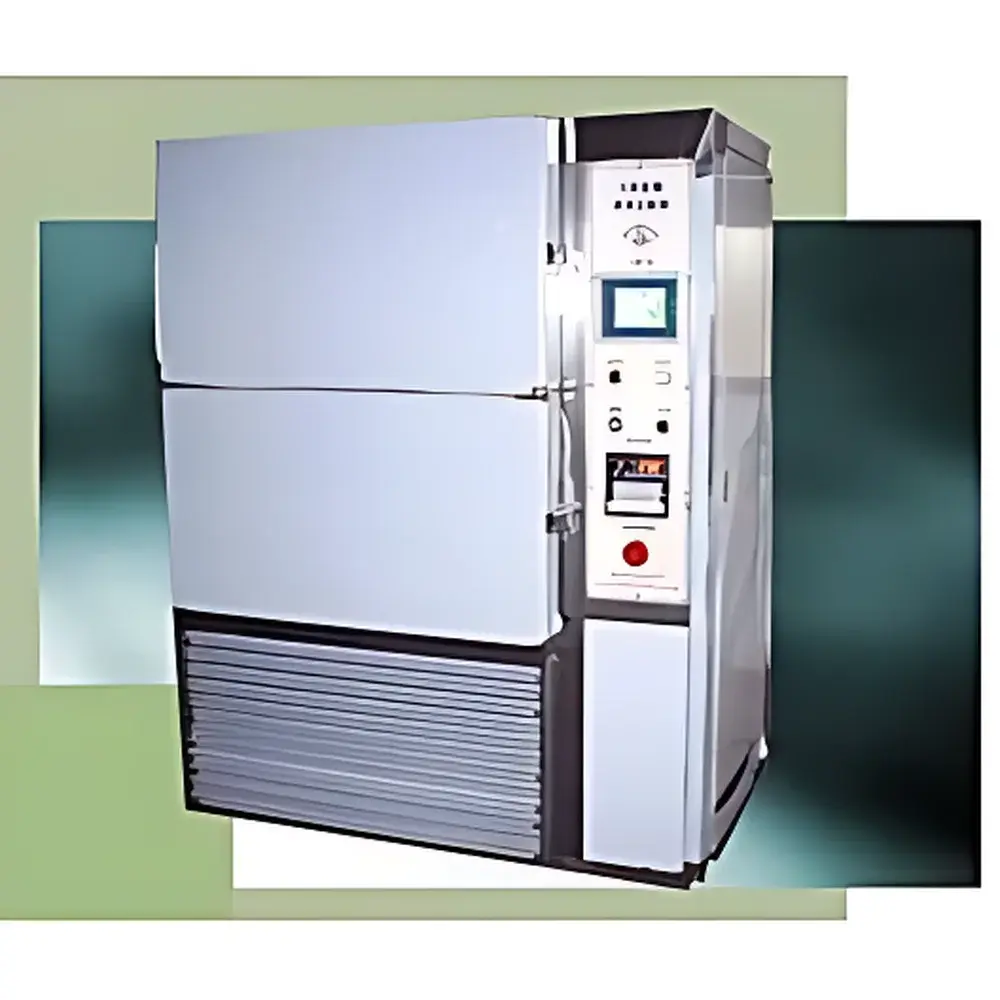
LabCompanion B-HC-3 Gas-Actuated Thermal Shock Test Chamber
| Brand | LabCompanion |
|---|---|
| Origin | Guangdong, China |
| Manufacturer Type | Direct Manufacturer |
| Model | B-HC-3 |
| Temperature Range | −70 °C to +200 °C |
| Chamber Configuration | Dual- or Tri-Zone Optional |
| Temperature Stabilization Time | ≤5 min |
| Programmable HMI Controller | 50 Preset Profiles |
Overview
The LabCompanion B-HC-3 Gas-Actuated Thermal Shock Test Chamber is an engineered solution for evaluating material reliability under rapid, repetitive transitions between extreme high and low temperatures. Based on the principle of gas-driven thermal transfer—utilizing compressed air or inert gas to isolate and rapidly shuttle test specimens between independently controlled hot and cold zones—the system delivers precise, repeatable thermal shock profiles without mechanical contact or liquid medium contamination. This architecture eliminates condensation risks associated with immersion-based systems and ensures clean, non-corrosive exposure conditions essential for electronics, aerospace components, and medical device validation. Designed for compliance-driven environments, the B-HC-3 supports deterministic thermal cycling protocols required by IEC 60068-2-14, MIL-STD-810H Method 503.6, and JESD22-A104D, enabling quantifiable assessment of failure modes induced by differential thermal expansion, interfacial delamination, solder joint fatigue, and microcrack propagation.
Key Features
- Gas-actuated dual- or tri-zone configuration with independent temperature control (−70 °C to +200 °C) for true thermal shock simulation
- Programmable Human-Machine Interface (HMI) supporting up to 50 user-defined test profiles, including multi-step ramp-soak cycles and conditional branching logic
- Temperature stabilization time ≤5 minutes after zone transfer—verified per ASTM E145 Annex A3 calibration methodology
- Automatic defrost cycle integrated into cold zone operation to maintain long-term repeatability and minimize manual maintenance intervals
- Real-time temperature data logging with timestamped records for both specimen chamber and transfer mechanism (e.g., lift table or shuttle carriage)
- Modular internal volume design: customizable test space dimensions (standard options from 49 L to 150 L) to accommodate PCB assemblies, battery modules, or automotive sensors
- Industrial-grade heating elements with PID-controlled power regulation and redundant overtemperature protection (dual-stage limit switches)
Sample Compatibility & Compliance
The B-HC-3 accommodates a broad spectrum of sample geometries and material classes—including printed circuit boards (PCBs), semiconductor packages, lithium-ion battery cells, polymer housings, and metal alloy fasteners—without requiring sample-specific fixtures. Its gas-isolated transfer mechanism prevents cross-contamination between thermal zones, satisfying cleanliness requirements for Class 1000 cleanroom-adjacent testing (ISO 14644-1). The system is configured to support audit-ready documentation workflows aligned with ISO/IEC 17025:2017 clause 7.8.2 (equipment verification), FDA 21 CFR Part 11 (electronic record integrity), and GLP-compliant thermal validation reports. Calibration traceability is maintained to NIST-traceable RTDs mounted at critical thermal nodes per ILAC-G8:2019 guidelines.
Software & Data Management
Embedded firmware enables local execution of standardized test sequences (e.g., dwell time, transition rate, cycle count) with configurable alarms for out-of-specification deviations. Exportable CSV-formatted logs include chamber setpoints, actual sensor readings (±0.3 °C accuracy), timestamp, and operational status flags. Optional Ethernet/IP connectivity allows integration into centralized lab management systems (LIMS) or MES platforms via Modbus TCP or OPC UA protocols. Audit trail functionality records all parameter modifications, user logins, and calibration events with immutable timestamps—fully compliant with FDA 21 CFR Part 11 Subpart B requirements for electronic signatures and record retention.
Applications
- Electronics qualification: SMT solder joint integrity testing per IPC-9701A and JEDEC J-STD-020E
- Aerospace component screening: Composite laminate delamination analysis under cyclic thermal stress (SAE ARP4754A)
- Automotive electronics: ECUs, ADAS sensors, and power inverters subjected to accelerated life testing per ISO 16750-4
- Battery safety evaluation: Thermal runaway initiation thresholds in Li-ion pouch and prismatic cells
- Medical device packaging validation: Seal strength degradation assessment across sterilization-compatible materials
- Research laboratories conducting fundamental studies on thermomechanical fatigue in thin-film metallization and MEMS structures
FAQ
What is the minimum achievable transition time between hot and cold zones?
Transition time depends on specimen mass and fixture thermal mass; typical values range from 10–15 seconds for standard 200 g test loads, verified using calibrated thermocouples per IEC 60068-2-14 Clause 6.2.
Does the system support custom thermal profiles beyond preloaded standards?
Yes—users may define arbitrary ramp rates (°C/min), soak durations, cycle counts, and conditional triggers (e.g., “pause if cold zone exceeds −65 °C”) via the HMI editor.
Is third-party calibration certification available?
LabCompanion provides optional factory calibration certificates traceable to national metrology institutes (NIM, China), with uncertainty budgets documented per ISO/IEC 17025 Annex A.3.
Can the B-HC-3 be integrated into an existing environmental test lab network?
Standard RS-485, Ethernet, and dry-contact I/O interfaces enable seamless integration with SCADA, LabVIEW, or Python-based automation frameworks.
What safety protections are built into the thermal shock sequence?
Hardware-enforced interlocks prevent simultaneous heater/cooler activation, while software-monitored thermal runaway detection halts operation if deviation exceeds ±3 °C from setpoint for >30 seconds.
Related Products



