
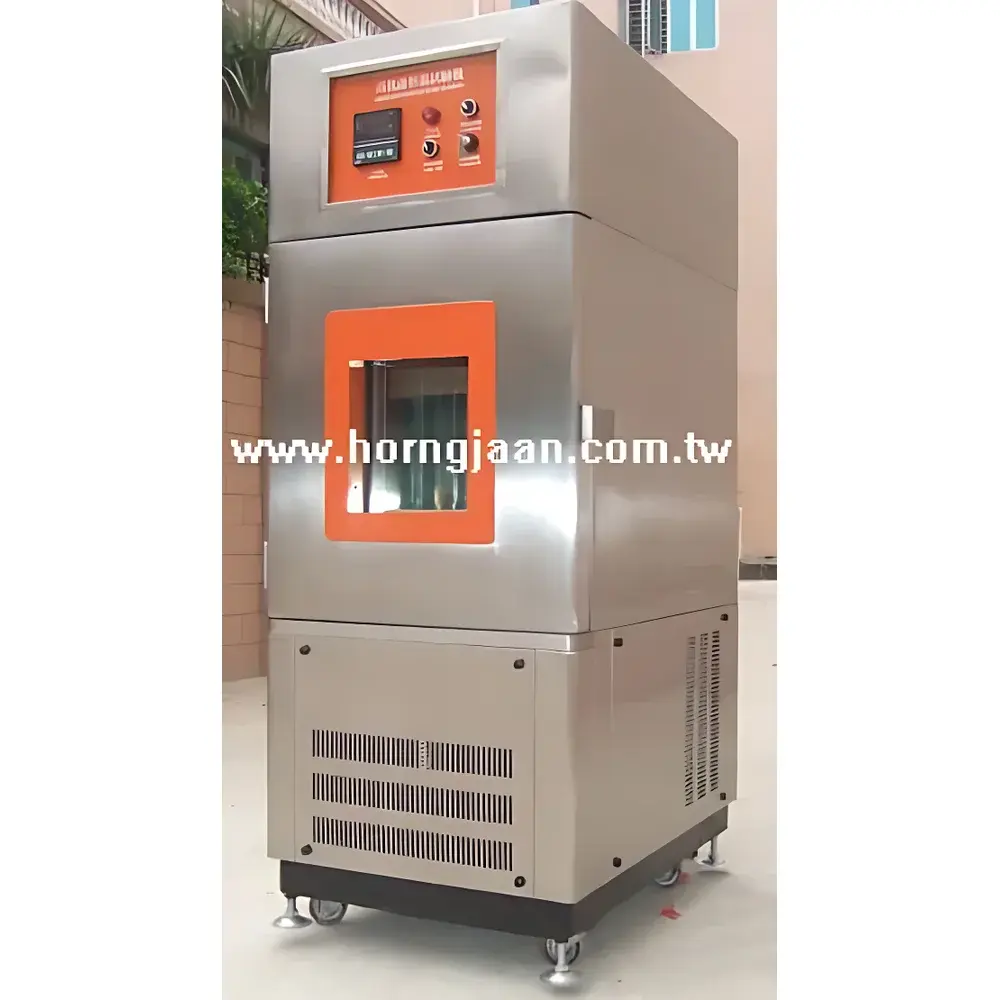
LabCompanion HC-80 High-Low Constant Temperature Chamber
| Brand | LabCompanion |
|---|---|
| Origin | Guangdong, China |
| Manufacturer Type | Direct Manufacturer |
| Product Category | Domestic |
| Model | HC Series |
| Pricing | Upon Request |
| Internal Volume | 80 L |
| Internal Dimensions (W×H×D) | 400 × 500 × 400 mm |
| Temperature Range | 0 to +150 °C |
| Temperature Uniformity | ≤ ±2.0 °C |
| Temperature Fluctuation | ±0.5 °C |
| Heating Rate | 0 → +150 °C in ≤20 min (~3 °C/min) |
| Cooling Rate | +20 → 0 °C in ≤20 min (~1 °C/min) |
| Refrigerant | R507 (HFC-based, environmentally compliant) |
| Control System | VT9620 Fixed-Value PID Controller (Taiwan-made, LED display, ±0.1 °C resolution) |
| Construction | SUS304 stainless steel interior & exterior with powder-coated finish |
| Insulation | High-density polyurethane foam + fiberglass |
| Cooling Method | Single-stage or cascade mechanical compression (air-cooled condenser) |
| Safety Protections | Independent over-temperature cutoff, low-water alarm, compressor overload/overcurrent protection, high-pressure refrigerant switch, earth-leakage circuit breaker, and thermal fuse |
Overview
The LabCompanion HC-80 High-Low Constant Temperature Chamber is an engineered environmental test system designed for precise, stable, and repeatable thermal conditioning of electronic components, optical devices, PCB assemblies, lithium-ion batteries, LCD modules, and other precision-engineered materials. It operates on the principle of forced-air convection thermoregulation, utilizing a dual-path BTHC (Balanced Thermal Heat Control) methodology that decouples heating and cooling circuits to eliminate thermal lag and ensure rapid, non-oscillatory stabilization. Unlike cycling chambers, the HC-80 is configured for constant-temperature operation—delivering sustained thermal exposure at user-defined setpoints across its full 0–+150 °C range. Its architecture conforms to fundamental thermodynamic requirements for laboratory-grade environmental simulation: uniform airflow distribution, minimized thermal gradient deviation (<±2.0 °C), and micro-fluctuation control (±0.5 °C) under no-load conditions per IEC 60068-3-5 and GB/T 10589–1989 test protocols.
Key Features
- Energy-optimized thermal management system delivering up to 30% lower power consumption and 20% reduced coolant usage versus conventional designs;
- Imported hermetic rotary compressors (EU/US-sourced) integrated with FastAIT intelligent refrigerant flow regulation for adaptive cooling load matching;
- SUS304 stainless steel chamber interior and structural frame with electrostatic powder coating on external panels—ensuring corrosion resistance and long-term dimensional stability;
- Dual independent air circulation paths with centrifugal blower and optimized duct geometry to eliminate dead zones and maintain spatial temperature uniformity;
- VT9620 fixed-value PID controller (Taiwan-manufactured) featuring LED display, ±0.1 °C setpoint resolution, auto-tuning capability, and selectable forward/reverse control action;
- Multi-layer safety architecture including independent over-temperature cutoff, refrigerant high-pressure interlock, water-level monitoring, motor overcurrent detection, and Class I earth-leakage protection;
- BTHC (Balanced Thermal Heat Control) thermal regulation—enabling simultaneous yet isolated modulation of resistive heating and vapor-compression cooling for zero-crossing overshoot and sub-minute recovery after door opening;
- Front-access water reservoir with submersible pump and sealed fill port—designed for ISO 17025-compliant lab workflows requiring minimal maintenance interruption.
Sample Compatibility & Compliance
The HC-80 accommodates standard industrial samples up to 400 mm (W) × 500 mm (H) × 400 mm (D), with two adjustable SUS304 shelves included as standard. A 50 mm diameter cable port (with blanking plug) permits external sensor integration or powered device-under-test (DUT) operation without compromising chamber integrity. The chamber meets mandatory performance criteria defined in GB/T 10592–1989 (General Specifications for Environmental Test Chambers), GB/T 2423.1–1989 (Cold Testing, Method Aa/Ab), and MIL-STD-810D Method 502.2 (Low Temperature Storage). While not certified to UL 1249 or IEC 61000-4-2 by default, its construction and control architecture support validation under GLP/GMP environments when operated within specified ambient conditions (+5 to +30 °C) and supplied with stable AC power (220 V ±10%, 50 Hz or 380 V ±10%, 50 Hz).
Software & Data Management
The HC-80 operates in fixed-value mode only; no embedded data logging or PC interface is provided in base configuration. However, optional RS-485 or Ethernet communication modules (available upon request) enable integration with third-party SCADA systems or centralized lab monitoring platforms compliant with IEEE 1451.2 or Modbus RTU standards. When paired with LabCompanion’s optional programmable controller upgrade, the unit supports time-stamped event logging—including door-open duration, temperature deviation alarms, and compressor runtime—with audit-trail functionality aligned with FDA 21 CFR Part 11 requirements for electronic records. All firmware updates are performed via secure USB interface with cryptographic signature verification.
Applications
This chamber serves critical roles in pre-compliance reliability screening for electronics manufacturing, particularly for thermal stress evaluation of fiber-optic transceivers, SMT-assembled PCBs, and solid-state battery cells prior to accelerated life testing. It is routinely deployed in QC laboratories for shelf-life validation of medical-grade sensors, calibration drift assessment of MEMS accelerometers, and qualification of automotive infotainment displays under extreme ambient storage conditions. In academic research, the HC-80 supports material science studies involving polymer crystallization kinetics, thin-film adhesion testing under thermal soak, and low-outgassing characterization of space-grade encapsulants per ECSS-Q-ST-70-02C.
FAQ
Is the HC-80 suitable for thermal cycling applications?
No—the HC-80 is specifically engineered for constant-temperature exposure. For programmable ramp-hold-cycling profiles, consider LabCompanion’s TC-series thermal shock chambers.
What is the maximum allowable ambient temperature for continuous operation?
The unit must be installed in environments maintained between +5 °C and +30 °C; operation outside this range may impair refrigerant efficiency and trigger safety shutdowns.
Can the chamber be validated for ISO/IEC 17025 accreditation?
Yes—its mechanical design, sensor traceability (via optional PT100 probe calibration certificate), and documented uncertainty budget support third-party validation per ILAC-G8:2019 guidelines.
Does the standard configuration include data recording capability?
No—data logging requires the optional communication module and external software platform; internal memory is limited to alarm history and runtime counters.
What refrigerant is used, and is it compliant with current environmental regulations?
R507—azeotropic HFC blend with zero ozone depletion potential (ODP = 0) and GWP of 3985—is approved under EU F-Gas Regulation (EC) No 517/2014 and EPA SNAP Program for laboratory use.



