
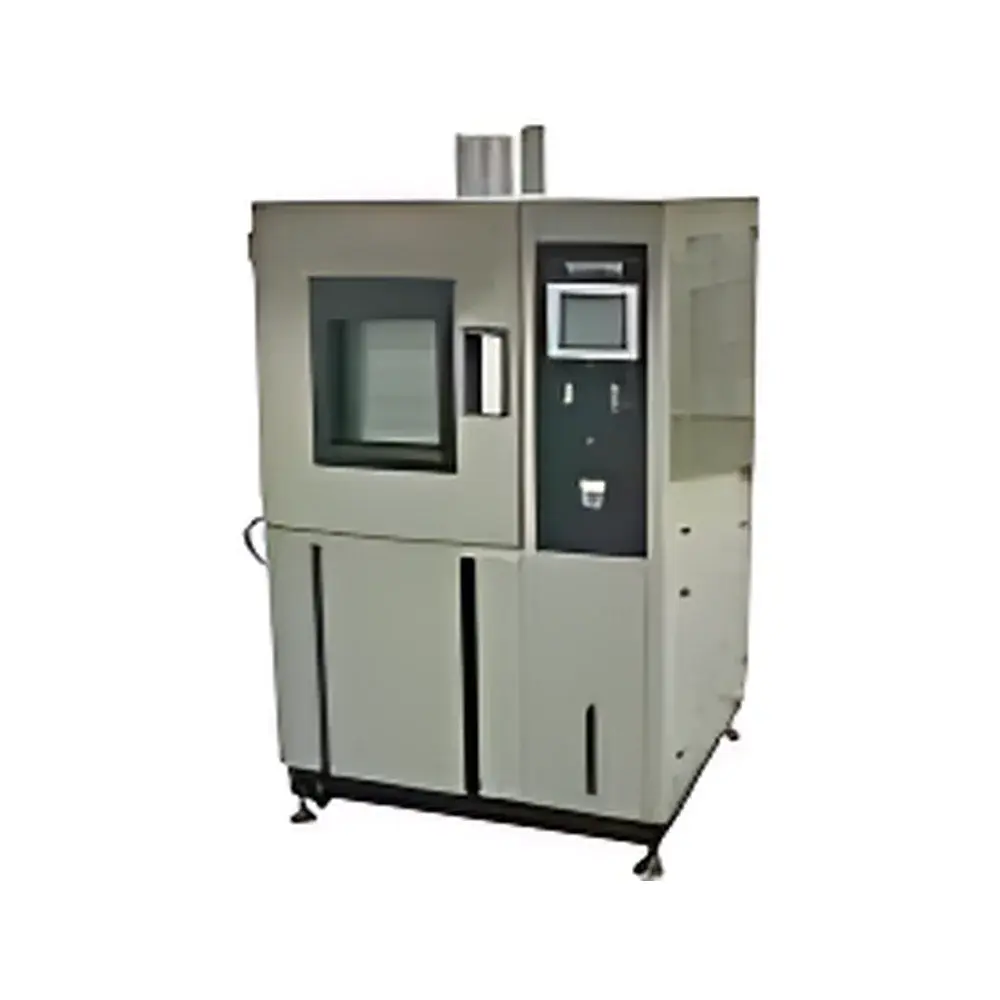
LabCompanion HP-150 Environmental Stress Screening Chamber (Temperature & Humidity Cycling Test Chamber)
| Brand | LabCompanion |
|---|---|
| Model | HP-150 |
| Temperature Range | -70°C to +150°C (selectable variants: -20°C, -40°C min) |
| Humidity Range | 20–98% RH |
| Temp. Uniformity | ±2°C |
| Temp. Stability | ±0.5°C |
| Humidity Stability | ±1% RH |
| Heating Rate | -70°C → +150°C ≤ 90 min |
| Cooling Rate | +20°C → -70°C ≤ 80 min |
| Controller | OYO (Japan) or TEMI (Korea) Touchscreen HMI |
| Refrigeration | Hermetic Twin-Screw Compressor (Tecumseh/Tecumseh-type), Eco-friendly Refrigerant R404A/R23 Cascade System |
| Insulation | Rigid Polyurethane Foam + Glass Wool |
| Interior Material | Mirror-Finish SUS304 Stainless Steel |
| Exterior Material | Powder-Coated Steel or SS304 |
| Power Supply | 3φ5W 380VAC ±10% or 2φ3W 220VAC ±10% |
Overview
The LabCompanion HP-150 Environmental Stress Screening Chamber is a precision-engineered temperature and humidity cycling test system designed for accelerated reliability validation of electronic components, automotive modules, aerospace subsystems, and medical devices under rigorously controlled thermal-hygric stress profiles. It operates on the Balanced Temperature and Humidity Control (BTHC) principle—dynamically modulating refrigeration output, electric heating power, and steam-based humidification in real time to maintain setpoint accuracy without overshoot or hysteresis. Unlike static chamber designs, the HP-150 supports programmable ramp-and-soak cycles compliant with IEC 60068-2-1 (cold), IEC 60068-2-2 (dry heat), IEC 60068-2-30 (damp heat, cyclic), and MIL-STD-810H Method 502.7 and 507.6. Its dual-stage cascade refrigeration architecture enables stable operation down to -70°C while maintaining sub-1% RH resolution and ±0.5°C temperature fidelity across the full working volume.
Key Features
- Triple-range low-temperature capability: configurable minimum operating points at -20°C, -40°C, or -70°C—achieved via optimized cascade refrigeration using R404A (high stage) and R23 (low stage) eco-compliant refrigerants
- High-fidelity PT100 dry/wet-bulb sensing array with NIST-traceable calibration support, enabling real-time dew point calculation and closed-loop humidity control within ±1% RH
- Mirror-finish SUS304 stainless steel interior (electropolished finish option available) resistant to condensate corrosion and compatible with ISO 14644-1 Class 5 cleanroom protocols
- OYO 8226 or TEMI 300 touchscreen controller with 32-bit ARM Cortex-M7 core, supporting up to 999 segments per program, 100 user-defined profiles, and automatic cycle interruption/resume logic
- Integrated safety architecture: compressor discharge overtemperature lockout, high-pressure cut-off, heater dry-run protection, water-level monitoring with auto-shutdown, and independent over-temperature alarm relay (settable independently from main controller)
- Standard 50 mm diameter cable port (left-side mounted), dual adjustable sample racks with 300 mm vertical adjustability, LED interior lighting, and castor-mounted base for lab-floor mobility
Sample Compatibility & Compliance
The HP-150 accommodates samples up to 60 × 50 × 50 cm (W × D × H) internal dimensions with unrestricted airflow distribution achieved via backward-curved centrifugal blower (air velocity: 1.8–2.4 m/s at work zone). It meets structural requirements for mounting PCB assemblies, battery packs, optical sensors, and sealed enclosures with IP65-rated connectors. Regulatory alignment includes full traceability to ISO/IEC 17025 calibration procedures, compatibility with FDA 21 CFR Part 11-compliant audit trail logging (when paired with optional RS485/Modbus or Ethernet interface), and mechanical design conformity to UL 61010-1 and EN 61000-6-3 EMC standards. Optional IEC 61000-4-2 ESD shielding kits and nitrogen purge ports are available for moisture-sensitive semiconductor testing.
Software & Data Management
The embedded controller supports native data logging to internal 16 GB eMMC storage (retention: ≥12 months at 1 Hz sampling), with export via USB 2.0 to CSV or Excel-compatible formats. Optional LabCompanion DataBridge™ software (Windows/Linux) provides remote monitoring, multi-chamber synchronization, statistical process control (SPC) charting (X̄-R, Cpk), and automated report generation per ISO/IEC 17025 Annex A.2. All logged parameters—including chamber setpoints, actual values, alarm events, and compressor duty cycles—are timestamped with microsecond resolution and digitally signed to satisfy GLP/GMP electronic record integrity requirements. Firmware updates are delivered via secure HTTPS OTA protocol with SHA-256 signature verification.
Applications
- Thermal cycling qualification of automotive ECUs per AEC-Q200 Rev D, including solder joint fatigue analysis under -40°C ↔ +125°C profiles
- Damp heat aging of photovoltaic module encapsulants (IEC 61215-2 MQT10) and printed circuit board conformal coatings
- Accelerated life testing of lithium-ion battery cells under combined thermal-hygric stress (UN 38.3 T.5 compliance screening)
- Validation of hermetic seal integrity in MEMS packaging using humidity soak followed by rapid thermal shock
- Material coefficient of thermal expansion (CTE) measurement via dimensional metrology during programmed ramp sequences
- Pre-conditioning of optical components prior to laser damage threshold (LDT) testing per ISO 21254
FAQ
What is the maximum allowable ambient operating temperature for the HP-150?
The unit requires an ambient environment between +5°C and +35°C, with relative humidity not exceeding 80% RH non-condensing. Installation in unconditioned spaces necessitates supplementary HVAC capacity to manage reject heat (up to 8.2 kW at full cooling load).
Can the HP-150 perform rapid thermal transients below 10°C/min?
No. As a convection-driven BTHC chamber, its certified ramp rates are defined per IEC 60068-3-5: max 10°C/min for heating, 5°C/min for cooling—achievable only within limited sub-ranges (e.g., 25°C → 85°C). True rapid thermal cycling (< 15 sec dwell) requires dedicated TCT systems.
Is NIST-traceable calibration documentation included with shipment?
A factory calibration certificate (per ISO/IEC 17025 Clause 7.7) is provided, listing as-found/as-left readings for all PT100 sensors at three points (-40°C, 25°C, 120°C; 30%, 60%, 90% RH). Full NIST-traceable calibration with uncertainty budget requires optional on-site service.
Does the chamber support custom humidity ramp profiles (e.g., linear %RH increase during temperature soak)?
Yes. The OYO/TEMI controller supports simultaneous independent programming of temperature and humidity setpoints, enabling complex multi-segment profiles such as “soak at 85°C/85% RH for 96 h” followed by “ramp humidity to 30% RH while holding temperature constant.”
What maintenance intervals are recommended for the refrigeration system?
Compressor oil analysis and filter-drier replacement every 24 months; refrigerant leak check every 6 months; PT100 sensor verification annually. Full preventive maintenance (including evaporator coil cleaning and blower bearing inspection) is advised every 18 months under continuous operation.



