
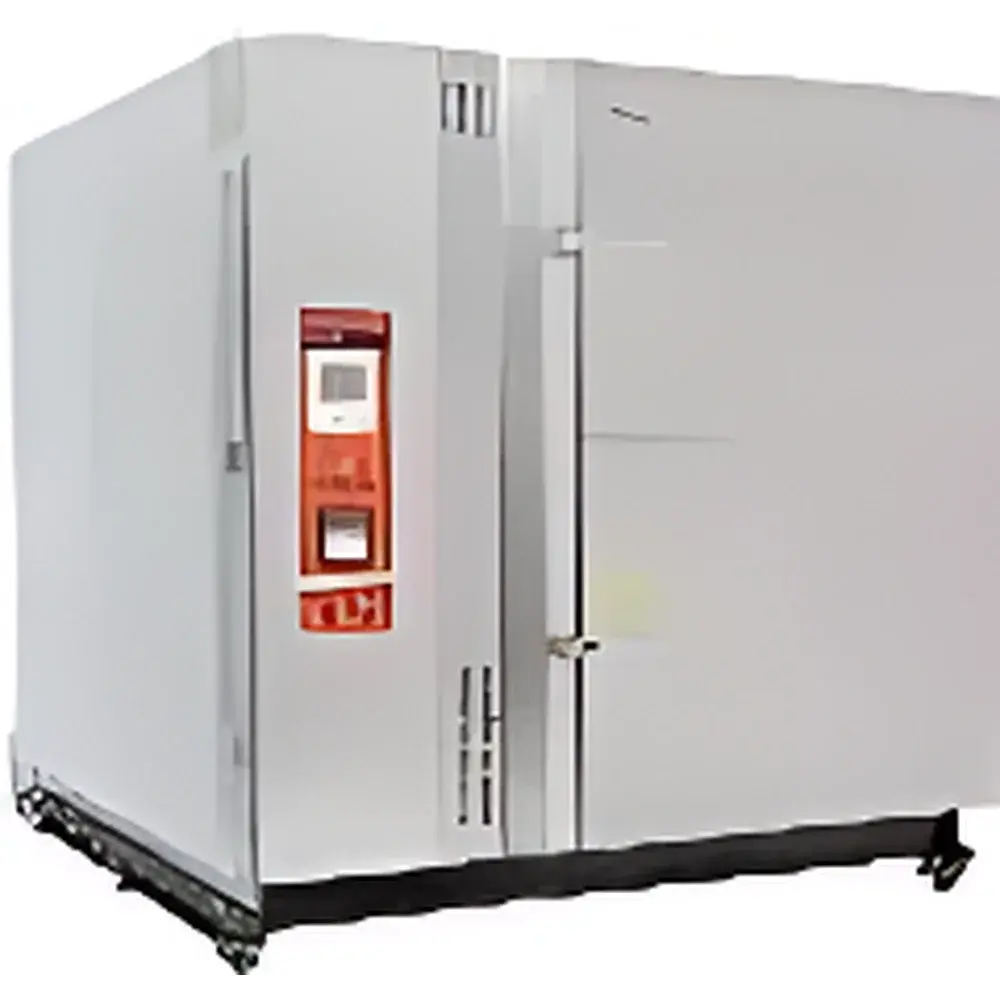
LabCompanion LCD-Specific Large-Scale Gas-Actuated Thermal Shock Test Chamber
| Brand | LabCompanion |
|---|---|
| Origin | Guangdong, China |
| Manufacturer Type | Direct Manufacturer |
| Product Category | Domestic |
| Model | LCD-Specific |
| Pricing | Available Upon Request |
Overview
The LabCompanion LCD-Specific Large-Scale Gas-Actuated Thermal Shock Test Chamber is an engineered environmental test system designed to evaluate the reliability and structural integrity of large-format liquid crystal display (LCD) modules, backlights, touch panels, and integrated display assemblies under rapid, repetitive temperature transitions. Unlike liquid-immersion or single-chamber cycling methods, this chamber employs a dual- or triple-gas-circuit architecture—utilizing high-purity, dry nitrogen or compressed air—to achieve highly controlled, contamination-free thermal transfer. The system operates on the principle of rapid gas exchange between independently conditioned hot and cold zones, enabling precise, repeatable thermal shock profiles without condensation, oxidation, or residue accumulation on sensitive optical and electronic surfaces. It is purpose-built for high-volume qualification testing in display manufacturing, R&D validation labs, and Tier-1 supplier quality assurance environments where dimensional stability, interfacial delamination resistance, and solder joint fatigue under extreme thermal gradients are critical pass/fail criteria.
Key Features
- Gas-actuated thermal transfer mechanism ensures zero liquid contact, eliminating risk of moisture ingress, corrosion, or surface fogging on polarized optical components.
- Large internal workspace (standard configurations ≥ 1000 L) accommodates full-size LCD panels up to 100″ diagonal, with customizable fixture mounting rails and inert-gas purge ports.
- Independent hot and cold zone control: typical operating ranges of +150 °C to –70 °C, with programmable transition times as fast as 10–15 seconds between extremes (subject to load mass and thermal inertia).
- Integrated dew point monitoring and automatic humidity suppression to maintain <5% RH during cold-phase dwell, preventing frost formation on TFT glass substrates.
- Robust stainless-steel construction with electrostatically shielded interior walls to minimize EMI interference during concurrent electrical functional testing.
- Compliance-ready architecture supporting configurable audit trails, user-level access control, and calibration traceability per ISO/IEC 17025 requirements.
Sample Compatibility & Compliance
This chamber is optimized for non-hermetic, multi-layer optoelectronic assemblies—including IPS, VA, and OLED hybrid modules—where differential thermal expansion across glass, ITO, polymer, and metal layers induces stress-related failure modes. Compatible sample fixtures include vacuum-suction pallets, low-outgassing silicone gaskets, and thermocouple-integrated clamping frames. The system supports test execution per ASTM D5229/D5229M (low-temperature impact), IEC 60068-2-14 (change of temperature), JIS C 60068-2-14, and MIL-STD-810H Method 503.5. Optional configuration enables GLP/GMP-aligned operation with 21 CFR Part 11-compliant electronic signatures and data integrity safeguards.
Software & Data Management
Equipped with LabCompanion’s TC-Studio v4.2 control suite, the chamber provides real-time graphical profiling, multi-channel thermocouple logging (up to 32 channels), and automated report generation in PDF/CSV formats. All test sequences—including dwell time, ramp rate, cycle count, and fault-triggered abort logic—are stored with timestamped metadata and user attribution. Raw thermal history data is exportable for post-test statistical analysis (e.g., Weibull life modeling, ΔT-induced strain correlation). Firmware updates and remote diagnostics are supported via secure TLS 1.2 Ethernet interface; local USB backup and RAID-1 redundant storage ensure data continuity during extended qualification runs.
Applications
- Qualification of LCD driver IC bonding integrity under repeated –55 °C ↔ +125 °C cycling.
- Evaluation of adhesive bondline durability between cover glass and TFT array in automotive-grade displays.
- Validation of encapsulant thermal cycling resistance in outdoor signage modules exposed to diurnal ambient swings.
- Screening for micro-crack propagation in color filter arrays following accelerated thermal shock exposure.
- Pre-shipment reliability screening for medical display systems requiring compliance with IEC 62304 software lifecycle controls.
FAQ
What distinguishes gas-actuated thermal shock from liquid-immersion methods?
Gas-based systems avoid direct contact with cryogenic liquids or heated oils, eliminating contamination risks, surface etching, and long-term material degradation—critical for optical clarity and touch sensitivity retention.
Can this chamber support custom thermal profiles required by OEM display specifications?
Yes. Up to 99 programmable steps per cycle—including variable ramp rates, asymmetric dwell times, and conditional branching based on sensor feedback—are fully configurable via TC-Studio.
Is nitrogen purging mandatory, or can compressed air be used?
Compressed air is acceptable for standard qualification; however, high-purity nitrogen (≤10 ppm H₂O, ≤1 ppm O₂) is recommended for production-level stress screening to prevent oxidation of fine-pitch copper traces.
How is temperature uniformity validated across the test volume?
Per IEC 60068-3-5, uniformity is verified using a 9-point sensor grid during SAT (System Acceptance Test), with results documented in the factory calibration certificate.
Does the system include hardware-level safety interlocks for operator protection?
Yes. Dual redundant door safety switches, over-temperature cutouts, gas pressure loss detection, and emergency thermal dump valves are integrated into the base hardware design and independently certified to UL 61010-1 and EN 61010-1 standards.



