
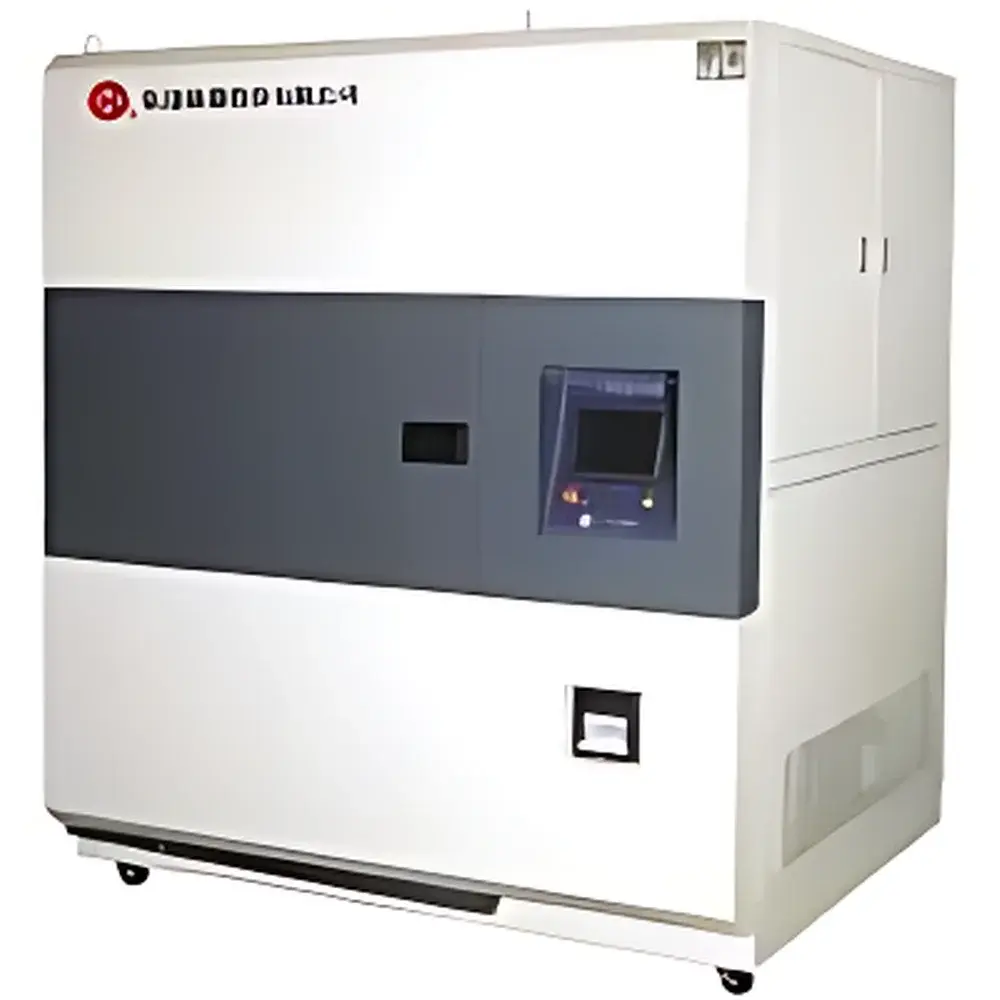
LabCompanion LTS-150-3P Programmable Three-Zone Gas-Actuated Thermal Shock Test Chamber
| Brand | LabCompanion |
|---|---|
| Origin | Guangdong, China |
| Manufacturer Type | Direct Manufacturer |
| Model | LTS-150-3P |
| Pricing | Upon Request |
Overview
The LabCompanion LTS-150-3P is a programmable, three-zone gas-actuated thermal shock test chamber engineered for high-fidelity evaluation of material and component resilience under rapid, repetitive temperature transitions. Unlike single- or dual-chamber systems, this chamber employs a fully isolated tri-compartment architecture—comprising independent high-temperature, low-temperature, and test zones—enabling precise, contamination-free thermal cycling without mechanical movement of the specimen. It operates on the principle of pneumatic air-path switching: conditioned air from pre-stabilized hot and cold reservoirs is directed into the test chamber via high-speed pneumatic dampers (switching completed in ≤10 s), achieving thermal recovery times of ≤5 minutes per shock cycle. This design eliminates thermal lag associated with direct immersion or forced convection-only methods, ensuring reproducible thermal gradients and minimizing convective artifacts during transient exposure. The system is calibrated for compliance with key international test standards including IEC 60068-2-14 (Environmental testing – Part 2-14: Tests – Test N: Change of temperature), MIL-STD-810H Method 503.6 (Temperature Shock), and JESD22-A104 (Temperature Cycling), making it suitable for qualification testing in aerospace, automotive electronics, semiconductor packaging, and medical device development.
Key Features
- Three-zone isolation architecture: Independent high-temperature zone (+80 °C to +200 °C), low-temperature zone (–75 °C to –10 °C), and static test chamber—ensuring zero specimen motion and eliminating mechanical stress artifacts.
- Gas-actuated thermal transfer: Rapid air-path switching using pneumatically controlled dampers; full hot-to-cold or cold-to-hot transition achieved within ≤10 seconds.
- Thermal recovery performance: ≤5 minutes to stabilize at target temperature (e.g., +150 °C or –60 °C) after each shock event, verified per IEC 60068-3-10 Annex A requirements.
- Advanced programmable controller: 7-inch color TFT LCD touchscreen interface with bilingual (English/Chinese) menu navigation, supporting up to 96 user-defined test profiles, cycle counts (1–999), and shock durations (up to 999 h 59 min).
- Dual-stage refrigeration system: Cascade configuration with HFC-based eco-refrigerants (R507/R23, zero ODP), utilizing imported hermetic or semi-hermetic compressors compliant with AHRI 540 standards.
- Structural integrity: Interior and exterior chambers fabricated from SUS#304 stainless steel; insulation composed of high-density glass wool and polyurethane foam (thermal conductivity ≤0.022 W/m·K at 25 °C).
- Integrated safety architecture: Comprehensive protection suite including compressor overcurrent/overheat, heater dry-run, phase failure, ground fault, overtemperature cutoff, pressure switch monitoring, and real-time fault logging with on-screen diagnostic codes.
Sample Compatibility & Compliance
The LTS-150-3P accommodates test specimens up to 10 kg and 600 × 500 × 500 mm (W×H×D) internal volume. Its static-test-zone design ensures compatibility with delicate assemblies—including bare die, wafer-level packages, MEMS sensors, PCBAs, and hermetically sealed modules—without vibration-induced damage. Standard 50 mm diameter test port (left-side mounted, sealed with silicone gasket) enables external power feedthrough, signal routing, or environmental monitoring integration. All operational parameters adhere to ISO/IEC 17025-accredited calibration traceability protocols. The system supports audit-ready documentation for GLP and GMP environments, including electronic log files with timestamped setpoints, actual chamber temperatures, alarm events, and operator actions—fully compatible with FDA 21 CFR Part 11-compliant data management platforms when interfaced via RS485/Ethernet.
Software & Data Management
The embedded controller provides native CSV export of time-stamped temperature logs (sample interval configurable from 1 s to 60 s), cycle counters, and alarm history. Optional Ethernet/IP or Modbus TCP connectivity enables integration with centralized MES/LIMS platforms (e.g., Siemens Opcenter, Thermo Fisher SampleManager). Firmware supports firmware version tracking, user role-based access control (admin/operator/viewer), and automatic backup of all program parameters to removable USB storage. Audit trails include immutable records of parameter changes, manual overrides, and emergency stops—retained for ≥36 months per internal retention policy. No proprietary cloud dependency; all data remains on-device unless explicitly exported.
Applications
- Semiconductor reliability: Qualification of flip-chip interconnects, solder joint fatigue, and die-attach delamination per JEDEC JESD22-A104 and A106.
- Automotive electronics: Validation of ADAS ECUs, battery management systems (BMS), and power inverters against thermal cycling-induced solder cracking and conformal coating adhesion loss.
- Aerospace components: Testing of avionics enclosures, optical sensor housings, and composite structural joints per RTCA DO-160 Section 24 (Temperature Variation) and MIL-STD-810H Method 503.6.
- Medical devices: Accelerated aging of implant-grade polymers (e.g., PEEK, PEKK), sterilization-packaging integrity, and sensor drift characterization under cyclic thermal load.
- Research & development: Fundamental studies of coefficient of thermal expansion (CTE) mismatch, interfacial fracture mechanics, and phase-change behavior in advanced ceramics and metal-matrix composites.
FAQ
What is the difference between two-zone and three-zone thermal shock testing?
A three-zone system isolates the test specimen statically while pre-conditioning hot and cold reservoirs independently—eliminating thermal mass interference and enabling faster, more repeatable transitions than two-zone (moving-basket) designs.
Does the LTS-150-3P support automated test sequencing across multiple temperature profiles?
Yes. Up to 96 distinct programs can be stored and executed sequentially or conditionally (e.g., “run Profile A → wait 30 min → run Profile B”) without manual intervention.
Can the chamber be integrated into a factory automation network?
Standard RS485 Modbus RTU and optional Ethernet/IP interfaces enable seamless integration with PLCs, SCADA, and MES systems for remote start/stop, real-time monitoring, and alarm forwarding.
Is the refrigeration system serviceable on-site by certified technicians?
Yes. The cascade refrigeration circuit uses industry-standard fittings and pressure ports; service manuals, spare parts lists, and OEM-certified technician training are available directly from LabCompanion’s global support network.
How is calibration traceability maintained for regulatory submissions?
Each unit ships with a NIST-traceable calibration certificate covering temperature uniformity (±1.5 °C), stability (±0.5 °C), and transition rate verification—valid for 12 months under normal operation.



