
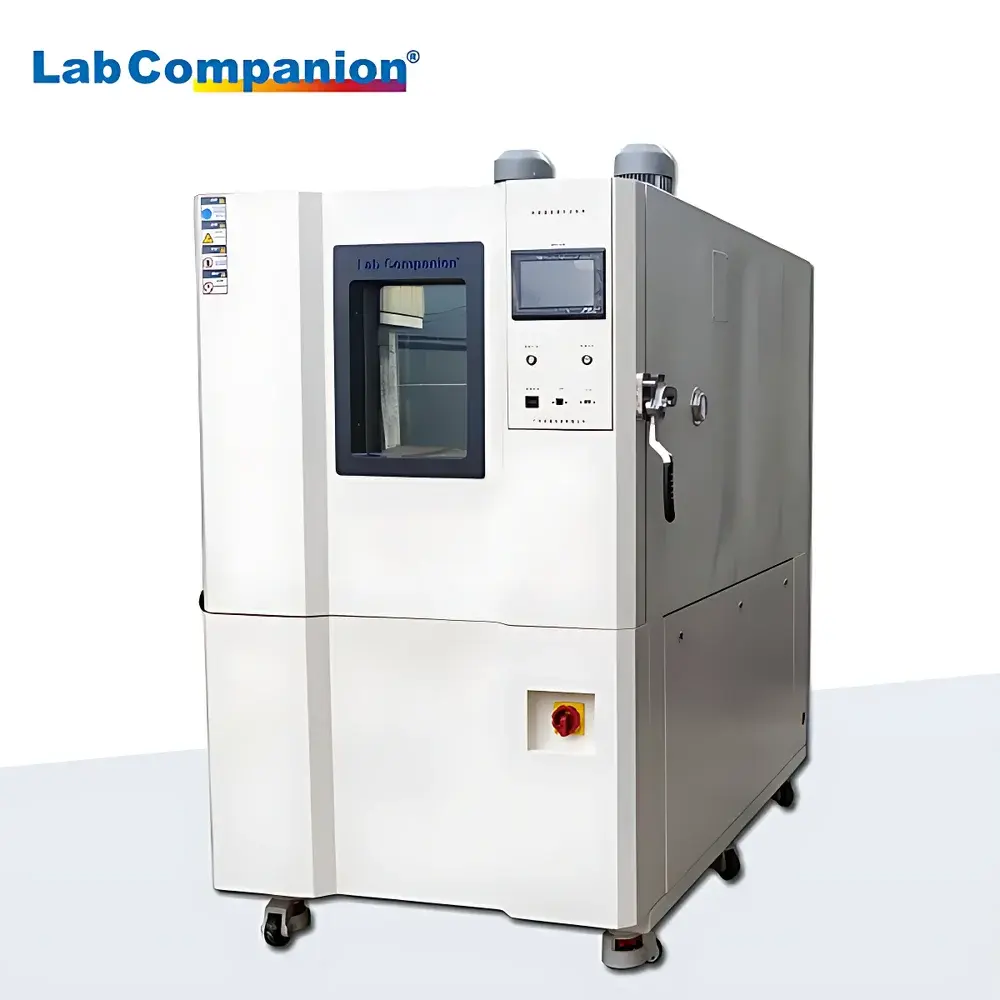
LabCompanion Model 302A Temperature & Humidity Environmental Test Chamber
| Brand | LabCompanion |
|---|---|
| Origin | Guangdong, China |
| Manufacturer Type | Direct Manufacturer |
| Model | 302A |
| Temperature Range | +10°C to +70°C (above ambient) |
| Temperature Uniformity | ≤ ±1°C |
| Humidity Range | 50–95% RH (dependent on temperature |
| Humidity Accuracy | +2 / −3 %RH |
| Humidification Method | Spray-type water atomization |
| Heating Power | 2.3 kW |
| Voltage | 220 V, 50 Hz |
| Internal Chamber Dimensions (W×D×H) | 500 × 400 × 500 mm |
| External Dimensions (W×D×H) | 900 × 570 × 1510 mm |
| Net Weight | 170 kg |
| Chamber Construction | Stainless steel interior, powder-coated mild steel exterior |
| Safety Features | Overcurrent protection, operational status indicators for heating, humidification, and water tank heating |
Overview
The LabCompanion Model 302A Temperature & Humidity Environmental Test Chamber is a purpose-built, benchtop-scale climatic chamber engineered for controlled exposure testing of small electronic components, precision instruments, polymer materials, and passive electrical elements under defined thermal and hygrothermal stress conditions. It operates on the principle of forced-air convection combined with spray-based humidification and resistive heating, enabling stable maintenance of user-specified temperature–humidity setpoints across its operational envelope. Designed for laboratory and quality assurance environments where reproducibility and long-term stability are critical—such as in pre-compliance screening, accelerated aging studies, and material stability qualification—the Model 302A delivers consistent environmental profiles compliant with fundamental requirements of IEC 60068-2-30 (damp heat, cyclic), IEC 60068-2-78 (damp heat, steady state), and ASTM D4332 (conditioning of plastics and electrical insulating materials). Its architecture prioritizes mechanical robustness, operator safety, and ease of integration into routine test workflows without requiring external plumbing or compressed air.
Key Features
- Stainless steel inner chamber construction ensures long-term corrosion resistance against repeated condensation cycles and chemical vapor exposure typical in high-humidity operation.
- Spray-type humidification system provides rapid humidity response and uniform moisture distribution without reliance on steam generators or ultrasonic misters—minimizing mineral deposit accumulation and reducing maintenance frequency.
- Dual independent control via mercury contact thermometers and hygrometers offers deterministic, analog-based regulation with high repeatability and immunity to electromagnetic interference—a design choice aligned with legacy industrial QA labs requiring traceable, non-software-dependent setpoint execution.
- Integrated visual status indicators clearly identify active states of main heating elements, humidifier circuitry, and water tank heater—supporting real-time operational verification and preventive maintenance scheduling.
- Overcurrent protection circuitry safeguards internal power distribution against load surges during startup or fault conditions, complying with IEC 61000-4-5 surge immunity guidelines for Class B equipment.
- Powder-coated carbon steel outer enclosure provides mechanical durability and aesthetic consistency suitable for shared laboratory spaces and ISO/IEC 17025-accredited testing facilities.
Sample Compatibility & Compliance
The Model 302A accommodates samples up to 400 mm (W) × 300 mm (D) × 400 mm (H) within its 500 L working volume. Its chamber geometry and airflow pattern support uniform thermal–hygric exposure across vertically stacked or horizontally arranged specimens—making it suitable for evaluating solder joint integrity, conformal coating performance, PCB delamination susceptibility, and elastomer compression set behavior. The unit meets structural and functional safety requirements outlined in GB/T 10586 (Chinese national standard for environmental test chambers) and aligns with essential clauses of EN 60068-1 (Environmental testing – Part 1: General and definitions). While not certified to UL 61010-1 or CE marking by default, its electrical architecture and protective measures satisfy baseline risk mitigation expectations for Class II laboratory equipment used under supervised conditions.
Software & Data Management
The Model 302A operates as a standalone analog-controlled instrument with no embedded microprocessor or digital interface. All parameter setting and monitoring occur manually via front-panel dials and analog readouts. This architecture eliminates software validation overhead and supports regulatory environments where audit trails must be maintained externally—e.g., GLP-compliant laboratories documenting test conditions via handwritten logs or synchronized external data loggers (e.g., Omega OM-DAQPRO-5300 series). Optional third-party USB or RS-485 adapters may be integrated for analog voltage output logging (0–5 V DC proportional to chamber temperature/humidity), enabling traceable digital recordkeeping compatible with FDA 21 CFR Part 11–compliant systems when paired with validated acquisition software.
Applications
- Accelerated aging of polymeric enclosures, gaskets, and adhesive bonds under elevated temperature–humidity combinations.
- Pre-screening of printed circuit assemblies for moisture-induced failure modes including electrochemical migration and tin whisker initiation.
- Conditioning of reference standards and calibration artifacts prior to dimensional or electrical metrology.
- Stability assessment of pharmaceutical packaging materials per ICH Q1A(R2) guidance on accelerated testing conditions.
- Qualification of sensor housings and optical window materials for outdoor deployment in tropical climates.
- Supporting ASTM D1708 (tensile properties of plastic bars) and ISO 291 (standard atmospheres for conditioning and testing) preconditioning protocols.
FAQ
Does the Model 302A support programmable ramp-and-soak profiles?
No. It is an analog-setpoint chamber designed for static condition maintenance only. For dynamic profile testing, consider the LabCompanion TH-4000 series.
Is distilled water required for the spray humidifier?
Yes. Use deionized or distilled water to prevent scaling and nozzle clogging. Tap water is not recommended.
Can the chamber operate continuously at 70°C and 95% RH?
No. At 70°C, maximum achievable humidity is 50–95% RH depending on ambient dew point; 95% RH is only attainable at temperatures ≤30°C.
What is the recommended calibration interval for temperature and humidity sensors?
Annual calibration against NIST-traceable references is advised for ISO/IEC 17025 compliance; quarterly verification using portable calibrated hygrometers is recommended for routine QA use.
Is external ventilation required for safe operation?
Not mandatory, but adequate room-level air exchange (≥3 air changes/hour) is recommended to manage heat dissipation and maintain ambient stability around the unit.



