
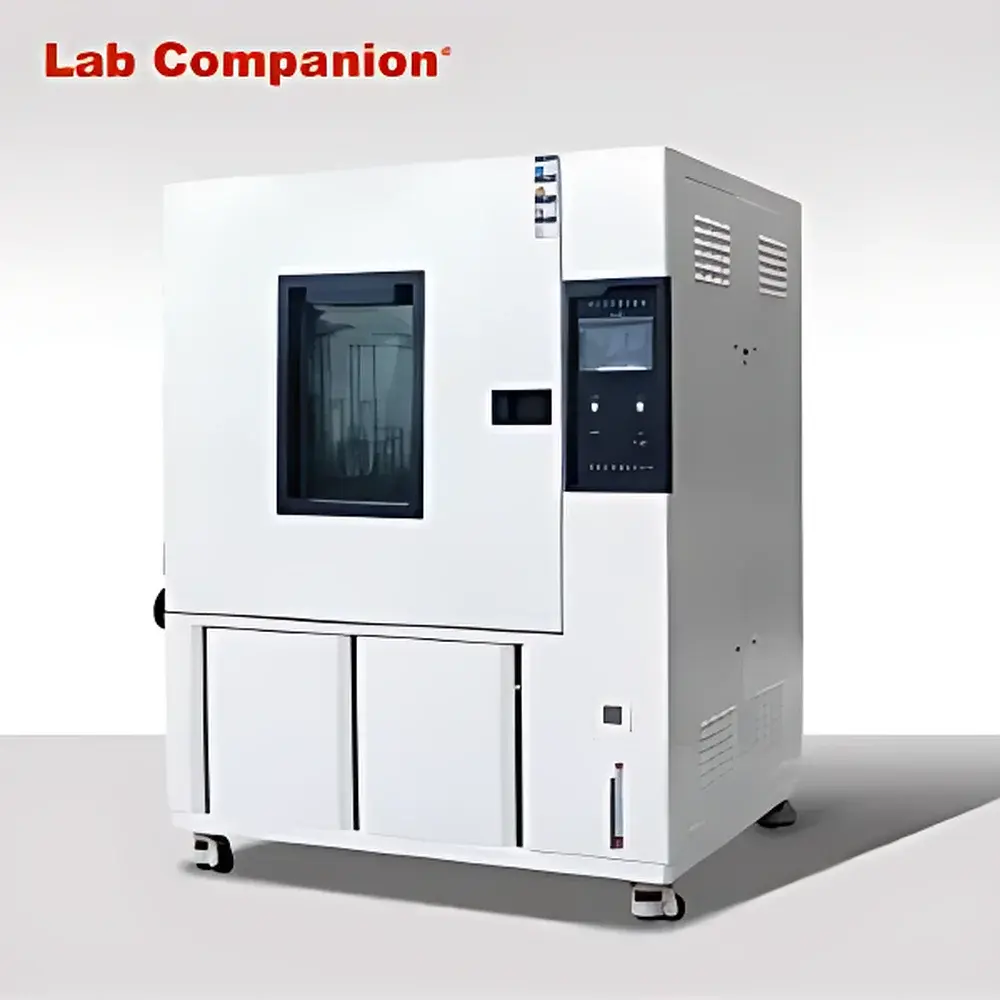
LabCompanion PH-800 High-Low Temperature Environmental Test Chamber
| Brand | LabCompanion |
|---|---|
| Origin | Guangdong, China |
| Manufacturer Type | Direct Manufacturer |
| Country of Origin | China |
| Model | PH-800 |
| Price Range | USD 0–7,200 (FOB) |
| Temperature Range | 0°C to +150°C |
| Cooling Method | Compressor-based Refrigeration |
| Explosion-Proof Design | Standard (Non-Explosion-Proof) |
| Temperature Fluctuation | ±0.5°C |
| Temperature Deviation | ±2.0°C |
| Temperature Uniformity | ±2.0°C |
| Heating Rate | 1.0–3.0°C/min |
| Cooling Rate | 1.2°C/min |
| Internal Chamber Dimensions (W×D×H) | 1000 × 1000 × 800 mm |
Overview
The LabCompanion PH-800 is a precision-engineered high-low temperature environmental test chamber designed for controlled thermal stress evaluation of materials, components, and finished products under standardized laboratory and industrial quality assurance conditions. Based on forced-air convection architecture with dual independent heating and refrigeration circuits, the PH-800 delivers stable, repeatable thermal profiles across its full operating range of 0°C to +150°C. Its chamber construction features high-density polyurethane insulation (≥100 mm thickness), stainless steel 304 interior walls, and a double-glazed observation window with anti-fog heating—ensuring long-term structural integrity and minimal thermal leakage. The system complies with core thermal testing requirements outlined in IEC 60068-2-1 (Cold), IEC 60068-2-2 (Dry Heat), and ASTM D3418 for thermal transition characterization of polymers. It is widely deployed in QC labs for pre-shipment validation, accelerated aging studies, and thermal cycling protocols per MIL-STD-810G Method 502.5.
Key Features
- Robust dual-system thermal control: Independent PID-regulated electric heating elements and a hermetic scroll compressor with R404A refrigerant ensure precise ramp-and-soak performance.
- High-stability air circulation: Triple-blade axial fan with adjustable speed and rear-mounted baffle design guarantees uniform airflow distribution—validated by internal thermocouple mapping per ISO 17025 calibration procedures.
- Real-time monitoring interface: 7-inch TFT-LCD touchscreen controller with embedded data logging (up to 10,000 data points), USB export capability, and configurable alarm thresholds for temperature deviation, door open, and over-temperature events.
- Structural reliability: 2.0 mm cold-rolled steel outer shell with epoxy-polyester powder coating; chamber floor rated for static load up to 150 kg; optional casters with locking mechanism for lab mobility.
- Compliance-ready architecture: Controller firmware supports audit trail generation, user-level access control (admin/operator/guest), and timestamped event logs—facilitating alignment with GLP and ISO/IEC 17025 documentation requirements.
Sample Compatibility & Compliance
The PH-800 accommodates samples up to 1000 mm (W) × 1000 mm (D) × 800 mm (H), with standard 4-layer stainless steel shelving (load capacity: 25 kg per shelf). It supports non-hazardous solid, semi-solid, and packaged specimens—including PCB assemblies, automotive gaskets, medical device housings, and polymer films. While classified as a standard (non-explosion-proof) chamber, it meets CE marking requirements under the EU Machinery Directive 2006/42/EC and Electromagnetic Compatibility Directive 2014/30/EU. Optional upgrades include RS-485 Modbus RTU output for integration into centralized facility monitoring systems (e.g., Siemens Desigo, Schneider EcoStruxure), and third-party IQ/OQ documentation packages aligned with FDA 21 CFR Part 11 expectations for electronic records.
Software & Data Management
The integrated controller runs proprietary LabCompanion TC-OS v3.2 firmware, supporting up to 99 programmable test segments with ramp/soak/hold logic, cycle repetition, and automatic profile recall. Data is stored internally with microSD backup option and exportable in CSV format via USB 2.0 port. For enterprise environments, optional LabCompanion ChamberLink™ PC software enables remote supervision, multi-chamber synchronization, real-time graphing, and automated report generation (PDF/Excel) compliant with internal QA templates. All logged parameters—including chamber setpoint, actual temperature (6-point average), elapsed time, and alarm status—are time-stamped with millisecond resolution and retain integrity during power interruption via non-volatile memory.
Applications
- Thermal endurance validation of lithium-ion battery modules per UN 38.3 Section 4.3 (high-temperature storage at +75°C).
- Dimensional stability testing of injection-molded thermoplastics under ISO 293 and ASTM D696 protocols.
- Accelerated life testing of adhesives and sealants using temperature cycling between –10°C and +85°C.
- Pre-conditioning of optical sensors and MEMS devices prior to functional electrical testing.
- Stability assessment of pharmaceutical packaging materials per USP under controlled humidity-optional configurations (when paired with external humidifier).
FAQ
What is the maximum sample weight the PH-800 can accommodate without compromising temperature uniformity?
The chamber maintains specified uniformity (±2.0°C) with total loaded mass ≤120 kg distributed evenly across shelves. Exceeding this may reduce airflow efficiency and increase settling time.
Does the PH-800 support custom temperature ramp profiles with variable rates?
Yes—users can define up to 99-step programs with independent ramp rates (0.1–10.0°C/min) and soak durations (0–999 hours), limited only by the physical heating/cooling capabilities (1.0–3.0°C/min and 1.2°C/min respectively).
Is NIST-traceable calibration documentation available?
Factory calibration certificates (with uncertainty values per ISO/IEC 17025) are provided. Optional on-site verification and annual recalibration services are available through authorized LabCompanion service partners in North America, EMEA, and APAC regions.
Can the PH-800 be integrated into a LIMS or MES platform?
Via optional RS-485 Modbus RTU or Ethernet TCP/IP interface (with LabCompanion Gateway Module), enabling bidirectional communication for setpoint updates, status polling, and alarm forwarding.
What maintenance intervals are recommended for optimal long-term performance?
Compressor oil and refrigerant levels should be verified annually; air intake filters require cleaning every 3 months; chamber door gasket integrity and heater continuity checks are advised semi-annually per preventive maintenance checklist included in the operator manual.



