
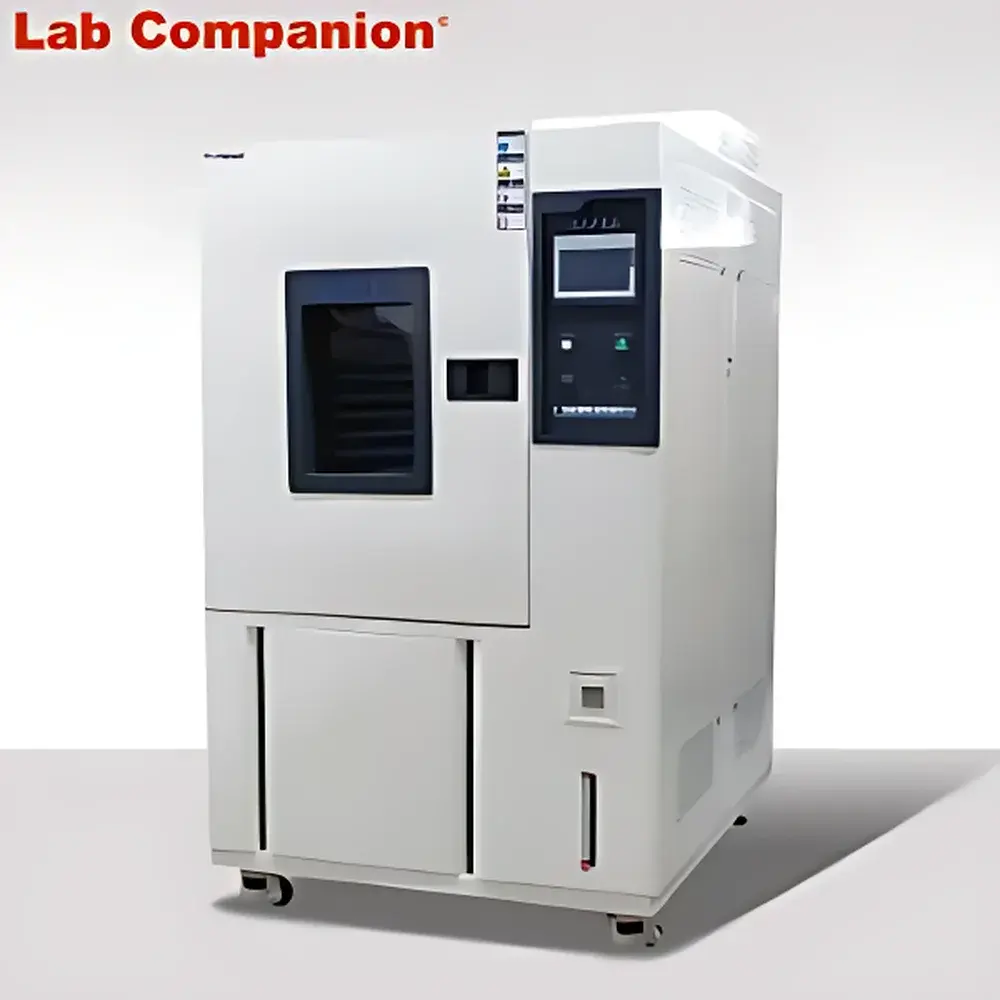
LabCompanion PR-15020 High-Low Temperature Test Chamber
| Brand | LabCompanion |
|---|---|
| Origin | Guangdong, China |
| Manufacturer Type | Direct Manufacturer |
| Country of Origin | China |
| Model | PR-15020 |
| Price Range | USD 4,200 – 7,000 (FOB Guangdong) |
| Temperature Range | -20 °C to +150 °C |
| Refrigeration Method | Mechanical Compression Cooling |
| Explosion-Proof | Standard (Non-Explosion-Proof) |
| Temperature Fluctuation | ±0.5 °C |
| Temperature Uniformity | ±2.0 °C |
| Temperature Deviation | ±2.0 °C |
| Heating Rate | 1.0–3.0 °C/min |
| Cooling Rate | 1.2 °C/min |
| Internal Chamber Dimensions (W×H×D) | 500 × 600 × 500 mm |
| Inner Material | SUS#304 Mirror-Finish Stainless Steel |
| Outer Material | Powder-Coated Steel |
| Insulation | 100 mm Fire-Retardant PU Foam + Glass Wool |
| Viewing Window | 280 × 350 mm with Electric Anti-Fog Heater (40 W) |
| Test Port | Ø50 mm (1×, centered on rear wall) |
| Shelving | Two Adjustable Stainless Steel Grid Shelves (50 mm spacing) |
| Lighting | 13 W Philips PL Lamp |
| Noise Level | <65 dB(A) |
| Power Supply | AC 220 V, 50/60 Hz |
| Rated Power | 4.9 kW |
| Net Weight | ~240 kg |
Overview
The LabCompanion PR-15020 High-Low Temperature Test Chamber is an engineered environmental simulation system designed for precise thermal stress evaluation of materials, components, and finished products under controlled non-humidity conditions. Operating on the principle of forced-air convection combined with dual-stage mechanical compression refrigeration and PID-controlled resistive heating, the chamber delivers stable, repeatable thermal profiles across a wide operational range of −20 °C to +150 °C. Its robust architecture supports long-duration testing protocols required in product development, quality assurance, and regulatory validation workflows—particularly where thermal cycling, storage stability, or accelerated life testing is mandated by industry standards such as IEC 60068-2-1 (cold), IEC 60068-2-2 (dry heat), MIL-STD-810G Method 501.6, and GB/T 2423.1–2022.
Key Features
- High-reproducibility temperature control with ±0.5 °C fluctuation and ±2.0 °C uniformity across the full 150 L working volume (500 × 600 × 500 mm)
- Dual-sensor feedback loop with independent chamber air and load-surface monitoring capability
- 100 mm composite insulation comprising fire-retardant polyurethane foam and high-density glass wool, minimizing thermal leakage and energy consumption
- SUS#304 mirror-finish stainless steel interior chamber—electropolished, corrosion-resistant, and compliant with ISO 14644-1 Class 8 cleanroom-compatible surface requirements
- Electrically heated anti-fog viewing window (280 × 350 mm, 40 W) enabling real-time visual inspection without condensation interference
- Two-tier adjustable stainless steel grid shelves (50 mm vertical pitch) supporting heterogeneous sample configurations up to 20 kg per shelf
- Single Ø50 mm test port positioned centrally on the rear wall for external signal/power feedthrough, sealed with silicone gasket and brass compression nut
- Integrated 13 W Philips PL lamp with diffused illumination—designed for low-heat, low-UV emission to prevent unintended photochemical effects during extended exposure
- Four heavy-duty casters (200 kg load rating each) with locking mechanism and leveling bolts for secure positioning on laboratory-grade epoxy flooring
Sample Compatibility & Compliance
The PR-15020 accommodates a broad spectrum of physical specimens—including printed circuit boards (PCBs), polymer enclosures, lithium-ion battery modules, automotive sensors, aerospace fasteners, and pharmaceutical packaging—without requiring modification to standard mounting fixtures. Chamber internal geometry avoids sharp corners and airflow dead zones, ensuring laminar thermal distribution validated per ASTM E2281-22 Annex A1 (thermal mapping protocol). All electrical components meet CE marking requirements under Directive 2014/30/EU (EMC) and 2014/35/EU (LVD). The unit is supplied with factory calibration certificates traceable to NIM (National Institute of Metrology, China) and includes pre-installed firmware supporting audit-ready logging per GLP and GMP environments (21 CFR Part 11-compliant data integrity optional via LabCompanion DataVault software).
Software & Data Management
Control and monitoring are executed via a 7-inch capacitive touchscreen HMI running embedded Linux-based firmware (v4.2+). The interface provides real-time graphing of chamber air temperature, setpoint deviation, compressor duty cycle, and heater status. All operational parameters—including ramp/soak sequences, alarm thresholds, and user access logs—are stored internally on encrypted eMMC (≥16 GB) with automatic daily backup to USB 2.0 host. Optional Ethernet connectivity enables integration into centralized lab infrastructure via Modbus TCP or HTTP REST API endpoints. Raw time-series data exports in CSV format include timestamp (ISO 8601), temperature (°C), and event flags (e.g., “Door Open”, “Compressor Off”). For regulated laboratories, the optional DataVault add-on module provides electronic signature, role-based permissions, and immutable audit trails meeting FDA 21 CFR Part 11 and EU Annex 11 requirements.
Applications
- Thermal aging studies of elastomers, adhesives, and thermoplastics per ASTM D3045 and ISO 2578
- Pre-conditioning of electronic assemblies prior to vibration or shock testing (MIL-STD-810G, Method 514.6)
- Validation of thermal shutdown thresholds in power electronics and EV battery management systems
- Stability assessment of active pharmaceutical ingredients (APIs) and solid dosage forms under ICH Q1A(R2) long-term and accelerated storage conditions
- Material compatibility screening for aerospace sealants and coatings exposed to extreme ambient gradients
- Qualification testing of military-grade connectors and cable harnesses per DEF STAN 00-35
FAQ
What is the maximum sample weight the chamber can accommodate without compromising thermal uniformity?
The chamber supports up to 40 kg total static load distributed across both shelves; however, for optimal uniformity (±2.0 °C), it is recommended to limit load mass to ≤25 kg with ≥50 mm clearance from all chamber walls.
Is the PR-15020 suitable for operation in cleanroom environments?
Yes—the SUS#304 interior, zero-VOC insulation, and absence of internal paint or adhesive substrates meet ISO 14644-1 Class 8 particulate requirements when operated with HEPA-filtered recirculation air (optional upgrade).
Can the unit be integrated into a SCADA or MES platform?
Yes—Modbus TCP and HTTP REST APIs are natively supported; LabCompanion provides documented register maps and JSON schema for seamless integration with Siemens Desigo, Rockwell FactoryTalk, or custom Python-based orchestration tools.
Does the chamber include factory calibration documentation?
Yes—each unit ships with a NIM-traceable calibration certificate covering temperature sensor linearity, uniformity mapping, and controller response verification at three points (−20 °C, 25 °C, +150 °C).
What maintenance intervals are recommended for sustained performance?
Compressor oil and refrigerant levels should be verified annually; air intake filters require cleaning every 90 days; door gaskets and viewing window heater functionality must be inspected quarterly per preventive maintenance checklist (included in user manual).
Related Products



