
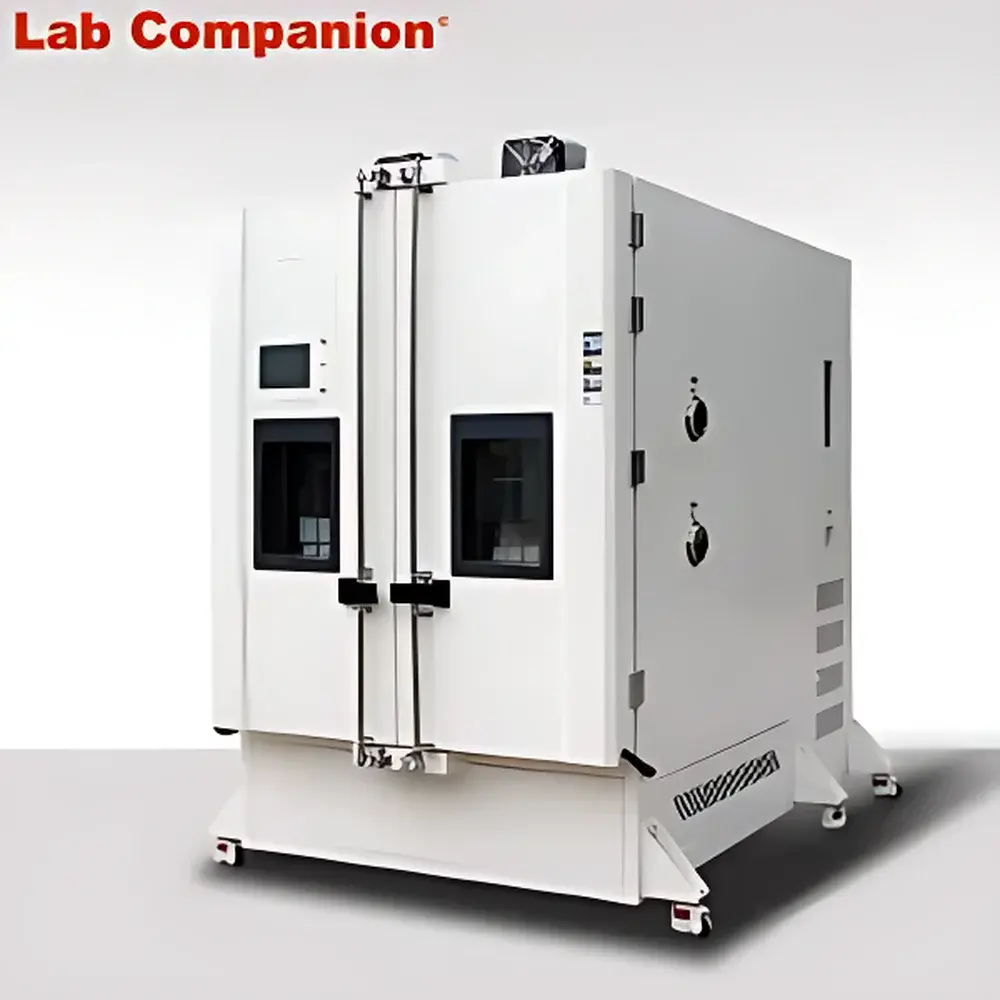
LabCompanion PSL80 High-Low Temperature Environmental Test Chamber
| Brand | LabCompanion |
|---|---|
| Origin | Guangdong, China |
| Manufacturer Type | Direct Manufacturer |
| Country of Origin | China |
| Model | PSL80 |
| Temperature Range | -70 °C to +150 °C |
| Refrigeration Method | Compressor-based Cooling |
| Explosion-Proof Design | Standard (Non-Explosion-Proof) |
| Temperature Fluctuation | ±0.5 °C |
| Temperature Uniformity | ±2.0 °C |
| Temperature Deviation | ±2.0 °C |
| Heating Rate | 1.0–3.0 °C/min |
| Cooling Rate | 1.2 °C/min |
| Internal Chamber Dimensions (W×D×H) | 400 mm × 500 mm × — mm (Height not specified in input |
| Compliance Reference | GB/T 5170.2–2008 |
Overview
The LabCompanion PSL80 High-Low Temperature Environmental Test Chamber is an engineered solution for accelerated environmental stress testing under controlled thermal conditions. It operates on the principle of forced-air convection with optimized airflow distribution to achieve precise and repeatable temperature profiles across the test volume. Designed for reliability-critical applications in electronics, automotive components, aerospace materials, and polymer R&D, the chamber subjects specimens to rapid thermal transitions—simulating real-world exposure to extreme cold, high heat, and cyclic thermal shocks. Its core function is to evaluate material integrity, dimensional stability, solder joint fatigue, seal performance, and long-term functional reliability through induced thermal expansion/contraction effects. The system complies with key international test standards including IEC 60068-2-1 (cold), IEC 60068-2-2 (dry heat), and MIL-STD-810G Method 502.5 (low temperature) and Method 501.5 (high temperature), supporting validation workflows aligned with ISO/IEC 17025-accredited laboratories.
Key Features
- Wide operational temperature range from –70 °C to +150 °C, enabled by a high-efficiency dual-stage compressor refrigeration system with imported critical components (including scroll compressors, electronic expansion valves, and copper-aluminum finned evaporators)
- Temperature stability maintained at ±0.5 °C fluctuation and ≤±2.0 °C deviation across the working volume per GB/T 5170.2–2008 verification methodology
- Optimized air circulation architecture featuring tangential multi-blade centrifugal fans and symmetrical baffle-guided wind tunnels, minimizing thermal stratification and ensuring uniformity within ±2.0 °C
- Robust safety framework incorporating over-temperature cut-off, compressor high/low pressure protection, phase failure monitoring, and door-open interlock circuits
- Integrated observation window with LED illumination and anti-fog heating film, enabling real-time visual inspection without compromising chamber integrity
- Intuitive 7-inch color touchscreen controller with programmable ramp-soak profiles, data logging (internal SD card), and USB export capability
Sample Compatibility & Compliance
The PSL80 accommodates samples up to 400 mm (W) × 500 mm (D) × ~500 mm (H) — suitable for PCB assemblies, small enclosures, sensors, battery modules, and molded plastic parts. Its non-explosion-proof configuration meets general industrial laboratory requirements per IEC 60079-0 and UL 61010-1. All electrical and mechanical designs conform to CE marking directives (EMC Directive 2014/30/EU, Low Voltage Directive 2014/35/EU). Calibration traceability follows ISO/IEC 17025 principles, with optional factory calibration certificates available upon request. While not inherently humidity-capable (PSL series is dry-cycle only), it serves as a foundational platform for thermal cycling qualification per JEDEC JESD22-A104E and A119B protocols.
Software & Data Management
The embedded controller supports up to 100 user-defined test programs, each with up to 99 segments (ramp, soak, hold). Real-time temperature curves are displayed graphically with timestamped event markers (e.g., door open, alarm trigger). Logged data includes chamber setpoint, actual temperature, runtime, and fault codes — stored in CSV format for post-processing in Excel or MATLAB. Optional PC-based software (LabCompanion ChamberLink™) enables remote monitoring, automated report generation (PDF/Excel), and audit-trail-enabled operation compliant with FDA 21 CFR Part 11 requirements when deployed with user authentication and electronic signature modules.
Applications
- Thermal cycling qualification of automotive ECUs and power electronics per AEC-Q200
- Pre-conditioning of lithium-ion battery cells prior to electrochemical testing
- Validation of adhesive bond strength under thermal stress gradients
- Reliability screening of medical device housings and sterilizable components
- Accelerated aging studies for optical coatings and elastomeric seals
- Environmental stress screening (ESS) in manufacturing quality control environments
FAQ
What is the typical cooling rate from +25°C to –40°C?
The standard PSL80 achieves an average cooling rate of 1.2 °C/min under no-load conditions per GB/T 5170.2–2008 test protocol. Actual rates may vary slightly depending on load mass, thermal inertia, and ambient room temperature.
Is the chamber compatible with external data acquisition systems?
Yes — RS485 Modbus RTU and Ethernet TCP/IP interfaces are standard, enabling integration with SCADA platforms, LIMS, or custom Python/LabVIEW scripts for synchronized multi-parameter logging.
Does the PSL80 support thermal shock testing?
No — the PSL80 is designed for controlled ramp-and-soak thermal cycling. For true two-zone thermal shock (e.g., –55°C ↔ +125°C), LabCompanion’s TC/TH series with separate hot/cold chambers is recommended.
Can the internal chamber be customized for special fixtures or cable ports?
Yes — optional side/port penetrations (Φ20–Φ50 mm), stainless steel shelves, and custom mounting rails are available under OEM engineering support with full mechanical drawings and installation guidance.
What maintenance intervals are recommended for optimal performance?
Compressor oil and refrigerant levels should be verified annually; air filters require cleaning every 3 months; calibration verification against NIST-traceable reference thermometers is advised every 6 months in GLP/GMP-regulated environments.



