
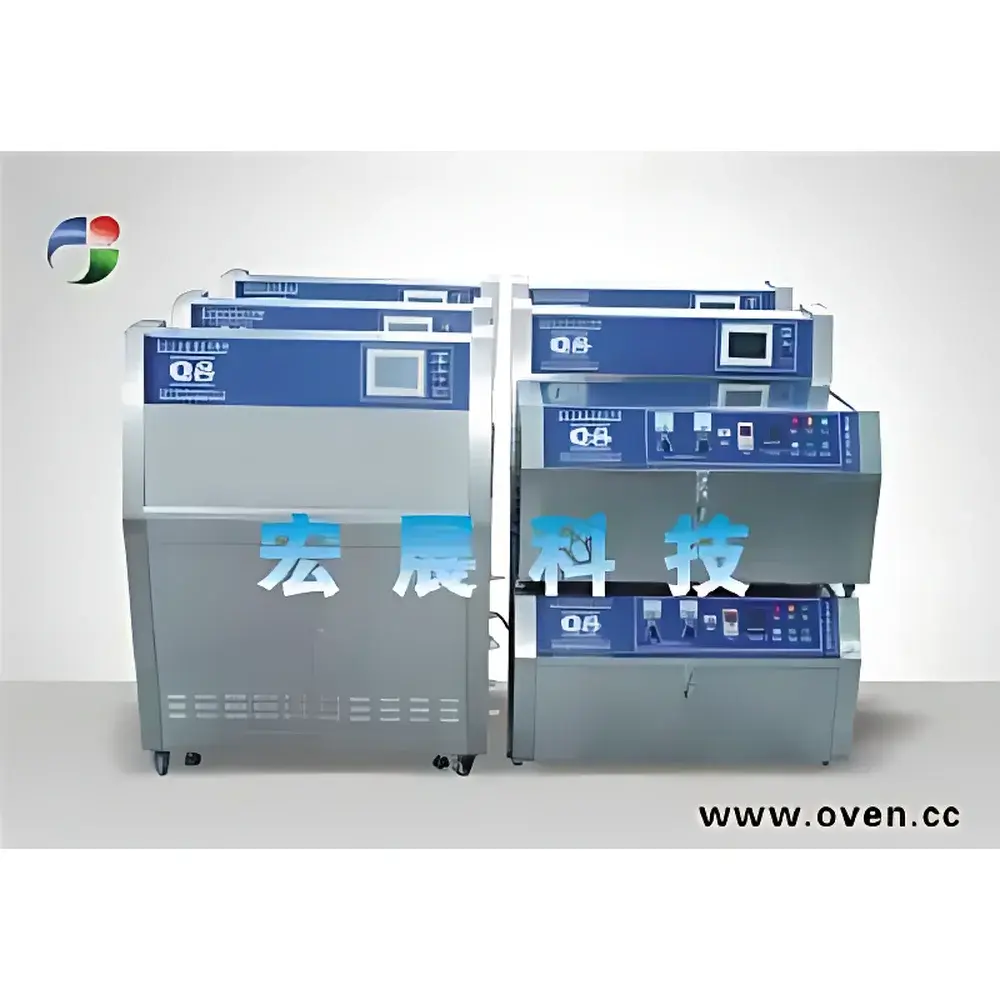
LabCompanion Q8 UV Aging Test Chamber
| Brand | LabCompanion |
|---|---|
| Origin | Guangdong, China |
| Manufacturer Type | Direct Manufacturer |
| Model | Q8 |
| Humidity Range | 45–98% RH |
| UV Lamp Power | 40 W per lamp |
| Irradiance Range | 0.1–1.0 W/m² @ 340 nm (adjustable) |
| Test Duration | 0–9999 h |
| Illumination Temperature Range | 50–70 °C |
| Black Panel Temperature Range | 30–80 °C |
| UV Wavelength Range | 315–400 nm (UVA band) |
| Effective Irradiated Area | 1300 × 700 × 700 mm (W×H×D) |
| Lamp Spacing | 70 mm |
| Sample-to-Lamp Distance | ~50 mm |
| Temperature Uniformity | ±2.5 °C |
| Temperature Fluctuation | ±0.5 °C |
| Condensation Temperature Range | 40–60 °C |
| Black Panel Sensor Accuracy | ±1 °C |
| Humidity Control Method | Water槽-based saturated vapor generation |
| Water Depth in Trough | ≤25 mm |
| Auto-refill System | Yes |
| Heating Method | Immersed water-trough heating |
| Recommended Ambient Conditions | 5–35 °C, 40–85% RH, ≥300 mm clearance from walls |
Overview
The LabCompanion Q8 UV Aging Test Chamber is an engineered solution for accelerated weathering evaluation of polymeric, coated, and composite materials under controlled ultraviolet (UV) radiation, thermal cycling, and moisture exposure. It operates on the principle of fluorescent UV irradiation—specifically UVA-340 lamps—to replicate the most damaging short-wavelength region of terrestrial solar spectrum (295–365 nm), with peak emission at 340 nm. This spectral match enables high-fidelity simulation of outdoor photodegradation mechanisms including chain scission, oxidation, pigment degradation, and surface embrittlement. Unlike broad-spectrum xenon arc systems, the Q8 focuses on UV-driven failure modes predominant in applications such as automotive exteriors, architectural coatings, packaging films, and outdoor textiles. Its modular test cycle architecture supports sequential or alternating phases of UV irradiation, condensation (simulating dew formation), and optional water spray (for thermal shock or stress corrosion assessment). The chamber delivers reproducible, standards-compliant aging in days or weeks—equivalent to months or years of natural exposure.
Key Features
- Eight UVA-340 fluorescent lamps (40 W each), arranged symmetrically to ensure uniform irradiance distribution across the test area (≤4% non-uniformity at sample plane)
- PID-controlled black panel temperature monitoring using Pt-100 sensors, with setpoint range 40–110 °C (BPT) and accuracy ±2.0 °C
- Integrated water trough heating system (40–60 °C) for controlled condensation cycles; auto-refill function prevents dry-heating damage
- Programmable test duration up to 9999 hours with cumulative time tracking and power-loss memory retention
- SUS304 stainless steel interior (1.0 mm thickness) and exterior (powder-coated), ensuring corrosion resistance and long-term dimensional stability
- Interlocked safety door complying with IEC 60204-1 and IEC 61000-4-5; automatic lamp shutdown upon door opening
- Dual overtemperature protection: primary cutoff at 93 °C ±10%, secondary thermal fuse integrated into heater circuit
- Low-water-level alarm and automatic refill mechanism safeguarding against heater burnout
Sample Compatibility & Compliance
The Q8 accommodates flat-panel specimens up to 1300 × 700 × 700 mm (W×H×D), with standard mounting fixtures for rigid substrates and optional clamping solutions for flexible films or fibers. Its design conforms to internationally recognized accelerated weathering protocols, including ASTM G154 (Standard Practice for Operating Fluorescent Ultraviolet (UV) Lamp Apparatus for Exposure of Non-Metallic Materials), ASTM D4329 (Standard Practice for Fluorescent UV Exposure of Plastics), ISO 4892-3 (Plastics — Methods of Exposure to Laboratory Light Sources — Part 3: Fluorescent UV Lamps), and GB/T 16422.3 (Plastics — Laboratory light source exposure methods — Part 3: Fluorescent UV lamps). It also satisfies requirements for GLP-compliant testing environments when paired with audit-trail-capable software and calibrated irradiance instrumentation (e.g., Q-Lab CR-10 radiometer, sold separately). All thermal and humidity control subsystems are traceable to NIST-calibrated references, supporting validation under ISO/IEC 17025 and FDA 21 CFR Part 11–compliant data management workflows.
Software & Data Management
The Q8 features a microprocessor-based controller with intuitive membrane keypad interface and real-time display of irradiance (W/m² @ 340 nm), black panel temperature, water trough temperature, and elapsed test time. While the base unit does not include PC connectivity, optional RS-485 or Ethernet modules enable integration with LabCompanion’s proprietary LabView-compatible data acquisition suite. This software provides full-cycle logging, trend visualization, alarm event timestamping, and export to CSV or PDF formats. When configured with external calibration hardware (e.g., CR-10), the system supports irradiance drift compensation via lamp current adjustment—ensuring consistent photon flux throughout lamp lifetime (typically 1800–2500 h). For regulated industries, optional 21 CFR Part 11 add-ons provide electronic signature capability, user access levels, and immutable audit trails for all parameter changes and test executions.
Applications
The Q8 serves critical roles in R&D, quality assurance, and regulatory submission support across multiple sectors. In automotive OEM supply chains, it validates UV resistance of bumpers, trim, and interior soft-touch surfaces per SAE J2020. Coating manufacturers use it to benchmark UV stabilizer efficacy in acrylic and polyurethane topcoats under ASTM D4587. Packaging engineers assess yellowing and tensile loss in PET and PE films exposed to retail shelf lighting. Aerospace composites labs apply it to evaluate matrix degradation in carbon-fiber-reinforced polymers per MIL-STD-810G Method 505.5. Additionally, the chamber supports comparative studies between UVA-340 and UVB-313 lamp configurations—enabling rapid screening (UVB) versus realistic outdoor correlation (UVA)—with seamless lamp interchangeability and independent irradiance calibration per lamp bank.
FAQ
What UV spectrum does the Q8 replicate, and why is UVA-340 preferred for most polymer testing?
The Q8 uses UVA-340 lamps emitting primarily between 315–400 nm, peaking at 340 nm—closely matching the short-wave UV component of noon sunlight at sea level. This spectral fidelity ensures high correlation with real-world outdoor degradation, especially for materials sensitive to photooxidation.
Can the Q8 perform combined UV + spray cycles, and what is the purpose of the spray function?
Yes—the optional spray module delivers programmable water pulses (duration and frequency configurable) to simulate thermal shock (short bursts) or sustained wetting (longer durations) for evaluating stress corrosion or hydrolytic degradation.
How is irradiance stability maintained over extended test periods?
Lamp output declines gradually; the Q8 implements staggered lamp replacement—replacing one of eight lamps every 25% of rated life—to maintain statistically stable irradiance profiles without interrupting ongoing tests.
Is third-party calibration support available for the black panel sensor and irradiance measurement?
Yes—LabCompanion provides factory calibration certificates traceable to national metrology institutes; users may also deploy NIST-traceable field instruments (e.g., Q-Lab CR-10) for in-situ verification and adjustment.
Does the Q8 meet requirements for ISO/IEC 17025-accredited laboratories?
When operated with documented calibration records, validated procedures, and appropriate environmental controls (per ISO/IEC 17025 Clause 6.4), the Q8 fulfills technical competence criteria for accredited weathering testing—particularly when paired with compliant data handling and uncertainty budgeting practices.



