
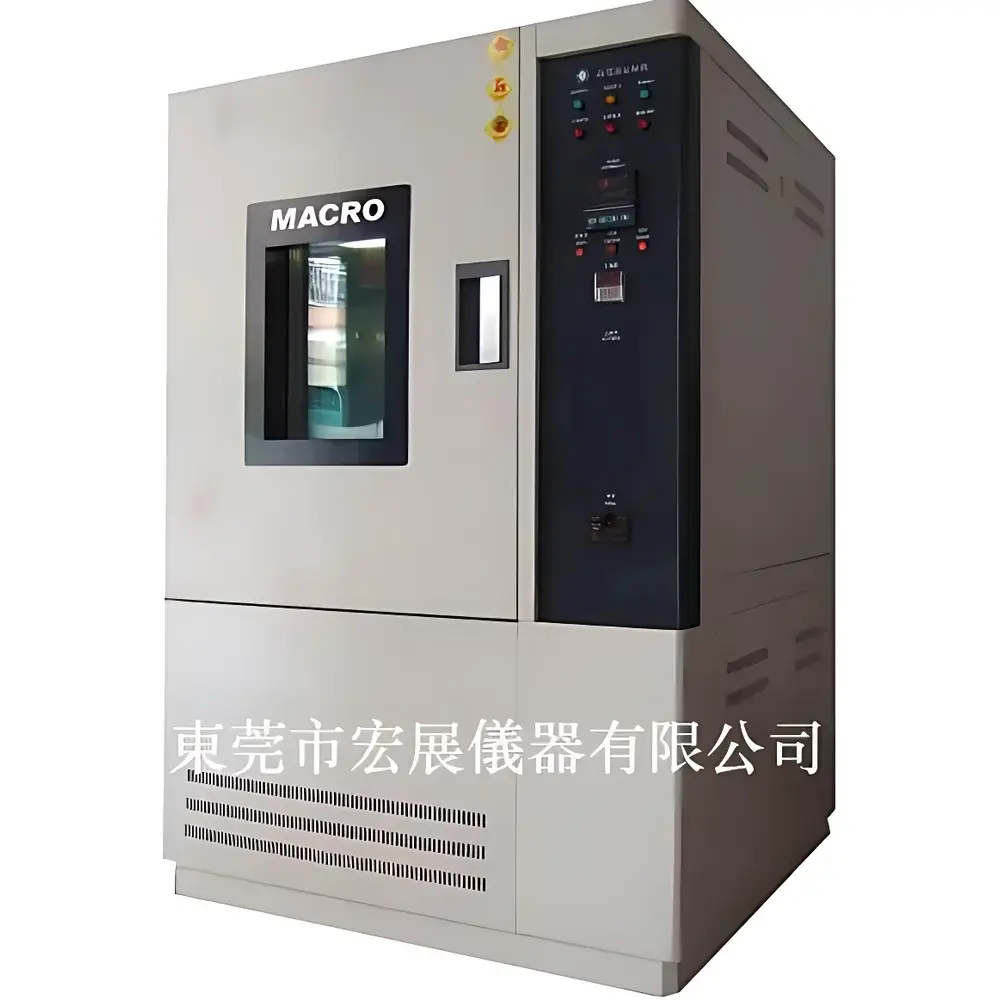
LabCompanion C-Series Environmental Test Chamber
| Brand | LabCompanion |
|---|---|
| Model | C-Series |
| Temperature Range | –70 °C to +150 °C |
| Temperature Uniformity | ≤2 °C |
| Temperature Stability | ±0.5 °C |
| Ramp Rate Options | 0.7–10 °C/min |
| Internal Dimensions (W×H×D, mm) | 400×500×400 to 1000×1000×1000 |
| Power Supply | 220 V/380 V, 50 Hz |
| Refrigeration System | Single-stage or Cascade (Dual-stage) with French Tecumseh hermetic compressors |
| Insulation | Rigid polyurethane foam + rock wool |
| Air Circulation | Stainless steel centrifugal blower with extended shaft |
| Humidity Control (if equipped) | ±2% RH, ±0.2 °C dew point stability |
| Safety Protections | Over-temperature cutoff, compressor high-pressure protection, leakage current protection, fast-blow fuse |
Overview
The LabCompanion C-Series Environmental Test Chamber is an engineered precision platform for controlled thermal exposure testing of materials, components, and finished products under reproducible ambient conditions. Designed in accordance with international environmental simulation standards—including IEC 60068-2, ASTM D4329, ISO 16750-4, and MIL-STD-810G—the chamber utilizes a dual-mode thermal management architecture: single-stage refrigeration for standard temperature ranges (–20 °C to +150 °C), and cascade (dual-stage) refrigeration for ultra-low operation down to –70 °C. Its core thermodynamic performance relies on a calibrated platinum resistance thermometer (PT100 Class A), coupled with a high-stability forced-air convection system featuring a stainless-steel centrifugal blower and optimized duct geometry. This ensures spatial temperature uniformity ≤2 °C and temporal stability within ±0.5 °C across the entire working volume—critical for validating product reliability during qualification, accelerated aging, and failure mode analysis.
Key Features
- Modular thermal architecture: Selectable single-stage or cascade refrigeration systems, enabling precise configuration for standard, low-, or ultra-low temperature applications
- High-fidelity control system: Touchscreen microprocessor controller with PID algorithm, real-time data logging, and programmable multi-step profiles (up to 99 segments)
- Robust thermal insulation: Dual-layer construction combining rigid polyurethane foam (thermal conductivity ≤0.022 W/m·K) and mineral rock wool, minimizing thermal bridging and energy loss
- Corrosion-resistant chamber construction: Interior and exterior surfaces fabricated from SUS304 stainless steel; optional electropolished finish available for pharmaceutical or cleanroom-compliant validation
- Integrated safety redundancy: Independent over-temperature cut-off, compressor high-pressure switch, earth-leakage circuit breaker, and fast-acting fuses compliant with IEC 61000-4 immunity requirements
- Standard ergonomic interface: Double-glazed vacuum-insulated observation window, two adjustable stainless-steel shelves, internal LED lighting, 50 mm diameter test port with silicone gasket, and lockable castor wheels
Sample Compatibility & Compliance
The C-Series accommodates a broad spectrum of sample types—from PCB assemblies and automotive ECUs to polymer packaging, aerospace composites, and medical device housings—without compromising thermal fidelity. Internal dimensions range from 400 × 500 × 400 mm to 1000 × 1000 × 1000 mm, supporting both small-batch R&D validation and full-size production unit stress screening. All models are designed to meet essential regulatory expectations for environmental testing infrastructure: traceable calibration paths per ISO/IEC 17025, documented design qualification (DQ) and installation qualification (IQ) support packages, and compatibility with GLP/GMP audit documentation workflows. Optional humidity control modules (not standard on all C-Series variants) comply with ISO 4882-2 for wet heat testing and ASTM G154 Annex A3 for UV-coupled thermal cycling protocols.
Software & Data Management
LabCompanion’s proprietary ChamberLink™ software enables remote monitoring, real-time parameter visualization, and automated report generation in PDF or CSV format. The system supports time-stamped event logging with configurable alarm thresholds and retains ≥30 days of continuous data onboard (expandable via USB or Ethernet). For regulated environments, optional 21 CFR Part 11 compliance packages include electronic signature capability, user-level access controls, and immutable audit trails—ensuring full traceability from test initiation through final report export. Data export formats align with common LIMS integration standards (ASTM E1384, HL7) and support direct ingestion into statistical process control (SPC) platforms such as Minitab or JMP.
Applications
- Thermal cycling qualification per JEDEC JESD22-A104 for semiconductor devices
- Automotive component endurance testing per SAE J2412 and GMW14872
- Accelerated shelf-life studies for pharmaceutical primary packaging (ICH Q1A–Q1E)
- Material coefficient of thermal expansion (CTE) characterization via dimensional metrology integration
- Pre-conditioning of sensors and optoelectronic assemblies prior to optical alignment
- Environmental stress screening (ESS) of avionics hardware in accordance with MIL-STD-2164
FAQ
What temperature ramp rates are available, and how are they validated?
Standard ramp rates span 0.7–10 °C/min, selectable at time-of-order. Rates are verified using NIST-traceable PT100 probes placed at nine standardized locations (corners and center) per IEC 60068-3-5, with rate accuracy certified to ±0.1 °C/min.
Can the chamber be integrated into an existing factory automation network?
Yes—Ethernet (TCP/IP) and RS485 Modbus RTU interfaces are standard. Optional OPC UA server module enables seamless integration with SCADA, MES, and Industry 4.0 digital twin platforms.
Is calibration documentation included with shipment?
Each unit ships with a Factory Calibration Certificate covering temperature uniformity, stability, and controller linearity—traceable to national metrology institutes (NMI) via ISO/IEC 17025-accredited subcontractors.
What maintenance intervals are recommended for the refrigeration system?
Compressor oil and filter replacement every 24 months; annual inspection of evaporator coil integrity and refrigerant charge verification per ASHRAE Guideline 3-2021.
Are custom modifications—such as additional ports, inert gas purging, or vibration isolation—available?
Yes. LabCompanion offers engineering consultation and mechanical customization under formal Design Transfer Agreements, including FAT/SAT protocol development for turnkey installations.



