
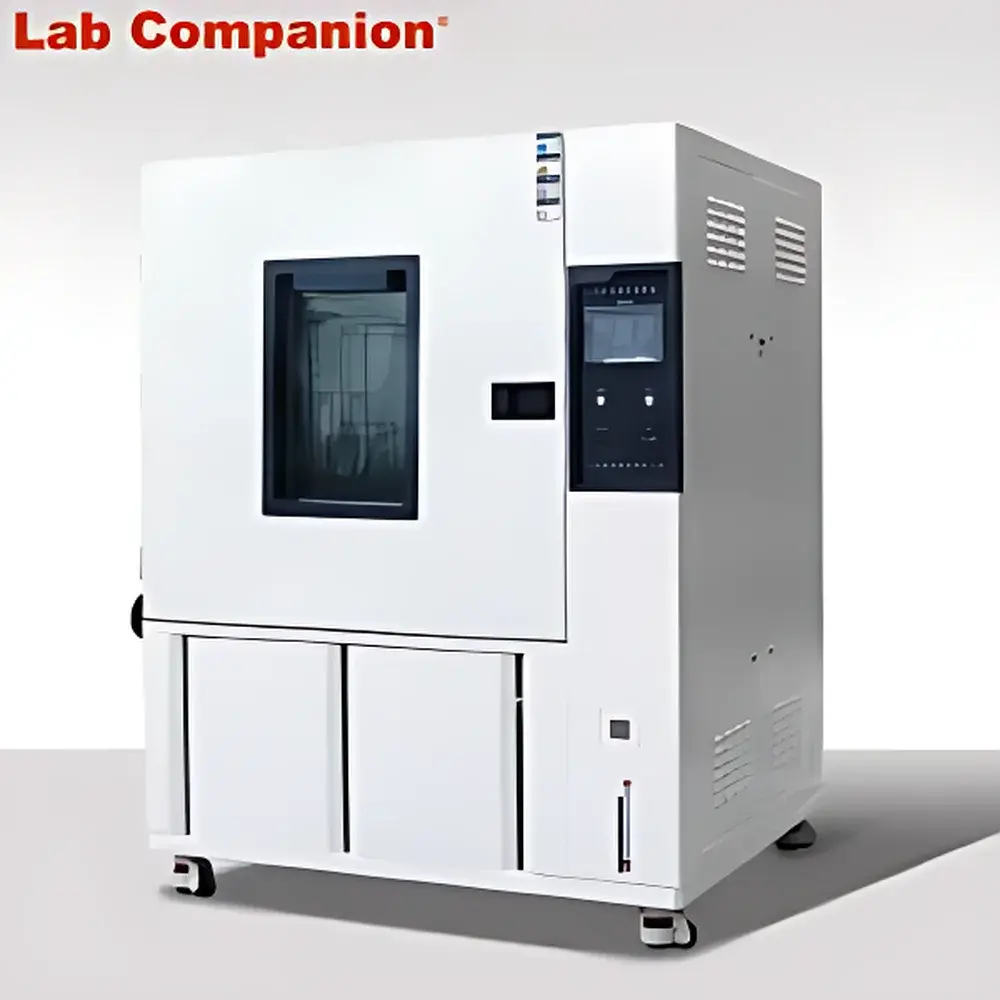
LabCompanion P-Series High-Low Temperature Cycling Chamber
| Brand | LabCompanion |
|---|---|
| Origin | Guangdong, China |
| Manufacturer Type | Direct Manufacturer |
| Product Category | Domestic |
| Model | P-Series H |
| Temperature Range | -70 °C to +150 °C |
| Refrigeration Method | Compressor-Based Cooling |
| Explosion-Proof Design | Standard (Non-Explosion-Proof) |
| Temperature Fluctuation | ±0.5 °C |
| Temperature Uniformity | ±2.0 °C |
| Temperature Deviation | ±2.0 °C |
| Heating Rate | 1.0–3.0 °C/min |
| Cooling Rate | 1.2 °C/min |
| Internal Chamber Dimensions (W×D×H) | 800 × 950 × 800 mm |
Overview
The LabCompanion P-Series High-Low Temperature Cycling Chamber is an engineered environmental test system designed to evaluate the thermal resilience and functional stability of materials, components, and finished products under controlled, dynamically alternating temperature conditions. Based on forced-air convection and dual-stage compressor refrigeration, the chamber precisely replicates real-world thermal stress profiles—including rapid transitions between extreme low and high temperatures—to assess physical integrity, dimensional stability, electrical performance, and long-term reliability. It operates in accordance with fundamental principles of thermal shock testing and cyclic environmental simulation, supporting both steady-state and programmable ramp-hold-cycle profiles. This system serves as a core tool for product qualification, design validation, and compliance verification across electronics, automotive, aerospace, polymer, and defense sectors.
Key Features
- Robust stainless steel (SUS304) interior chamber construction—resistant to corrosion, thermal fatigue, and repeated thermal cycling
- High-density polyurethane foam insulation with optimized thermal resistance to minimize energy loss and enhance temperature stability
- Precision-engineered door sealing system using high-temperature silicone rubber gaskets, ensuring minimal air leakage and consistent chamber integrity
- Large-area, double-glazed, electrically heated observation window with internal LED lighting—enabling clear visual monitoring without thermal interference
- Modular control architecture supporting customizable ramp rates, dwell times, cycle counts, and multi-step profiles via intuitive touchscreen interface
- Optional accessories including standardized test ports (Φ50/Φ100 mm), embedded data logging modules, and shielded cable feedthroughs for in-situ electrical monitoring
- Eco-conscious refrigerant (R404A/R507 compliant alternative) meeting current international environmental regulations and OEM sustainability requirements
Sample Compatibility & Compliance
The P-Series chamber accommodates a broad range of sample types—from printed circuit boards (PCBs) and semiconductor packages to molded plastics, elastomers, and metallic assemblies—with maximum dimensions of 800 × 950 × 800 mm (W×D×H). Its performance and calibration traceability align with internationally recognized standards for environmental testing equipment, including ISO 16750-4 (Road vehicles — Environmental conditions and testing), IEC 60068-2-1 (Cold tests), IEC 60068-2-2 (Dry heat tests), and IEC 60068-2-14 (Change of temperature). It further satisfies national and military specifications such as GB/T 2423.1–2008 (Cold), GB/T 2423.2–2008 (Dry heat), GB/T 10592–2008 (Chamber performance criteria), GJB 150.3A–2009 (High temperature), GJB 150.4A–2009 (Low temperature), and GJB 150.5A–2009 (Temperature shock). All units undergo factory calibration with documented uncertainty budgets per ISO/IEC 17025 guidelines.
Software & Data Management
The integrated controller supports real-time data acquisition at configurable intervals (1–60 s), with onboard storage for up to 30 days of continuous temperature logs. Export options include CSV and PDF formats compatible with statistical process control (SPC) platforms and laboratory information management systems (LIMS). Optional Ethernet or RS485 connectivity enables remote monitoring and integration into centralized facility management networks. For regulated environments, optional software packages provide audit trail functionality, user access levels, electronic signatures, and data integrity safeguards aligned with FDA 21 CFR Part 11 and EU Annex 11 requirements—supporting GLP and GMP-compliant validation protocols.
Applications
- Qualification testing of automotive ECUs, sensors, and battery modules under accelerated thermal aging conditions
- Evaluation of solder joint reliability and intermetallic growth in PCB assemblies per IPC-9701
- Validation of packaging integrity for pharmaceutical primary containers exposed to seasonal distribution profiles
- Material screening for coefficient of thermal expansion (CTE) mismatch in multilayer ceramic capacitors (MLCCs)
- Thermal endurance assessment of aerospace-grade adhesives, composites, and sealants per MIL-STD-810H Method 502.7
- Pre-compliance screening for consumer electronics prior to formal certification per JEDEC JESD22-A104 (Temperature Cycling) and A106 (Thermal Shock)
FAQ
What is the difference between temperature cycling and thermal shock testing?
Temperature cycling involves gradual, programmable transitions between defined high and low setpoints with dwell periods; thermal shock uses near-instantaneous transfers between separate hot and cold zones. The P-Series supports both modes when configured with optional dual-chamber or lift-basket mechanisms.
Can this chamber be validated for IQ/OQ/PQ protocols?
Yes—the unit includes full documentation packages (Factory Acceptance Test Report, Calibration Certificate, Installation Qualification checklist) and supports third-party validation services for Installation Qualification (IQ), Operational Qualification (OQ), and Performance Qualification (PQ) in regulated industries.
Is remote monitoring and alarm notification supported?
Standard Ethernet connectivity allows integration with building management systems (BMS) or SCADA platforms; optional SMS/email alert modules trigger notifications upon deviation from setpoint tolerances or system fault conditions.
What maintenance intervals are recommended?
Compressor oil and refrigerant pressure checks every 12 months; condenser coil cleaning every 3–6 months depending on ambient particulate load; door gasket inspection and replacement every 24 months or as wear dictates.
Does the chamber meet RoHS and REACH requirements?
All structural materials, wiring harnesses, and internal components comply with RoHS Directive 2011/65/EU and REACH Regulation (EC) No. 1907/2006, with full material declarations available upon request.



