
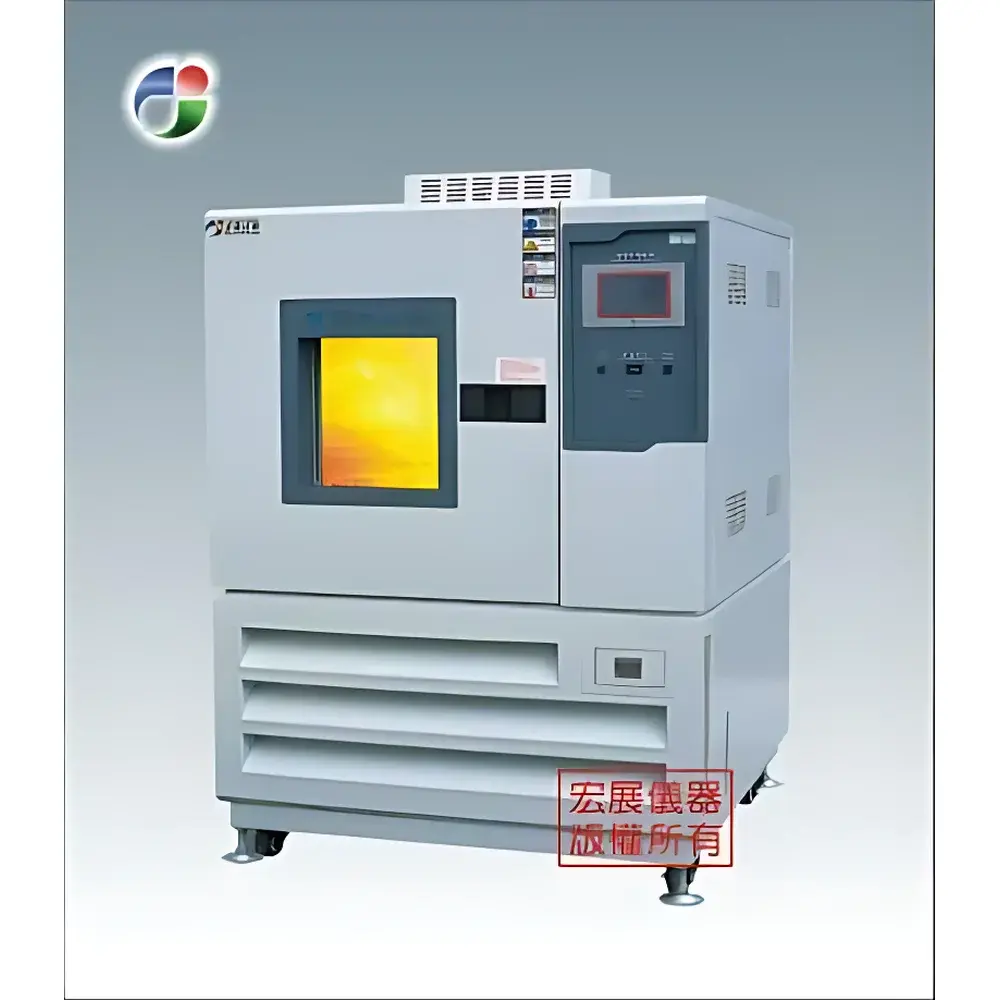
LabCompanion P-Series Programmable Environmental Test Chamber (Constant Temperature & Humidity Chamber)
| Brand | LabCompanion |
|---|---|
| Origin | Guangdong, China |
| Manufacturer Type | Direct Manufacturer |
| Country of Origin | China |
| Model | P-Series |
| Pricing | Upon Request |
| Temperature Range | −20 °C to +150 °C (standard) |
| Humidity Range | 30–98% RH |
| Temperature Uniformity | ±2 °C |
| Temperature Fluctuation | ±0.5 °C |
| Humidity Uniformity | ±2% RH (≤75% RH), ±3% RH (>75% RH) |
| Internal Dimensions (W×H×D mm) | 500×600×500 (150 L), 500×750×600 (225 L), 600×850×800 (408 L), 1000×1000×800 (800 L) |
| Cooling Method | Air-cooled or water-cooled (model-dependent) |
| Refrigeration System | Hermetic compressors (Tecumseh France or Embraco/Gaulin Germany) |
| Controller | Q8-900 bilingual (English/Chinese) LCD touch HMI with 120 programs × 1200 segments, up to 999 cycles |
| Compliance | GB 10586-89, GB 10592-89, GB/T 10589-1989, IEC 60068-2-1/-2/-3, MIL-STD-810F (501.4, 502.4, 507.4), JIS C60068-2-1/-2/-3, JESD22-A101-B/A103-C/A119, GB/T 2423.1–2423.4, GJB 150.9-86 |
Overview
The LabCompanion P-Series Programmable Environmental Test Chamber is an engineered solution for precise, repeatable simulation of temperature and humidity stress conditions in laboratory and industrial qualification environments. Designed around a dual-loop PID-controlled refrigeration-heating-humidification architecture, the chamber employs forced-air convection with optimized airflow distribution to maintain thermodynamic equilibrium across the test volume. Its core function is to replicate real-world environmental exposure profiles—including steady-state humid heat, dry heat, low-temperature storage, and cyclic temperature-humidity sequences—as defined by international reliability testing standards. The system is not a general-purpose incubator but a rigorously calibrated environmental stress screening platform used during design validation, component qualification, and production lot release testing.
Key Features
- Q8-900 bilingual (English/Chinese) LCD touch HMI controller supporting up to 120 programmable test profiles, each comprising up to 1200 individual segments, with cycle repetition capability up to 999 times per program.
- High-resolution thermal management: nine independent PID parameter sets allow fine-tuned optimization for distinct temperature ramping, soaking, and recovery phases across wide operating ranges (−70 °C to +150 °C).
- Dual-glass observation window with vacuum-sealed, anti-frost coating ensures unobstructed visual monitoring without condensation interference during high-RH operation.
- Front-mounted automatic water-fill system with level sensor integration minimizes manual maintenance and eliminates downtime due to evaporative depletion.
- Robust mechanical architecture: SUS304 stainless steel interior chamber walls, electrostatically coated cold-rolled steel outer casing, and high-efficiency insulation using either polyurethane foam or ultra-fine glass fiber.
- Standard RS232 interface included; optional RS485 expansion enables daisy-chain networking for multi-chamber synchronization and centralized control via SCADA or MES platforms.
- Comprehensive fault diagnostics: real-time on-screen error codes, audible alarms, and event-logged fault history support rapid root-cause analysis and preventive maintenance planning.
Sample Compatibility & Compliance
The P-Series accommodates a broad spectrum of physical test specimens—from printed circuit assemblies (PCBAs), semiconductor packages, and polymer enclosures to aerospace fasteners and automotive electronic control units (ECUs). Internal chamber dimensions range from 150 L to 800 L, with standardized 50 mm diameter test ports (with sealing cap), adjustable stainless steel shelves, and integrated fluorescent lighting for visual inspection. All models comply with GLP-relevant operational traceability requirements when paired with optional data logging hardware. The chamber meets full regulatory alignment with IEC 60068-2 series (including Tests A, B, Ca), MIL-STD-810F methods 501.4 (high temperature), 502.4 (low temperature), and 507.4 (humidity), as well as JESD22-A101-B (constant TH), A103-C (HTOL), and A119 (LTOL). It satisfies the metrological criteria of GB/T 2423.1–2423.4 and GJB 150.9-86 for military-grade environmental testing.
Software & Data Management
While the embedded Q8-900 controller provides local program execution and real-time parameter visualization, LabCompanion supplies optional PC-based software (compatible with Windows 10/11) for remote configuration, live data streaming, and automated report generation. The software supports CSV export of time-stamped temperature/humidity logs with millisecond-level timestamp resolution, enabling post-test statistical process control (SPC) analysis. When configured with audit trail-enabled firmware and user-access controls, the system can meet FDA 21 CFR Part 11 requirements for electronic records and signatures in regulated pharmaceutical or medical device development labs. Optional printer and analog recorder interfaces facilitate hard-copy documentation for QA/QC archival.
Applications
- Accelerated life testing of electronic components under combined thermal and hygroscopic stress (e.g., moisture ingress evaluation per JEDEC J-STD-020).
- Validation of material stability for polymers, adhesives, and conformal coatings exposed to tropical or desert climatic profiles.
- Environmental stress screening (ESS) of avionics modules prior to flight certification per DO-160 Section 4 and 5.
- Pre-conditioning of lithium-ion battery cells before safety testing (UN 38.3, IEC 62133).
- Qualification of optical sensors and MEMS devices subject to condensation-induced micro-corrosion.
- Reliability assessment of packaging integrity for sterile medical devices under ISO 11607 accelerated aging protocols.
FAQ
What is the maximum allowable load mass inside the chamber without compromising temperature uniformity?
The chamber’s thermal performance specifications assume an empty chamber per IEC 60068-3-5. For loaded conditions, LabCompanion recommends ≤15% of internal volume occupied by non-heat-generating test articles. Load-specific validation is advised for high-mass or high-power-dissipation samples.
Can the P-Series be integrated into a factory-wide environmental monitoring network?
Yes—via optional RS485 Modbus RTU communication, multiple chambers can be addressed on a single serial bus and interfaced with PLCs or centralized LIMS platforms using standard protocol mapping.
Is calibration certificate traceable to NIM or other national metrology institutes available?
Factory calibration reports are provided with each unit. NIM-traceable third-party calibration services (including ISO/IEC 17025 accredited providers) can be arranged upon request at additional cost.
Does the controller support custom alarm logic beyond default thresholds?
The Q8-900 allows user-defined alarm conditions based on deviation duration, rate-of-change limits, and interlocked parameter dependencies—enabling application-specific failure detection rules.
What maintenance intervals are recommended for refrigeration system integrity?
Compressor oil and refrigerant levels should be verified annually; filter-driers replaced every 24 months; and heat exchanger coils inspected quarterly for dust accumulation—especially in high-particulate lab environments.



