
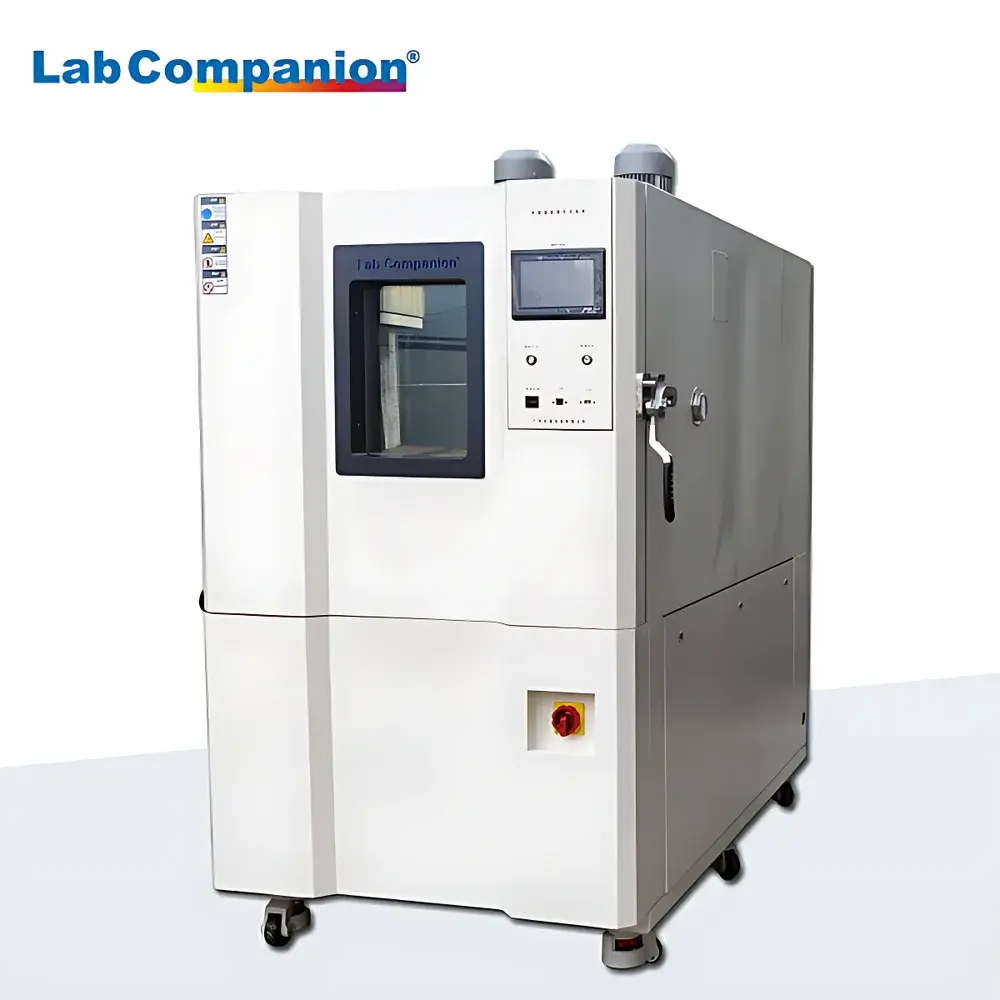
LabCompanion TC-400-7 Rapid Temperature Transition Chamber
| Brand | LabCompanion |
|---|---|
| Origin | Guangdong, China |
| Manufacturer Type | Direct Manufacturer |
| Model | TC-400-7 |
| Temperature Range | -70°C to +150°C |
| Temperature Deviation | ±2.0°C |
| Heating Rates | 5–25°C/min (linear or non-linear) |
| Cooling Rates | 5–25°C/min (linear or non-linear) |
| Optional LN₂-Assisted Cooling | Up to 30°C/min |
| Internal Dimensions (W×H×D) | 800×950×800 mm |
| Compliance | GB/T 5170.2-2008 |
Overview
The LabCompanion TC-400-7 Rapid Temperature Transition Chamber is an engineered environmental test system designed for accelerated thermal stress evaluation of electronic components, automotive modules, aerospace materials, and packaging systems. It operates on a dual-compartment forced-air convection architecture with independent high-efficiency heating and cryogenic cooling circuits—enabling precise, repeatable, and programmable transitions between extreme temperature extremes. Unlike conventional thermal chambers, the TC-400-7 implements dynamic air management and optimized thermal mass distribution to achieve high-fidelity ramp-and-soak profiles without overshoot or prolonged stabilization delays. Its core function is to simulate rapid ambient thermal transients encountered during real-world operational cycles—including power-on/power-off events, altitude-induced thermal shock, and seasonal storage conditions—thereby supporting reliability validation per IEC 60068-2-14 (Change of Temperature), MIL-STD-810H Method 503.7, and JESD22-A104.
Key Features
- Dual-zone thermal isolation design with independent hot/cold air paths minimizes cross-contamination and ensures stable transition fidelity.
- Programmable ramp rates from 5°C/min to 25°C/min (linear or non-linear), with optional liquid nitrogen (LN₂) auxiliary cooling enabling up to 30°C/min cooling under specified load conditions.
- Temperature uniformity maintained at ≤±0.5°C (at steady state, per GB/T 5170.2-2008), verified across the full working volume using NIST-traceable calibrated sensors.
- Robust stainless-steel interior chamber (800 × 950 × 800 mm W×H×D) with reinforced insulation and low-outgassing seals suitable for long-duration qualification testing.
- Integrated safety interlocks including over-temperature cut-off, LN₂ pressure monitoring, door-open thermal inhibition, and real-time compressor discharge temperature surveillance.
- Modular control platform compliant with IEC 61000-4-30 Class A for electromagnetic immunity in industrial lab environments.
Sample Compatibility & Compliance
The TC-400-7 accommodates test specimens up to 50 kg (distributed load), with unobstructed airflow ensuring representative thermal exposure across heterogeneous assemblies—including PCBs with mixed-signal ICs, battery packs, optical sensors, and polymer-based enclosures. Chamber performance conforms to national and international standards including GB/T 5170.2-2008 (Environmental Testing Equipment Verification), IEC 60068-3-5 (Methods of Test—Thermal Shock), and supports traceable calibration documentation aligned with ISO/IEC 17025 requirements. While the base TC-series model is dry-cycle only (no humidity control), its mechanical and control architecture is compatible with retrofitted humidity modules (TH-series variants) should hygrothermal profiling be required in future configurations.
Software & Data Management
Equipped with LabCompanion’s TC-Studio v4.2 embedded controller, the system delivers intuitive profile programming via touchscreen HMI or remote Ethernet interface. All test sequences—including multi-step ramps, dwell periods, and conditional triggers—are stored with full audit trail metadata (user ID, timestamp, parameter set hash). Raw temperature data is logged at 1 Hz resolution and exportable in CSV or .tdms format. The software architecture supports 21 CFR Part 11-compliant user role management (Admin/Operator/Viewer), electronic signature capture, and immutable event logging—meeting GLP and GMP documentation rigor for regulated industries such as medical device manufacturing and automotive Tier-1 supplier validation.
Applications
- Thermal shock qualification of semiconductor packages (e.g., QFN, BGA) per JEDEC JESD22-A104 and A106.
- Reliability screening of EV battery management systems (BMS) under fast-cycling thermal loads.
- Material coefficient-of-thermal-expansion (CTE) mismatch analysis in multi-layer composites.
- Validation of adhesive bond integrity in optoelectronic subassemblies subjected to repeated thermal cycling.
- Pre-compliance stress testing for MIL-STD-810H environmental categories (e.g., Method 503.7, Method 501.7).
- Process window definition for reflow soldering simulation and post-reflow component inspection protocols.
FAQ
What is the maximum achievable temperature transition rate with LN₂ assistance?
With optional liquid nitrogen injection enabled and under no-load conditions, the TC-400-7 achieves cooling rates up to 30°C/min between –55°C and +125°C. Actual rate depends on specimen thermal mass and placement.
Is the chamber suitable for testing under vacuum or inert gas purge?
The standard TC-400-7 is not rated for vacuum operation; however, it features dual-purpose gas purge ports (N₂ or dry air) compatible with external inert gas supply systems for oxygen-sensitive applications.
How is temperature uniformity validated across the working volume?
Uniformity verification follows GB/T 5170.2-2008 Annex B: nine-point sensor mapping at three vertical levels, conducted annually or after major maintenance using accredited third-party calibration services.
Can the controller log data directly to a network server?
Yes—via configurable FTP/SFTP or OPC UA protocol, enabling integration into centralized MES or LIMS platforms without manual file transfer.
Does the system support custom alarm escalation workflows?
Alarm thresholds, notification methods (email/SMS), and escalation hierarchies are fully configurable within TC-Studio v4.2 and persist across firmware updates.



