
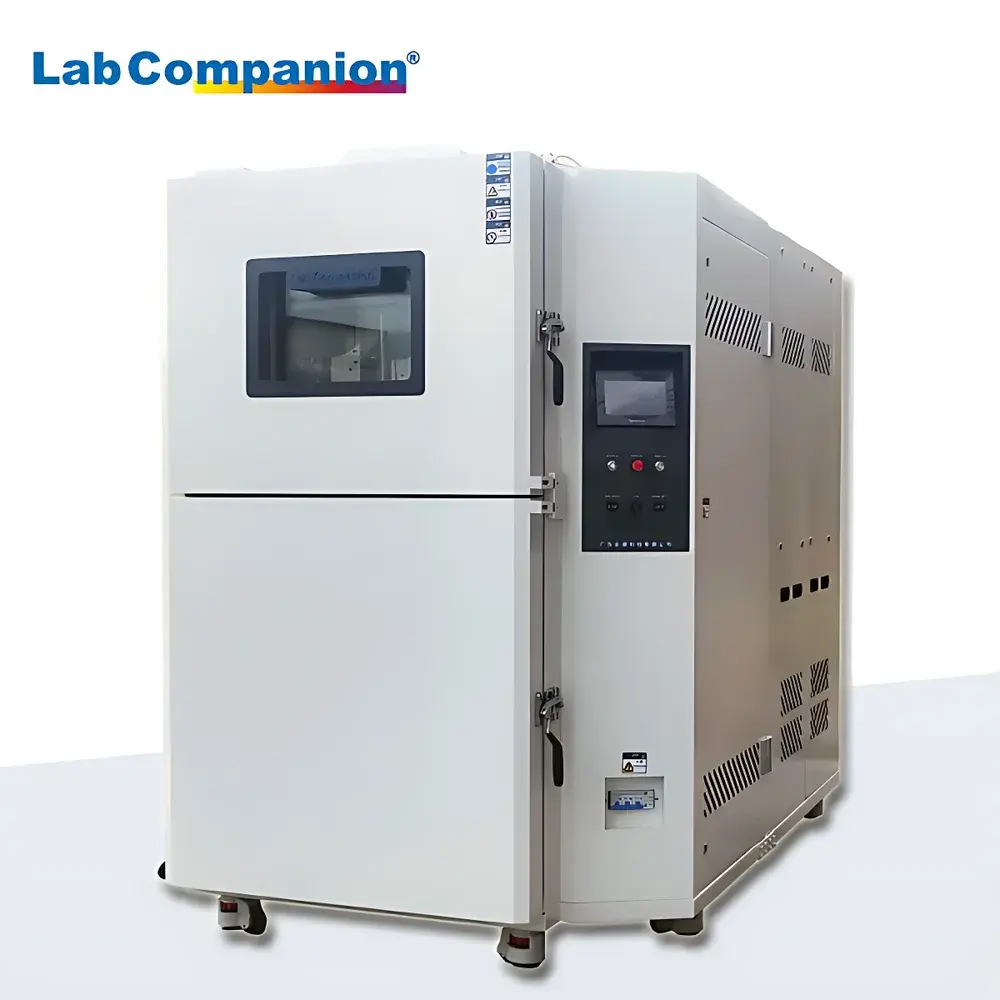
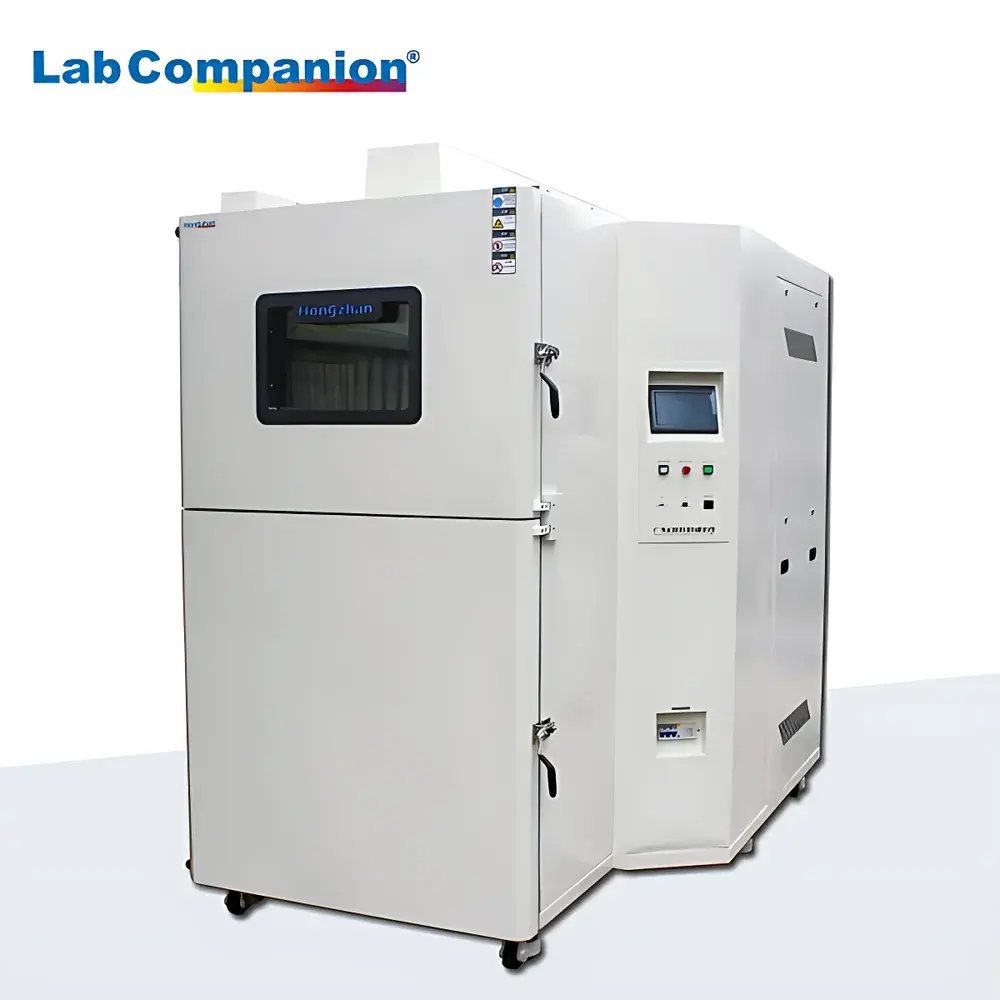
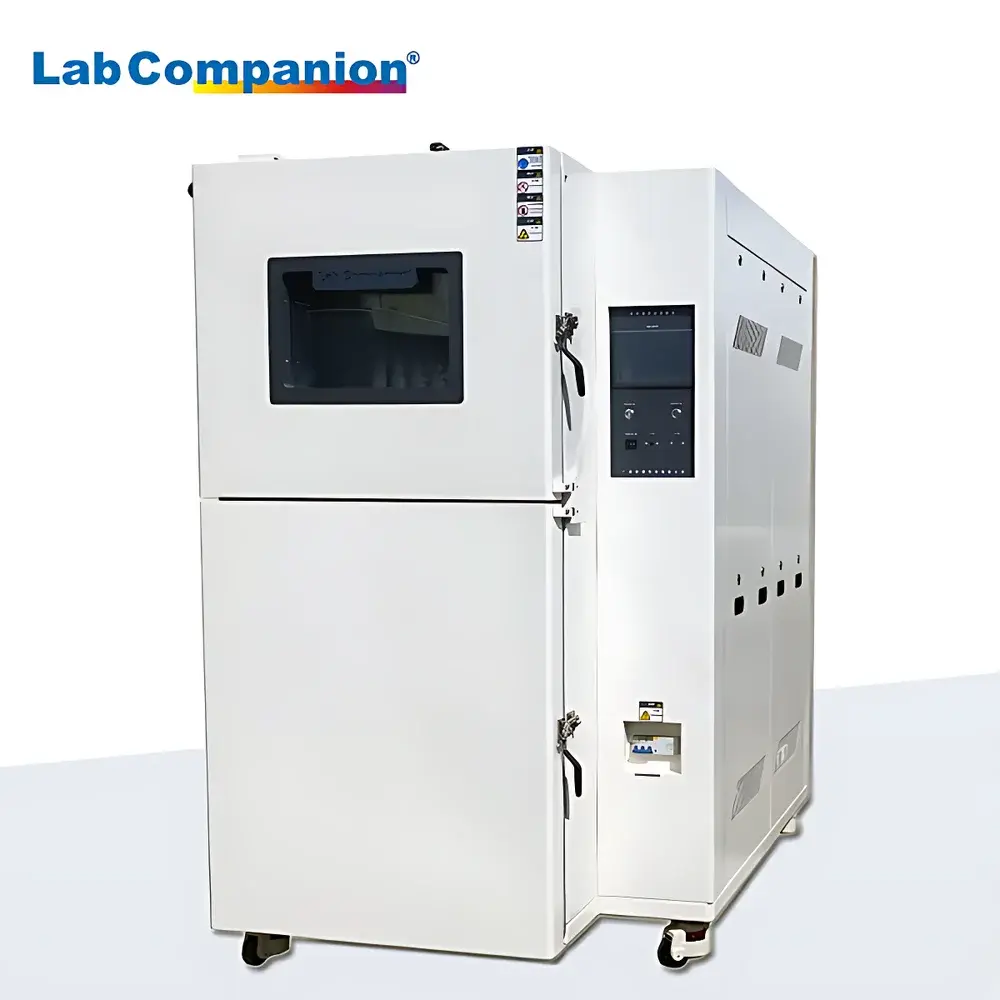
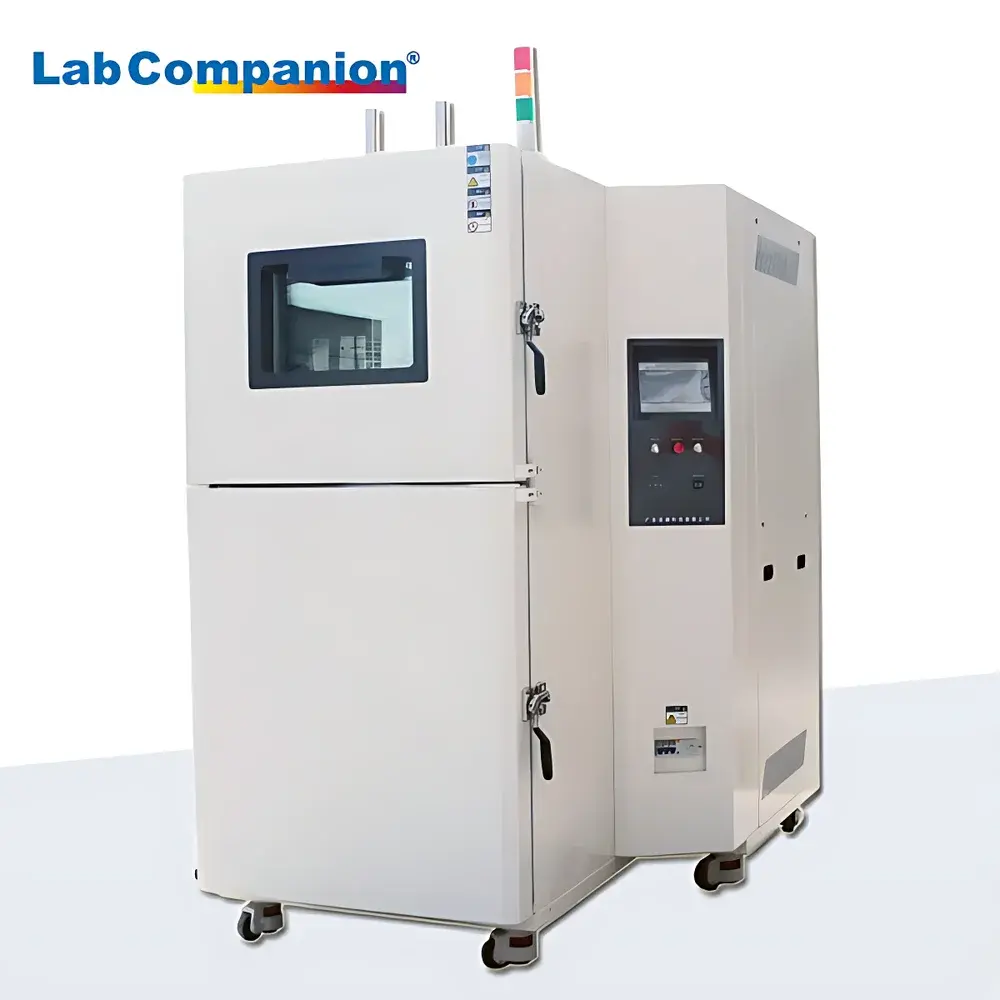
LabCompanion TS2-150S Thermal Shock Test Chamber
| Brand | LabCompanion |
|---|---|
| Origin | Guangdong, China |
| Manufacturer | Hongzhan Technology Co., Ltd. |
| Model | TS2-150S |
| High-Temperature Range | +10 °C to +150 °C (above ambient) |
| Low-Temperature Range | 0 °C to −70 °C |
| Thermal Shock Range | −65 °C to +150 °C |
| Temperature Stability | ±2 °C |
| Ramp-Up Time | ~35 min (from RT to +150 °C) |
| Ramp-Down Time | ~60 min (from RT to −70 °C) |
| Internal Basket Dimensions (W×H×D) | 600×500×500 mm |
| Chamber Construction | SUS#304 Stainless Steel Interior |
| Insulation | 100 mm Fire-Retardant PU Foam + Glass Wool |
| Controller | EKE (Japan) |
| Compressor | Tecumseh (France) or Bitzer (Germany) |
| Safety Protections | Over-Temperature, Phase Failure, Ground Fault, Compressor High-Pressure & Overcurrent, Fan Overload, SSR Failure Detection, Fuse & MCB Protection |
Overview
The LabCompanion TS2-150S Thermal Shock Test Chamber is an engineered solution for accelerated reliability assessment of electronic components, aerospace subsystems, automotive ECUs, and medical devices subjected to rapid thermal transients. Based on the two-zone static chamber architecture with independent high-temperature (+10 °C to +150 °C) and low-temperature (0 °C to −70 °C) compartments, the system achieves controlled thermal shock exposure through mechanical transfer of test specimens between zones using a pneumatically actuated stainless steel basket. This design conforms to fundamental principles defined in IEC 60068-2-14 (Test N: Change of temperature), MIL-STD-810H Method 503.6, and JESD22-A104D, enabling reproducible evaluation of solder joint integrity, material delamination, seal failure, and interfacial stress-induced cracking under extreme ΔT conditions up to 215 °C total span (−65 °C to +150 °C).
Key Features
- Independent dual-zone temperature control with dedicated refrigeration and heating circuits—eliminates cross-contamination of thermal mass during cycling
- SUS#304 stainless steel inner chamber and reinforced insulated enclosure (100 mm fire-retardant polyurethane + mineral glass wool) ensuring long-term dimensional stability and thermal retention
- Precision EKE programmable controller (Japan) with 0.1 °C resolution, real-time PID + PWM + SSR modulation, and built-in data logging (up to 10,000 cycles)
- High-efficiency compressor systems: selectable Tecumseh (France) or Bitzer (Germany) units rated for continuous operation at −70 °C condensing load
- Automated basket transfer mechanism with ≤10 s dwell-to-dwell transition time and ≤5 min temperature recovery post-transfer (per IEC 60068-2-14 compliance requirements)
- Comprehensive safety architecture including dual-stage over-temperature cutoff, phase sequence monitoring, ground fault interruption, compressor discharge pressure sensing, and redundant SSR fail-safe logic
Sample Compatibility & Compliance
The TS2-150S accommodates test specimens up to 600 × 500 × 500 mm (W×H×D) within its stainless steel basket—compatible with standard JEDEC trays, PCB assemblies, molded packages (QFN, BGA, CSP), and encapsulated sensors. Optional 50 mm diameter cable ports (standard) support in-situ electrical biasing or thermocouple feedthrough during thermal cycling. The chamber meets structural and operational criteria for ISO/IEC 17025-accredited laboratories performing environmental qualification per AEC-Q200, IPC-9701, and NASA-SSP 30238. All thermal profiles are traceable to NIST-calibrated reference probes, and deviation across working volume remains ≤ ±2.0 °C (per ASTM E741–22 spatial uniformity verification protocol).
Software & Data Management
The embedded EKE controller supports USB export of time-stamped temperature logs (CSV format), cycle count tracking, alarm history with timestamped event codes, and user-defined profile sequencing (up to 99 segments). Optional Ethernet interface enables integration into centralized lab management systems compliant with FDA 21 CFR Part 11 via third-party SCADA platforms. Audit trail functionality records operator login/logout events, parameter modifications, and manual intervention timestamps—supporting GLP/GMP documentation requirements for regulated industries including automotive Tier-1 suppliers and Class II/III medical device manufacturers.
Applications
- Qualification testing of semiconductor packages per JEDEC JESD22-A104D and A106B
- Thermal fatigue validation of automotive ADAS modules under ISO 16750-4 cold-hot cycling conditions
- Reliability screening of avionics enclosures per DO-160G Section 4 (Temperature Variation)
- Material compatibility assessment of conformal coatings, potting compounds, and adhesive bonds
- Failure mode analysis of MEMS devices, OLED displays, and battery management systems exposed to rapid ambient shifts
- Process validation for reflow soldering line changeovers and conformal coating cure stability
FAQ
What standards does the TS2-150S comply with for thermal shock testing?
The chamber is designed to meet the operational and performance requirements of IEC 60068-2-14, MIL-STD-810H Method 503.6, JESD22-A104D, and ASTM E741–22 for spatial uniformity and recovery time verification.
Can the chamber be configured for extended low-temperature operation below −70 °C?
Standard configuration supports down to −70 °C; custom variants with cascade refrigeration are available upon request for operation to −80 °C, subject to additional lead time and validation per IEC 60068-3-3.
Is remote monitoring and control supported?
Yes—via optional Ethernet module and compatible OPC UA or Modbus TCP drivers; local HMI remains fully functional during network disconnection.
What maintenance intervals are recommended for compressor-based thermal shock chambers?
Compressor oil analysis and filter replacement every 2,000 operating hours; annual calibration of chamber-mounted PT100 sensors against NIST-traceable references is advised.
Does the system include validation documentation for GxP environments?
Factory-installed IQ/OQ documentation packages are available, including as-built drawings, sensor calibration certificates, alarm response verification reports, and software traceability matrices aligned with Annex 11 and ALCOA+ principles.



