
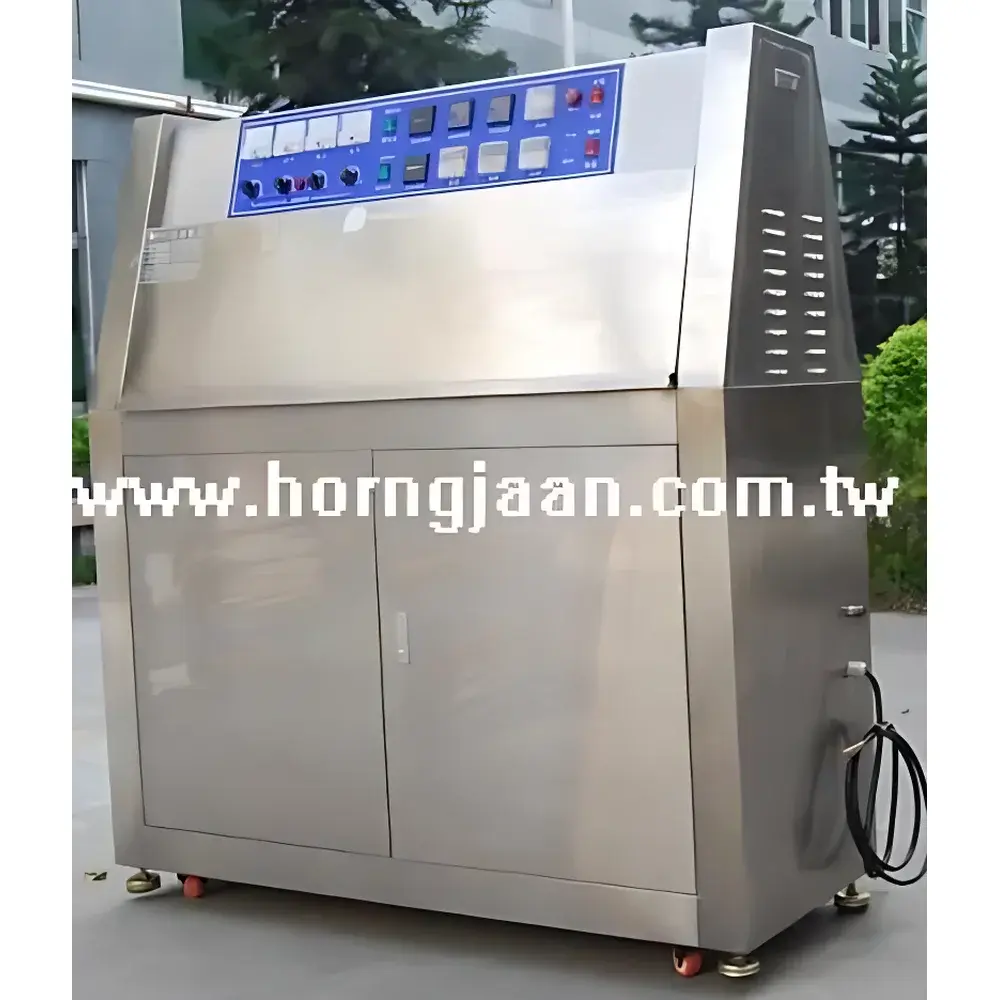
LabCompanion UV3 Advanced UV Accelerated Weathering Test Chamber
| Brand | LabCompanion |
|---|---|
| Origin | Guangdong, China |
| Manufacturer Type | OEM Manufacturer |
| Country of Origin | China |
| Model | UV3 |
| Pricing | Upon Request |
| Temperature Range | RT+10°C to 70°C |
| Humidity Range | ≥90% RH |
| Sample-to-Lamp Distance | 50 ± 2 mm |
| Lamp Center-to-Center Spacing | 70 mm |
| Irradiance | UVA-340 @ 0.68 W/m² (295–360 nm), UVB-313 @ 0.60 W/m² (280–315 nm) |
| Internal Chamber Dimensions | 1170 × 450 × 500 mm (W×D×H) |
| External Dimensions | 1300 × 550 × 1380 mm (W×D×H) |
| Control System | Intelligent Digital PID Controller with AI Algorithm |
| Condensation Mechanism | Steam-based Surface Condensation Cycle |
| Compliance Standards | GB/T 16422.3–1997, ASTM G53–88, GB/T 14522–93 |
| Safety Protections | Overcurrent, Ground Fault, Overtemperature, Low-Water, Compressor Overpressure, and Auto-Power-Cut Interlocks |
Overview
The LabCompanion UV3 Advanced UV Accelerated Weathering Test Chamber is an engineered solution for simulating the photochemical degradation effects of solar ultraviolet radiation on polymeric and organic materials. Designed around the fundamental principles of photodegradation kinetics, the system employs controlled fluorescent UV lamp irradiation—specifically UVA-340 (295–360 nm) and UVB-313 (280–315 nm)—to replicate critical short-wavelength components of terrestrial sunlight. Unlike full-spectrum xenon arc or carbon arc systems, this chamber isolates UV-driven mechanisms such as chain scission, oxidation, and chromophore disruption, enabling accelerated assessment of surface-level deterioration including color shift, gloss loss, chalking, cracking, blistering, and embrittlement. The UV3 operates on a cyclic exposure protocol: UV irradiation under controlled temperature and humidity is alternated with condensation phases that simulate nocturnal dew formation—a key driver of hydrolytic degradation in real-world outdoor service life.
Key Features
- Stainless steel construction (interior and exterior) ensures long-term corrosion resistance and compliance with ISO 9001 manufacturing protocols.
- Dual-lamp compatibility: Pre-calibrated UVA-340 lamps for realistic solar spectrum simulation; UVB-313 lamps for high-acceleration screening per ASTM G154 Annex A2.
- Precision digital PID controller with AI-based adaptive tuning enables stable temperature regulation (±0.5°C) and seamless transition between UV and condensation cycles.
- Steam-condensation mechanism generates uniform, reproducible dew layers on specimen surfaces without external water spray—minimizing non-uniform wetting artifacts.
- Integrated irradiance monitoring option (UV sensor module) provides real-time feedback and automatic lamp power compensation to maintain target irradiance within ±5% tolerance over lamp lifetime.
- Comprehensive safety architecture includes redundant thermal cutoffs, ground-fault interruption, low-water level detection, compressor overpressure protection, and automatic power disengagement upon fault detection.
Sample Compatibility & Compliance
The UV3 accommodates flat-panel specimens up to 1170 mm wide, mounted on an anodized aluminum frame with spring-tensioned clamping. It supports standardized sample carriers compliant with ASTM D7869 and ISO 4892-3 geometries. The chamber meets the technical requirements of multiple international standards: GB/T 16422.3–1997 (Chinese national standard for plastics UV exposure), ASTM G53–88 (Standard Practice for Operating Fluorescent Ultraviolet (UV) and Condensation Exposure Apparatuses), and GB/T 14522–93 (Mechanical industry standard for artificial climate aging of plastics, coatings, and rubber). While not certified to IEC 60068-2-5 or MIL-STD-810H by default, its operational envelope and control fidelity allow method transfer validation for GLP-compliant environmental stress testing in R&D and QC laboratories.
Software & Data Management
The UV3’s embedded controller logs time-stamped operational parameters—including chamber temperature, setpoint deviation, lamp status, and (when equipped) real-time irradiance values—at user-defined intervals. Data export is supported via USB interface in CSV format, compatible with LIMS integration and statistical process control (SPC) platforms. Though no proprietary cloud platform is included, the device supports audit trail generation for internal quality documentation per ISO/IEC 17025:2017 Clause 7.7. All alarm events are timestamped and retained in non-volatile memory for post-test forensic review. For regulated environments, optional 21 CFR Part 11-compliant data acquisition modules (with electronic signatures and role-based access control) are available through authorized LabCompanion integration partners.
Applications
- Evaluation of automotive interior trim polymers under ISO 4892-3 Cycle 1 (UV + condensation).
- Formulation screening of architectural coatings per ASTM D4587 accelerated UV/weathering protocols.
- Comparative durability testing of photovoltaic encapsulants and backsheets under IEC 61215 UV preconditioning requirements.
- Accelerated aging of medical device packaging films (e.g., Tyvek®) to assess seal integrity and barrier performance loss.
- Validation of UV stabilizer packages in polyolefin compounds used in outdoor infrastructure applications.
FAQ
What UV lamp types are supported, and how do they differ in application?
The UV3 accepts both UVA-340 and UVB-313 fluorescent lamps. UVA-340 closely matches the solar UV cutoff at 295 nm and is recommended for realistic outdoor weathering simulations. UVB-313 emits shorter, more energetic wavelengths below 315 nm and is used for rapid screening where extreme acceleration is acceptable.
Is condensation achieved via water spray or steam generation?
Condensation is generated exclusively through a heated water reservoir and saturated air circulation—no direct water spray contacts specimens, eliminating runoff variability and ensuring uniform dew layer formation.
Can the UV3 be validated for GLP or ISO 17025 compliance?
Yes—the system’s traceable temperature control, irradiance monitoring capability (with optional sensor), and event-logged operation support method validation and equipment qualification per ISO/IEC 17025 Section 6.4 and OECD GLP Principles.
What maintenance intervals are recommended for UV lamps and sensors?
UVA-340 and UVB-313 lamps require replacement every 1,600–2,000 hours of operation. The optional UV irradiance sensor should be calibrated annually using NIST-traceable reference detectors.
Does the UV3 support custom test profiles beyond standard cycles?
Yes—the controller allows user-defined sequences of UV intensity, temperature setpoints, and condensation duration, enabling bespoke protocols aligned with internal material specifications or customer-specific test plans.



