
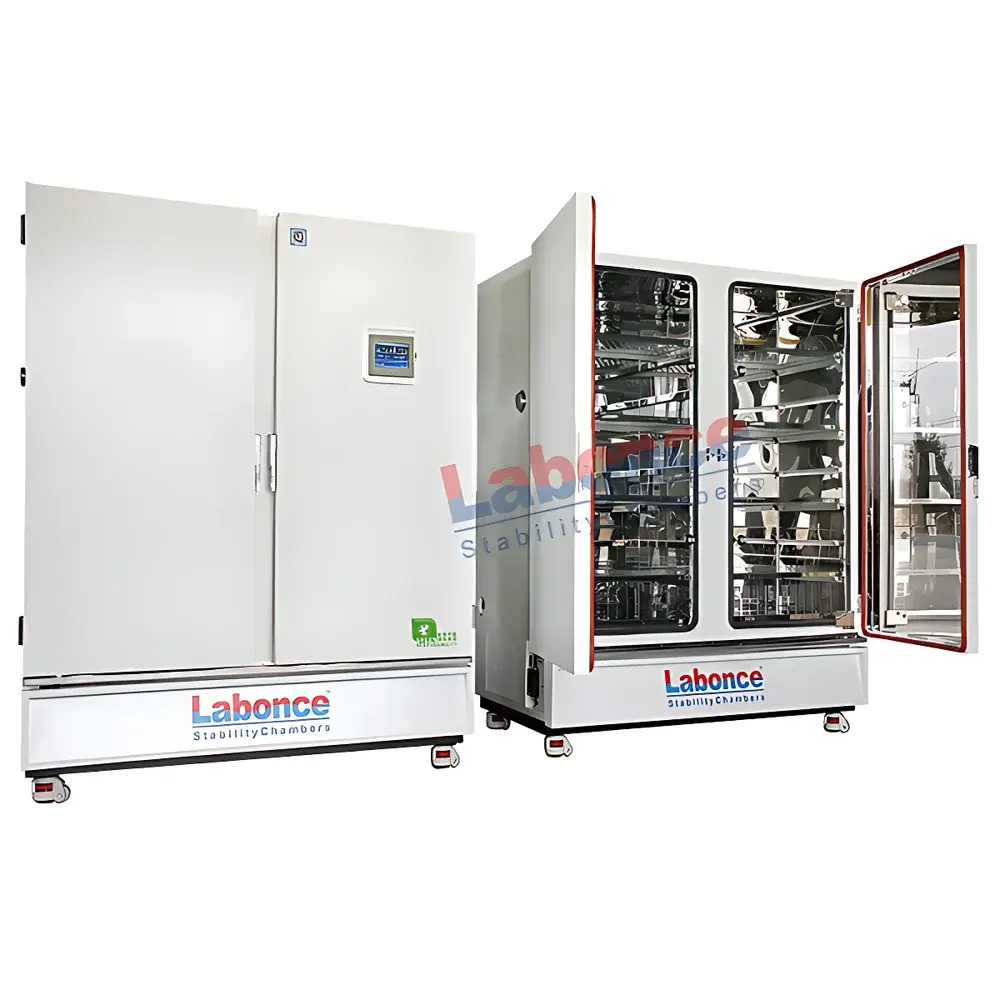
Labonce Labonce-1000GS-FC Dual-Door Pharmaceutical Stability Testing Chamber
| Brand | Labonce |
|---|---|
| Origin | Beijing, China |
| Manufacturer Type | Direct Manufacturer |
| Model | Labonce-1000GS-FC |
| Temperature Range | 10–65 °C |
| Humidity Range | 15–95 %RH |
| Chamber Volume | 1000 L |
| Internal Dimensions (W×D×H) | 1400×510×1400 mm |
| External Dimensions (W×D×H) | 1615×925×1975 mm |
| Power Consumption | 3.0 kW |
| Temperature Uniformity | ±1.0 °C |
| Temperature Fluctuation | ±0.5 °C |
| Humidity Uniformity | ±3 %RH |
| Humidity Fluctuation | ±2 %RH |
| Ambient Operating Temperature | +5 to +35 °C |
| Power Supply | 220 V, 50/60 Hz |
| Door Configuration | Dual-door (outer solid door + inner tempered glass door) |
| Compressor | Imported hermetic inverter compressor |
| Humidity Sensor | Imported capacitive humidity sensor |
| Control System | 7-inch full-color programmable touchscreen controller with real-time inverter output display |
| User Access | Three-tier role-based authentication (admin/operator/user) |
| Audit Trail | Time-stamped, tamper-resistant operation and alarm logs exportable via USB in read-only format |
| Data Output | Built-in dot-matrix printer + internal electronic data storage |
| Safety Systems | Independent overtemperature protection, compressor overheat/overpressure cutoff, low-water and dry-burn prevention, phase failure detection |
| Alarm Notification | Local audible alarm + remote SMS alert for temperature/humidity deviation and power failure |
| Insulation | High-density polyurethane foam (≥80 mm thickness) |
| Interior Material | Mirror-finish 304 stainless steel |
| Exterior Finish | Powder-coated steel |
| Compliance | Designed per ICH Q1A(R2), Q5C, Q5D |
Overview
The Labonce Labonce-1000GS-FC Dual-Door Pharmaceutical Stability Testing Chamber is an engineered environmental simulation system designed specifically for long-term stability studies of pharmaceutical products under controlled temperature and humidity conditions. It operates on the fundamental principle of regulated thermal and hygroscopic conditioning—maintaining precise, uniform, and reproducible climatic environments within a sealed chamber to accelerate or monitor degradation kinetics per internationally recognized protocols. Its architecture conforms to the scientific and regulatory expectations of drug development laboratories conducting ICH-aligned stability trials (Q1A–Q1E), forced degradation studies, and accelerated shelf-life estimation. The chamber’s dual-door configuration—featuring an outer insulated solid door and an inner tempered glass observation door—minimizes thermal and moisture mass transfer during routine sample inspection, thereby preserving chamber integrity without requiring extended recovery periods. This design directly supports continuous compliance with GMP and cGMP operational standards, where environmental consistency and data traceability are non-negotiable.
Key Features
- Inverter-driven hermetic refrigeration system with imported compressors—reducing energy consumption by >50% versus conventional fixed-speed units while enabling smooth, stepless cooling capacity modulation.
- Capacitive humidity sensing technology with factory-calibrated drift compensation—ensuring stable RH measurement accuracy (±2%RH fluctuation, ±3%RH uniformity) across the full 15–95%RH range without field recalibration or maintenance.
- 7-inch industrial-grade color touchscreen controller with real-time visualization of inverter output percentage, setpoint tracking, and multi-segment programmable profiles (up to 100 steps).
- Three-tier user permission framework: Administrator (full configuration & audit log access), Operator (routine run control & parameter adjustment), and Viewer (read-only status monitoring)—enabling strict separation of duties.
- Tamper-evident, time-stamped audit trail capturing all critical events—including parameter changes, door openings, alarm activations, and user logins—with USB export capability in immutable PDF or CSV formats compliant with FDA 21 CFR Part 11 requirements.
- Dual independent safety layers: primary microprocessor-controlled logic plus hardware-based backup protection circuits for overtemperature, compressor overload, low water level, and dry-burn scenarios.
- High-density polyurethane insulation (≥80 mm thick) combined with seamless 304 stainless steel interior surfaces—eliminating crevices, preventing microbial harborage, and ensuring cleanability per ISO 14644 and EU GMP Annex 1 guidelines.
Sample Compatibility & Compliance
The Labonce-1000GS-FC accommodates diverse pharmaceutical sample formats—including blister packs, vials, syringes, sachets, and bulk powders—within its 1000 L working volume and optimized airflow distribution pattern. Its chamber geometry and fan-assisted convection ensure ≤±1.0 °C temperature uniformity and ≤±3%RH humidity uniformity at all designated test positions (per ICH Q1A validation protocol). The system is pre-configured to support stability testing conditions defined in ICH Q1A(R2) (e.g., 25 °C/60%RH, 30 °C/65%RH, 40 °C/75%RH), as well as photostability testing when integrated with optional UV/visible light modules. All firmware, calibration certificates, IQ/OQ documentation templates, and validation support files are provided to facilitate qualification under FDA, EMA, PMDA, and NMPA regulatory frameworks. The device meets electromagnetic compatibility (EMC) Class B requirements and complies with electrical safety standards IEC 61010-1 and GB 4793.1.
Software & Data Management
Data integrity is maintained through embedded dual-path recording: real-time logging to internal flash memory (retaining ≥12 months of minute-interval data at default sampling) and parallel hardcopy output via integrated dot-matrix printer. The controller firmware implements secure data handling per ALCOA+ principles—ensuring data is Attributable, Legible, Contemporaneous, Original, Accurate, Complete, Consistent, Enduring, and Available. Exported audit logs include digital signatures, hash verification metadata, and UTC timestamps synchronized via NTP-compatible network interface (optional). Optional Ethernet or RS485 connectivity enables integration into centralized Laboratory Information Management Systems (LIMS) or SCADA platforms for automated report generation, trend analysis, and electronic signature workflows aligned with 21 CFR Part 11 Subpart C.
Applications
- ICH-compliant long-term, accelerated, and intermediate stability studies for APIs and finished dosage forms.
- Real-time shelf-life determination and expiration date assignment per regulatory submission requirements.
- Forced degradation (stress) testing under elevated temperature/humidity to identify degradation pathways and validate analytical methods.
- Stability-indicating method development and validation support.
- Environmental qualification of packaging systems (e.g., moisture barrier performance assessment).
- Reference standard storage under controlled conditions meeting USP and Ph. Eur. 2.9.40 specifications.
FAQ
Does the Labonce-1000GS-FC meet FDA 21 CFR Part 11 requirements for electronic records and signatures?
Yes—the system includes role-based access control, audit-trail functionality with immutable export, electronic signature support via configurable password policies, and data encryption at rest, fulfilling core technical criteria for Part 11 compliance.
What validation documentation is supplied with the chamber?
Factory-supplied IQ/OQ protocols, calibration certificates traceable to NIST standards, temperature/humidity mapping reports (as optional add-on), and electronic record retention policy documentation are included.
Can the chamber operate continuously for 24/7 stability studies lasting 60+ months?
Yes—designed for uninterrupted operation with redundant safety systems, predictive maintenance alerts, and inverter compressor technology proven for >20,000 hours MTBF in GMP environments.
Is remote monitoring and alarm notification supported?
Standard SMS-based alerting for temperature/humidity excursions and power loss is integrated; optional Modbus TCP or MQTT interfaces enable cloud-based dashboard integration.
How is humidity calibrated and verified?
The capacitive sensor undergoes factory calibration against chilled-mirror hygrometry standards; users may perform field verification using saturated salt solutions per ISO 12048 or USP .
Related Products






