
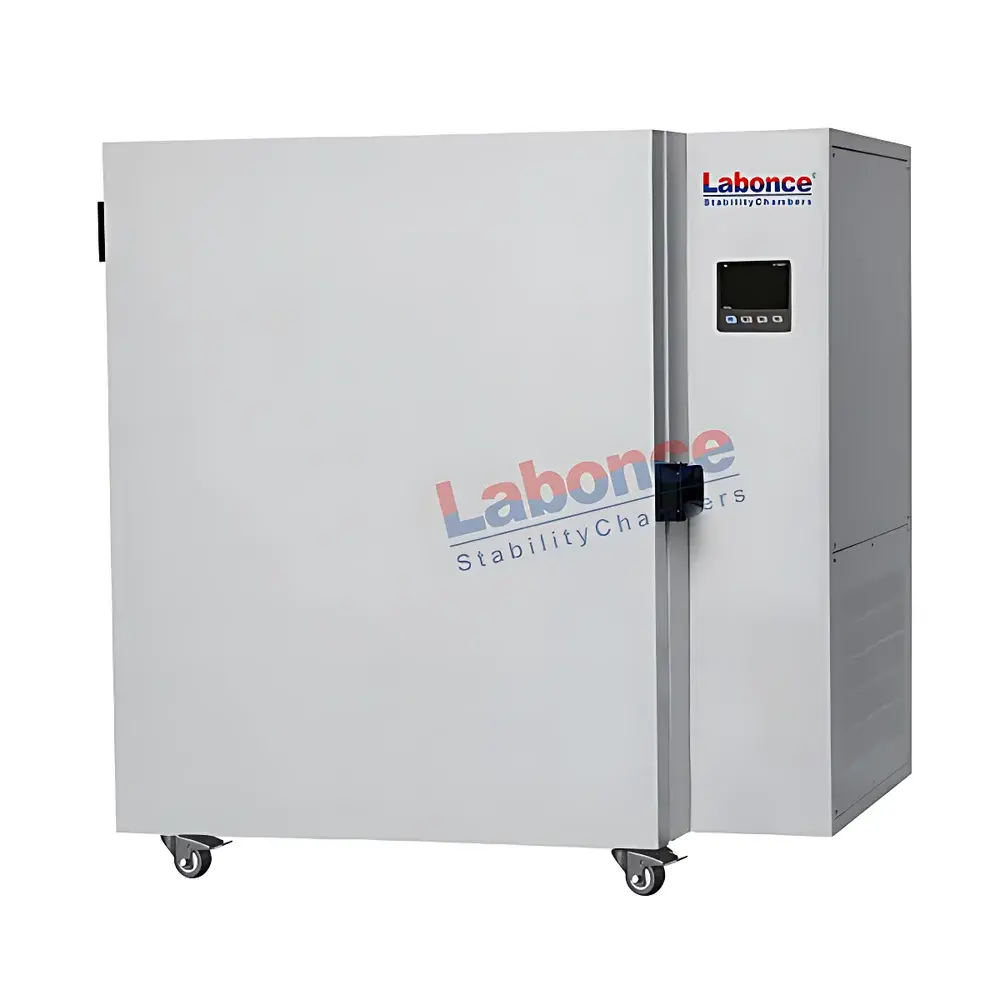
Labonce Labonce-100GW-T High-Temperature Constant-Temperature Test Chamber (200 °C)
| Brand | Labonce |
|---|---|
| Origin | Beijing, China |
| Manufacturer Type | Direct Manufacturer |
| Region of Origin | Domestic (China) |
| Model | Labonce-100GW-T |
| Temperature Range | RT+15 °C to 200 °C |
| Internal Volume | 100 L |
| Internal Dimensions (W×D×H) | 450×450×450 mm |
| External Dimensions (W×D×H) | 1100×700×800 mm |
| Power Rating | 2.0 kW |
| Standard Shelving | 2 adjustable stainless steel shelves |
| Temperature Uniformity | ≤ ±2.0 °C (at ≤200 °C) |
| Temperature Stability | ≤ ±0.5 °C (at ≤200 °C) |
| Controller Type | Programmable color touchscreen controller with three-tier user permissions and audit trail capability |
| Compliance | GB/T 11158–2008 |
Overview
The Labonce Labonce-100GW-T High-Temperature Constant-Temperature Test Chamber is an engineered environmental test system designed for precise thermal exposure testing of electrical, electronic, and material specimens under sustained elevated temperatures up to 200 °C. It operates on forced-air convection principles, utilizing a balanced horizontal airflow architecture to maintain stable and repeatable thermal conditions across the entire working volume. Unlike general-purpose ovens, this chamber is purpose-built for compliance-driven reliability testing—supporting qualification protocols in R&D, quality assurance, and production validation workflows where temperature fidelity, spatial uniformity, and operational traceability are critical. Its design adheres strictly to GB/T 11158–2008, the Chinese national standard governing performance requirements and test methods for high-temperature test chambers, ensuring metrological integrity in both laboratory and industrial settings.
Key Features
- Forced-air horizontal circulation system optimized for thermal homogeneity: achieves ≤ ±2.0 °C temperature deviation across the 100 L working volume at 200 °C, validated per GB/T 11158–2008 test methodology.
- Programmable color touchscreen controller with configurable multi-step temperature profiles, real-time data logging, and embedded audit trail functionality compliant with GLP/GMP documentation expectations.
- Three-tier hierarchical access control (Operator / Engineer / Administrator) ensures secure parameter management and prevents unauthorized configuration changes during qualification runs.
- Dual-layer thermal protection architecture: primary PID-controlled heating system paired with an independent mechanical overtemperature cut-off circuit, certified to IEC 61000-4-2 immunity standards.
- Robust dual-wall construction: exterior cold-rolled steel with epoxy-polyester powder coating; interior 304 stainless steel chamber liner resistant to oxidation and thermal cycling fatigue.
- Two adjustable, load-rated stainless steel shelves (standard), each supporting up to 15 kg uniformly distributed load without deflection or sagging at 200 °C.
Sample Compatibility & Compliance
The Labonce-100GW-T accommodates a broad range of non-volatile, non-explosive samples—including PCB assemblies, polymer components, battery cells (in discharge state), ceramic substrates, and metal alloys—within its 450 × 450 × 450 mm internal cavity. It is routinely deployed in pre-compliance screening for IEC 60068-2-2 (Test B: Dry Heat), MIL-STD-810G Method 501.6, and JEDEC JESD22-A108F thermal aging protocols. While not rated for humidity control, its sealed chamber design minimizes ambient moisture ingress during extended high-temperature dwell cycles. All firmware and controller logs retain timestamps, user IDs, setpoints, and actual chamber readings—enabling retrospective verification required under ISO/IEC 17025-accredited laboratories and FDA-regulated environments operating under 21 CFR Part 11 guidelines.
Software & Data Management
The integrated touchscreen controller supports USB export of CSV-formatted temperature history files, including setpoint, measured chamber temperature, ramp rate, dwell duration, and event markers (e.g., door open/close, alarm activation). Optional Ethernet connectivity enables remote monitoring via Modbus TCP or HTTP-based API endpoints for integration into centralized MES or LIMS platforms. Audit trail records capture all critical actions—including profile uploads, parameter edits, and manual overrides—with immutable timestamps and authenticated user credentials. Data retention spans ≥30 days onboard; external archival is supported via scheduled automated backups to networked storage devices.
Applications
- Accelerated life testing of thermosetting resins and encapsulants used in automotive electronics.
- Thermal stress screening of solder joints and wire bond integrity prior to HALT/HASS deployment.
- Material degradation analysis of elastomers, adhesives, and flame-retardant composites under sustained 200 °C exposure.
- Pre-conditioning of sensors and MEMS devices before functional calibration in controlled thermal environments.
- Stability assessment of passive components (capacitors, resistors, inductors) per AEC-Q200 stress test schedules.
- Validation of thermal management solutions for power electronics modules in renewable energy inverters.
FAQ
What is the maximum continuous operating temperature for the Labonce-100GW-T model?
The chamber is rated for continuous operation at 200 °C, with thermal stability maintained within ±0.5 °C at steady state below 200 °C.
Does the unit support ramp-soak-hold thermal profiles?
Yes—the programmable touchscreen controller supports up to 99 segments per profile, with individually defined ramp rates (0.1–10.0 °C/min), soak durations (1 min to 999 h 59 min), and temperature setpoints.
Is the controller compliant with 21 CFR Part 11 requirements?
The audit trail, electronic signature support, and role-based access control meet foundational technical controls outlined in FDA 21 CFR Part 11; full validation documentation (IQ/OQ/PQ templates) is available upon request.
Can the chamber be integrated into a factory automation system?
Yes—Modbus TCP and optional RS-485 interfaces enable bidirectional communication with PLCs and SCADA systems for centralized environmental monitoring and alarm relay outputs.
What maintenance intervals are recommended for long-term reliability?
Heating element resistance checks and airflow sensor calibration are advised every 12 months; fan motor lubrication and gasket inspection every 24 months under typical usage (≤6 h/day at 200 °C).



