
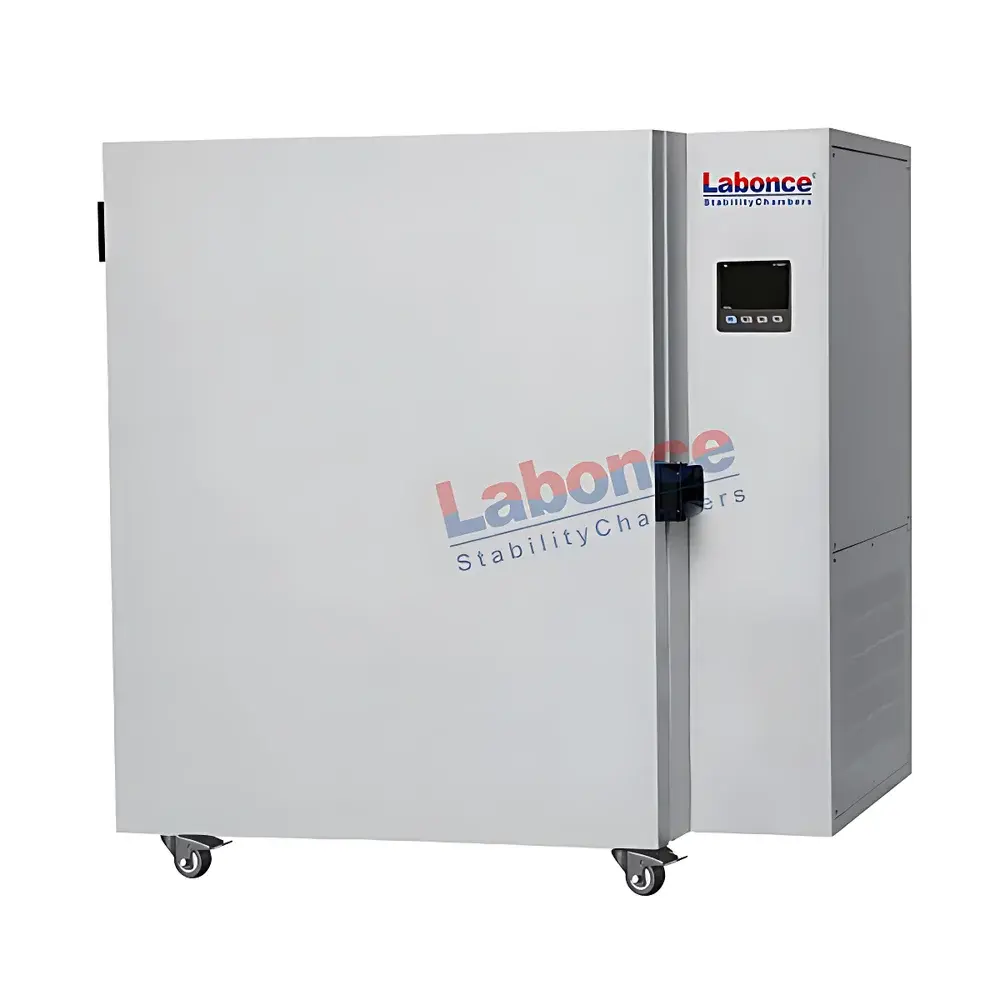
Labonce Labonce-250GWH-T High-Temperature Constant-Temperature Test Chamber (300 °C)
| Brand | Labonce |
|---|---|
| Model | Labonce-250GWH-T |
| Temperature Range | +20 to 300 °C |
| Internal Volume | 250 L |
| Internal Dimensions (W×D×H) | 600 × 600 × 700 mm |
| External Dimensions (W×D×H) | 1250 × 850 × 1000 mm |
| Power Consumption | 2.5 kW |
| Standard Shelving | 2 adjustable stainless steel shelves |
| Controller Type | Programmable color touchscreen with 3-tier user permissions and audit trail |
| Temperature Uniformity | ≤ ±2.0 °C (≤200 °C) |
| Temperature Fluctuation | ≤ ±0.5 °C (≤200 °C) |
| Compliance | GB/T 11158–2008 |
| Construction | Exterior – powder-coated steel |
| Safety | Independent overtemperature protection circuit |
Overview
The Labonce Labonce-250GWH-T is a high-temperature constant-temperature test chamber engineered for precise, repeatable thermal exposure of electronic components, polymers, composites, and other industrial materials under controlled ambient conditions up to 300 °C. Unlike general-purpose ovens, this chamber employs a forced-air convection system with optimized airflow distribution to maintain stringent thermal stability across the entire working volume—critical for accelerated aging, thermal endurance validation, and qualification testing in R&D and quality assurance laboratories. Its design adheres to GB/T 11158–2008, the Chinese national standard specifying performance requirements for high-temperature test chambers—including temperature uniformity, fluctuation, recovery time, and sensor calibration traceability. The chamber operates on a dual-wall insulated architecture with mineral wool insulation and sealed door gaskets to minimize thermal leakage and ensure energy-efficient operation during prolonged dwell cycles.
Key Features
- Programmable color touchscreen controller with intuitive graphical interface, real-time trend display, and built-in data logging (up to 10,000 data points)
- Three-level user access control (Operator / Engineer / Administrator) supporting role-based parameter restrictions and password-protected configuration changes
- Audit trail functionality compliant with GLP and internal QA documentation requirements—records timestamped events including setpoint modifications, door openings, alarm triggers, and controller reboots
- Independent mechanical overtemperature cut-off system, physically isolated from the main controller, providing fail-safe thermal protection for both test specimens and chamber integrity
- Double-layer insulated chamber walls with high-density mineral fiber insulation and seamless 304 stainless steel interior—resistant to oxidation, corrosion, and thermal cycling degradation
- Optimized horizontal air circulation ductwork with tangential blower and adjustable baffle plates ensures temperature uniformity ≤ ±3.0 °C across the full 250 L workspace at 300 °C
Sample Compatibility & Compliance
The Labonce-250GWH-T accommodates a broad range of sample geometries and mounting configurations via two standard adjustable stainless steel shelves (load capacity: 15 kg per shelf, uniformly distributed). Optional accessories include wire mesh trays, sample racks, and calibrated PT100 probe ports for in-situ monitoring. The chamber meets the structural and metrological requirements of GB/T 11158–2008 for high-temperature environmental test equipment. While not certified to IEC 60068-2-2 or ASTM E145 by default, its thermal performance profile—including temperature deviation, fluctuation, and recovery metrics—is directly comparable to Class B chambers defined in those standards. For regulated environments, the audit-trail-enabled controller supports alignment with FDA 21 CFR Part 11 requirements when deployed with validated procedures and electronic signature protocols.
Software & Data Management
Data acquisition and chamber supervision are managed through the embedded controller’s native firmware, which stores all operational logs internally with non-volatile memory retention. Export is supported via USB flash drive (CSV format), enabling integration into LIMS or statistical process control platforms. Optional PC-based software (Labonce ChamberLink™) provides remote monitoring, multi-chamber synchronization, automated report generation (PDF/Excel), and alarm escalation via email/SNMP. All logged parameters—including chamber setpoint, actual chamber temperature, runtime, and event timestamps—are time-stamped with millisecond resolution and cryptographically signed to prevent post-hoc tampering—essential for ISO/IEC 17025-accredited testing labs.
Applications
- Thermal aging studies of insulating materials, adhesives, and elastomers per IEC 60216 and UL 746B
- High-temperature storage testing of lithium-ion battery cells and modules prior to safety evaluation
- Pre-conditioning of PCB assemblies and semiconductor packaging before thermal shock or humidity testing
- Validation of heat resistance in aerospace-grade composites and fire-retardant coatings
- Stability testing of pharmaceutical excipients and active ingredients under accelerated thermal stress (ICH Q1A)
- Calibration verification of thermocouples, RTDs, and infrared sensors in accredited metrology labs
FAQ
What is the maximum continuous operating temperature of the Labonce-250GWH-T?
The chamber is rated for continuous operation at 300 °C, with thermal stability maintained per GB/T 11158–2008 specifications across the full internal volume.
Does the touchscreen controller support data export for regulatory audits?
Yes—the controller exports timestamped CSV logs via USB, and optional ChamberLink™ software enables PDF report generation with digital signatures and revision history tracking.
Is the chamber suitable for testing samples that outgas volatile organic compounds?
The standard configuration lacks an exhaust port; however, an optional top-mounted vent flange with condensate trap and external ducting interface is available for controlled off-gassing applications.
Can the overtemperature protection be disabled for calibration purposes?
No—the independent overtemperature cut-off is hardwired and non-bypassable per functional safety design principles; it remains active even during controller firmware updates or power loss.
What maintenance intervals are recommended for long-term reliability?
Inspect door gaskets and clean air intake filters every 3 months; verify sensor calibration annually using NIST-traceable reference standards; replace blower motor thermal grease every 24 months under continuous use.



