
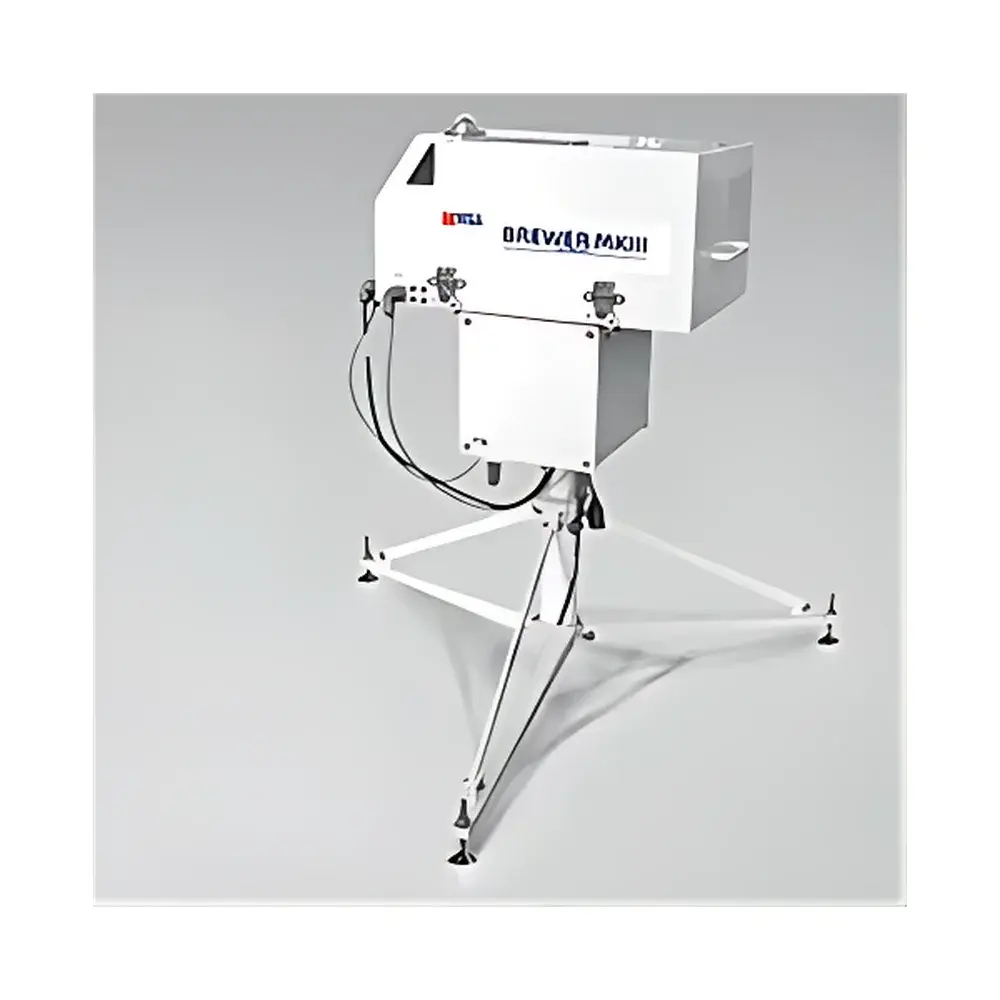
Kipp & Zonen Brewer MkIII Dual-Monochromator UV Spectrophotometer
| Brand | Kipp & Zonen |
|---|---|
| Origin | Netherlands |
| Model | Brewer MkIII |
| Wavelength Range | 286.5–363 nm |
| Spectral Resolution | 0.6 nm |
| Wavelength Stability | ±0.01 nm (over full operating temperature range) |
| Detector | Photomultiplier Tube (PMT) |
| Optical Design | Dual Monochromator |
| Power Supply | 230 VAC or 115 VAC |
| Operating Temperature | −20 °C to +50 °C (−50 °C to +50 °C with optional cold-weather housing) |
| Measured Parameters | Total Ozone Column, SO₂ Column, Spectral UV Irradiance (UVA, UVB, UVE), UV Index (UVI) |
Overview
The Kipp & Zonen Brewer MkIII Dual-Monochromator UV Spectrophotometer is a field-deployable, high-precision ground-based instrument engineered for continuous, long-term monitoring of solar ultraviolet radiation and atmospheric trace gases. It operates on the principle of differential optical absorption spectroscopy (DOAS) in the near-ultraviolet spectral region, utilizing a double monochromator optical architecture to achieve exceptional stray-light rejection—critical for accurate retrieval of weak absorption features of ozone (O₃) and sulfur dioxide (SO₂) across the 286.5–363 nm wavelength band. Unlike earlier MkII and MkIV variants that employ a single monochromator, the MkIII’s dual-stage dispersion design reduces stray light by more than two orders of magnitude, enabling reliable quantification of total column ozone with an uncertainty better than ±1% under standard calibration conditions and SO₂ column measurements at sub-Dobson Unit sensitivity. Its robust, weatherproof enclosure and azimuthal sun-tracking mount support unattended operation in remote observatories, polar stations, and regulatory monitoring networks aligned with Global Atmosphere Watch (GAW) and World Meteorological Organization (WMO) protocols.
Key Features
- Dual monochromator optical system with <0.01 nm wavelength stability across −20 °C to +50 °C, ensuring reproducible spectral calibration without manual intervention
- Photomultiplier tube (PMT) detector optimized for low-noise, high-dynamic-range signal acquisition in the biologically critical UV-B (280–315 nm) and UV-A (315–400 nm) bands
- Automated dual-axis solar tracking with real-time zenith angle compensation and filter wheel control for sequential spectral acquisition
- Integrated environmental housing rated IP65, compatible with optional cold-weather shroud for sustained operation down to −50 °C
- Compliance with ISO/IEC 17025:2017 requirements for measurement traceability when operated with NIST-traceable ozone reference standards and calibrated quartz filters
- Modular firmware architecture supporting both local PC-based control (via GW-Basic v3.75f) and networked remote command via RS-232 or Ethernet interfaces
Sample Compatibility & Compliance
The Brewer MkIII does not require sample introduction in the conventional laboratory sense; instead, it performs direct, non-invasive spectral radiometry of extraterrestrial solar irradiance through the atmosphere. Its measurement methodology conforms to internationally accepted standards including WMO GAW Photochemistry Expert Team guidelines, ASTM E2797–22 (Standard Practice for Solar Ultraviolet Spectral Irradiance Measurements), and ISO 17166:2021 (Erythema reference action spectrum). Data outputs—including total ozone column (in Dobson Units), SO₂ column (in DU), and spectrally resolved UV irradiance (in W·m⁻²·nm⁻¹)—are structured to support compliance with national air quality reporting frameworks (e.g., U.S. EPA UVNet, EU Copernicus Atmosphere Monitoring Service) and GLP-aligned long-term trend analysis. Instrument validation follows triennial intercomparison protocols coordinated by the WMO/GAW UV Reference Facility at Mauna Loa Observatory.
Software & Data Management
The MkIII is operated using the vendor-validated GW-Basic v3.75f software suite, specifically developed for “single-board” MkIII configurations and certified for use in regulated environments. The software supports automated daily calibration sequences (including Langley plot analysis, lamp-based wavelength verification, and dark-current subtraction), real-time spectral QA/QC flagging, and export of time-stamped Level 1b irradiance data in NetCDF-4 format compliant with CF Metadata Conventions. Audit trails record all user-initiated parameter changes, calibration events, and instrument status transitions—meeting FDA 21 CFR Part 11 requirements for electronic records when deployed in health-related UV exposure assessment programs. Raw spectra and derived geophysical products are stored locally on industrial-grade SD cards and can be synchronized hourly to secure cloud repositories via TLS-encrypted FTPS or MQTT protocols.
Applications
- Long-term trend analysis of stratospheric ozone recovery under the Montreal Protocol framework
- Validation of satellite-derived ozone and UV products (e.g., from TROPOMI, OMI, and GOME-2 instruments)
- Ground-truthing of radiative transfer models used in climate projections (e.g., CMIP6)
- Quantitative assessment of UV erythemal dose rates for public health advisories and occupational safety planning
- Monitoring volcanic SO₂ plumes and anthropogenic pollution episodes affecting regional UV transmission
- Supporting ecological studies on UV-induced DNA damage in phytoplankton, crop photoinhibition, and amphibian population decline
FAQ
What distinguishes the Brewer MkIII from MkII/MkIV instruments?
The MkIII replaces the single monochromator with a dual-monochromator optical train, significantly reducing stray light and improving spectral fidelity—particularly below 300 nm where ozone absorption is strongest.
Is the MkIII suitable for polar deployments?
Yes—when equipped with the optional cold-weather housing and thermostatically controlled electronics bay, it maintains operational integrity from −50 °C to +50 °C.
Does the system comply with regulatory data integrity standards?
Yes—GW-Basic v3.75f provides full audit trail logging, electronic signature capability, and 21 CFR Part 11–compliant user access controls when configured per Kipp & Zonen’s validation package.
How often does the instrument require calibration?
Primary calibration against traveling standard Brewer instruments is recommended every three years; daily internal lamp checks and weekly Langley plots ensure ongoing traceability between intercomparisons.
Can raw spectral data be exported for third-party processing?
Yes—Level 1b netCDF files contain fully annotated, unprocessed detector counts, slit functions, and instrumental metadata required for advanced inversion algorithms such as DOAS or optimal estimation retrieval.





