
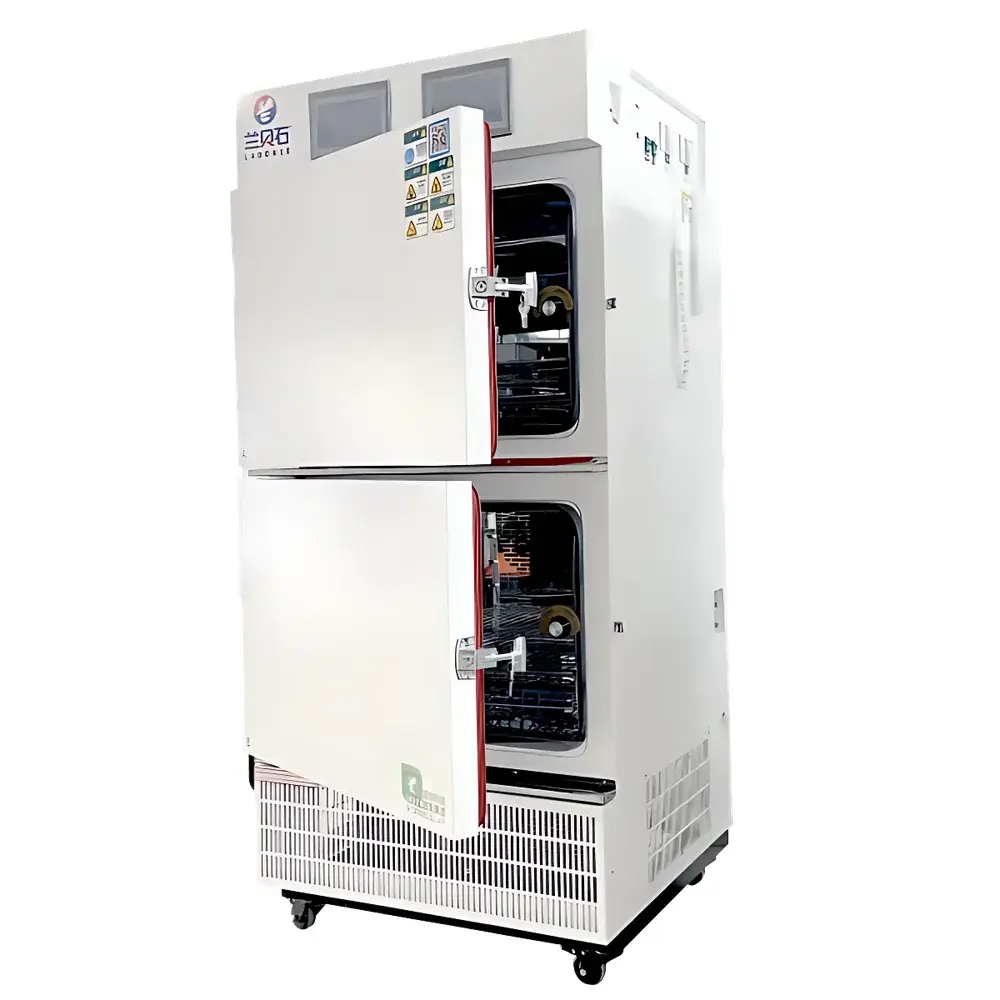
Labonce Labonce-320GS-FC Two-Chamber Drug Stability Testing Chamber
| Brand | Labonce |
|---|---|
| Origin | Beijing, China |
| Manufacturer Type | Direct Manufacturer |
| Product Category | Domestic |
| Model | Labonce-320GS-FC |
| Pricing | Upon Request |
Overview
The Labonce Labonce-320GS-FC Two-Chamber Drug Stability Testing Chamber is an ICH Q1-compliant, GMP-aligned environmental simulation system engineered for long-term, accelerated, and intermediate stability studies of pharmaceutical products in accordance with the Chinese Pharmacopoeia (2020 Edition), ICH Guidelines (Q1A–Q1E), and WHO Technical Report Series No. 953. Unlike single- or three-chamber configurations, this two-chamber design separates temperature-humidity conditioning from photostability testing—enabling concurrent yet independent operation of thermal/hygrometric stress (Chamber A) and light exposure (Chamber B), while maintaining strict regulatory traceability and physical isolation between test conditions. The chamber employs a dual-loop control architecture: a high-efficiency variable-frequency refrigeration system coupled with capacitive humidity sensing and PID-driven air distribution to ensure stable, reproducible environments across its operational range of 15–65°C and 20–95% RH. Its structural integrity, material selection, and control logic are specifically validated for use in GLP/GMP-regulated laboratories requiring audit-ready data integrity.
Key Features
- Variable-frequency hermetic compressor system — reduces energy consumption by ≥50% versus fixed-speed alternatives, with integrated high-pressure/overheat protection and low-water cutoff safeguards
- Triple-tier user access control — role-based authentication (Administrator, Supervisor, Operator) enforced via username/password login with encrypted credential storage
- Audit trail functionality — full chronological logging of all parameter changes, alarm events, door openings, and manual interventions; exportable to USB in write-protected .csv format compliant with FDA 21 CFR Part 11 requirements
- 7-inch full-color programmable touchscreen controller — displays real-time compressor output ratio, setpoint deviation, and active alarm status with intuitive navigation and multi-language UI support
- High-density polyurethane insulation (≥120 mm thick) — minimizes thermal bridging and ensures uniform internal temperature distribution (±0.5°C fluctuation, ±1.0°C deviation at 25°C/60% RH)
- 304 stainless steel mirror-finish interior — non-porous, corrosion-resistant, and compatible with routine cleaning validation protocols (e.g., residue testing per USP & EP guidelines)
- Dual-door architecture — outer solid insulated door maintains ambient isolation; inner tempered glass door enables visual monitoring without compromising chamber stability (≤1.5 min recovery time after brief opening)
- Capacitive humidity sensor (imported, factory-calibrated) — drift 5 years under continuous use
- Integrated thermal safety systems — independent overtemperature cut-off, dry-run prevention, phase-loss detection, and automatic fault-lockout on critical failures
Sample Compatibility & Compliance
The Labonce-320GS-FC accommodates standard pharmaceutical packaging formats—including blister packs, vials, ampoules, sachets, and secondary cartons—on adjustable 304 stainless steel shelves (2 standard, 5 optional). Its chamber volume (150 L net), internal dimensions (680 × 500 × 460 mm W×D×H), and uniform airflow design meet ICH Q5C recommendations for spatial homogeneity. All materials in contact with the test environment comply with ISO 10993-5 (cytotoxicity) and USP Class VI biocompatibility standards. The system supports qualification documentation packages (IQ/OQ/PQ) aligned with Annex 15 (EU GMP), ASTM E2500-13 (verification of pharmaceutical equipment), and WHO TRS 992 (validation of stability chambers). Calibration certificates for temperature and humidity sensors are provided with NIST-traceable references.
Software & Data Management
Data acquisition and reporting are managed through the embedded Labonce ControlSuite™ firmware, which logs timestamped readings every 1–60 seconds (user-configurable). Stored data includes chamber setpoints, actual values, compressor duty cycle, humidity sensor output, and event flags. Historical records persist for ≥12 months onboard (expandable via external NAS integration). Optional Ethernet/WiFi connectivity enables remote monitoring via secure HTTPS interface and automated daily report generation (PDF/Excel). Electronic signatures, electronic record retention policies, and data encryption (AES-256) satisfy ALCOA+ principles and support inspection readiness for FDA, EMA, and NMPA audits.
Applications
- ICH Q1A(R2) long-term (25°C/60% RH) and accelerated (40°C/75% RH) stability testing
- Intermediate condition studies (30°C/65% RH) per ICH Q5C
- Bracketing and matrixing study designs for multi-dose formulations
- Excipient compatibility screening under controlled hygrothermal stress
- Stability-indicating method development support (e.g., forced degradation preconditioning)
- Reference standard storage under defined climatic conditions (e.g., WHO “Zone IVb”)
- Process validation chamber mapping (temperature/humidity uniformity per ISO 14644-3)
FAQ
Does the Labonce-320GS-FC meet ICH Q1B photostability requirements?
No — this is a two-chamber thermal/hygrometric chamber only. Photostability testing requires the CGS-series (e.g., Labonce-320CGS-FC), which integrates visible and near-UV irradiation modules.
Is the system compatible with 21 CFR Part 11 compliance?
Yes — audit trail, electronic signatures, role-based access, and immutable data export fulfill core technical requirements for electronic records and signatures.
What is the calibration interval recommendation for temperature and humidity sensors?
Annual calibration is recommended using NIST-traceable reference standards; factory calibration certificates are supplied with initial delivery.
Can the chamber operate continuously for 6-month stability studies?
Yes — designed for unattended 24/7 operation with redundant safety circuits, predictive maintenance alerts, and self-diagnostic startup sequences.
Are shelf load capacity and airflow uniformity validated per ISO 14644-3?
Yes — IQ/OQ documentation includes chamber mapping reports demonstrating ≤±1.0°C and ≤±3% RH spatial variation at full load under worst-case operating conditions.






