
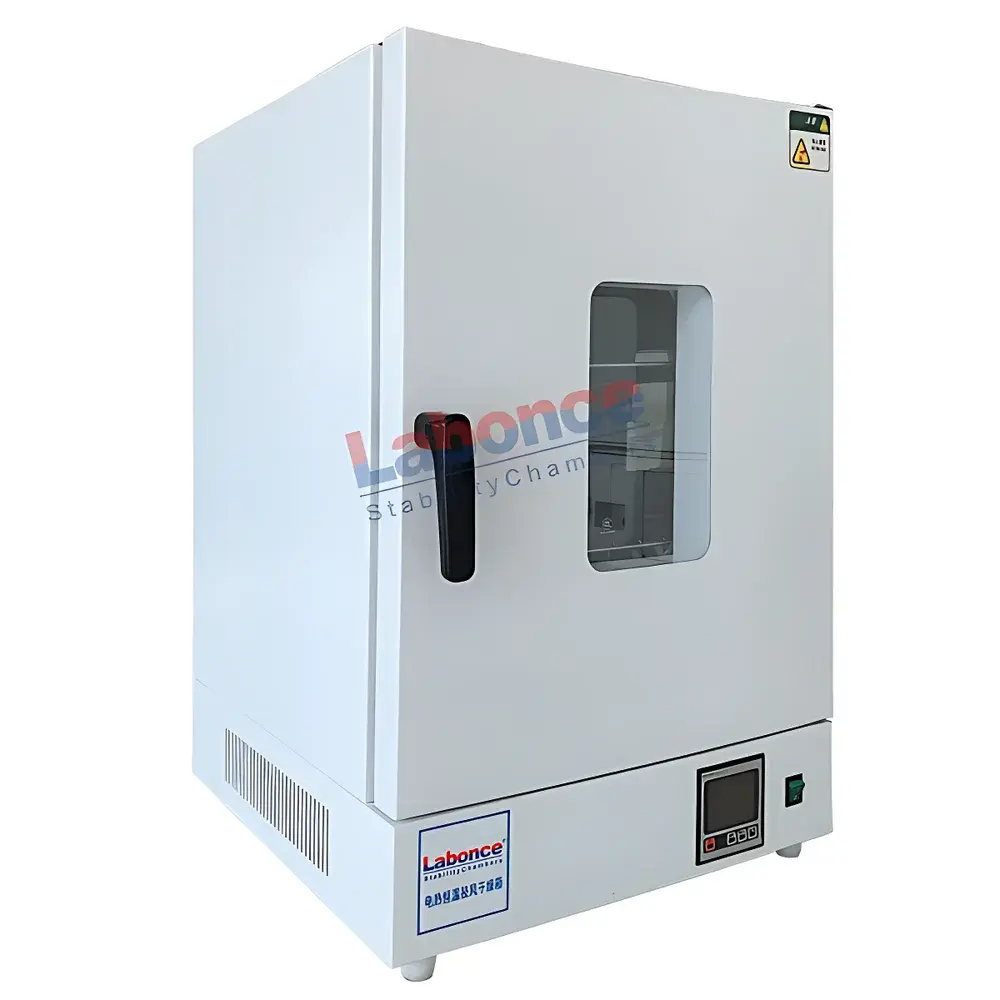
Labonce Labonce-625JMH Precision Forced-Air Drying Oven (300°C)
| Brand | Labonce |
|---|---|
| Model | Labonce-625JMH |
| Temperature Range | +20 to 300°C |
| Chamber Volume | 620 L |
| Internal Dimensions (W×D×H) | 780 × 600 × 1355 mm |
| External Dimensions (W×D×H) | 980 × 800 × 1880 mm |
| Power Supply | AC 380 V ±10%, 50 Hz |
| Rated Power | 4.0 kW |
| Temperature Uniformity | ±3.0°C (at ≤200°C), ±4.0°C (at 300°C) |
| Temperature Fluctuation | ±1.0°C |
| Standard Shelving | 4 adjustable stainless steel shelves (max. 8 optional) |
| Construction | Exterior – powder-coated steel |
| Control System | Digital PID temperature controller with independent over-temperature protection circuit |
| Compliance | Designed for GLP-compliant laboratories |
Overview
The Labonce Labonce-625JMH Precision Forced-Air Drying Oven is an industrial-grade, high-temperature laboratory drying system engineered for thermal stability, uniform heat distribution, and long-term operational reliability. Based on forced convection principle, the oven utilizes a precisely balanced axial fan-driven air circulation system that ensures consistent airflow across the entire chamber volume—critical for applications demanding reproducible thermal treatment of samples under controlled ambient conditions. With a maximum operating temperature of 300°C and a chamber capacity of 620 liters, the Labonce-625JMH serves as a core thermal processing platform in quality control labs, materials research facilities, and electronics manufacturing environments where precise, repeatable heating profiles are required for aging tests, moisture removal, curing, pre-conditioning, and residual solvent evaporation.
Key Features
- Forced-air convection architecture with optimized duct design and rear-mounted centrifugal blower—ensures <±4.0°C temperature uniformity across the full working volume at 300°C, validated per ASTM E2207 practices.
- Double-wall insulated chamber with high-density mineral wool insulation (≥100 mm thickness) and seamless 304 stainless steel interior—minimizes thermal loss and prevents corrosion from acidic or alkaline volatiles.
- Digital PID temperature controller with dual-sensor input (working + safety sensor), real-time display, and programmable ramp-soak profiles—enables precise setpoint management and traceable thermal history logging.
- Independent mechanical over-temperature cut-off system (bimetallic thermal switch), electrically isolated from the main control circuit—provides fail-safe protection compliant with IEC 61010-1 safety standards.
- Four standard heavy-duty, perforated stainless steel shelves (load capacity: 15 kg/shelf), fully adjustable in height with 25 mm pitch—supports flexible sample arrangement and optimal air penetration.
- Robust structural frame with powder-coated carbon steel exterior and reinforced door seal—designed for continuous operation in ISO Class 8 cleanroom-adjacent or industrial lab settings.
Sample Compatibility & Compliance
The Labonce-625JMH accommodates a broad range of sample types including polymer pellets, PCB assemblies, ceramic substrates, metal components, pharmaceutical excipients, and coated optical elements. Its inert stainless steel chamber and non-contaminating airflow path make it suitable for applications governed by USP , ISO 10993-12 (biocompatibility sample conditioning), and IPC-TM-650 2.6.25.1 (PCB thermal stress testing). While not certified to UL or CE as a standalone unit, the oven conforms to the essential safety and electromagnetic compatibility principles outlined in IEC 61010-1 and EN 61326-1 when installed per manufacturer specifications. It supports GLP and GMP workflows through stable thermal performance and audit-ready operational parameters—no internal data storage is provided, but analog voltage output (0–5 V) enables integration with external SCADA or LIMS systems for electronic record retention.
Software & Data Management
The Labonce-625JMH operates via a dedicated digital controller without embedded software or network connectivity. All configuration—including setpoint, ramp rate, soak time, and alarm thresholds—is managed locally via membrane keypad and LED display. For laboratories requiring electronic data capture, the unit provides a 0–5 V analog output proportional to chamber temperature (calibrated to NIST-traceable reference), compatible with third-party data loggers (e.g., Omega OM-DAQ, Testo Saveris 2) or PLC-based monitoring systems. Optional RS-485 Modbus RTU interface (add-on module) allows remote readout of real-time temperature, status flags, and fault codes—supporting FDA 21 CFR Part 11 compliance when paired with validated acquisition software and user access controls.
Applications
- Thermal aging of elastomers, composites, and adhesives per ASTM D573 and ISO 188.
- Pre-drying of hygroscopic reagents and analytical standards prior to gravimetric analysis (e.g., ASTM E1293).
- Stabilization and outgassing of vacuum-compatible components in semiconductor R&D labs.
- Moisture content determination in food, feed, and agricultural products (AOAC 950.46, ISO 665).
- Curing of powder coatings and conformal coatings on electronic assemblies (IPC-HDBK-830).
- Conditioning of test specimens for tensile, impact, and dielectric testing per ASTM D638, D256, and D149.
FAQ
What is the recommended maximum continuous operating temperature for the Labonce-625JMH?
The oven is rated for continuous operation up to 280°C; prolonged use at 300°C is permissible only for short-duration validation or qualification cycles.
Can the Labonce-625JMH be used for sterilization or depyrogenation?
No—it lacks HEPA filtration, steam generation, or validated bioburden reduction protocols; it is not designed or certified for medical device sterilization (ISO 11135/11137) or depyrogenation (USP ).
Is calibration documentation included with shipment?
A factory-issued calibration certificate (traceable to CNAS-accredited standards) is available upon request at time of order; on-site IQ/OQ validation support can be arranged separately.
Does the oven support programmable multi-step temperature profiles?
Yes—the digital controller supports up to 8 segment ramp-soak programs, each with independently adjustable rate (°C/min) and dwell time (0–9999 min).
What maintenance intervals are recommended for long-term reliability?
Blower motor lubrication every 12 months; door gasket inspection quarterly; temperature sensor verification semiannually using a calibrated reference thermometer (e.g., Fluke 1523).



