
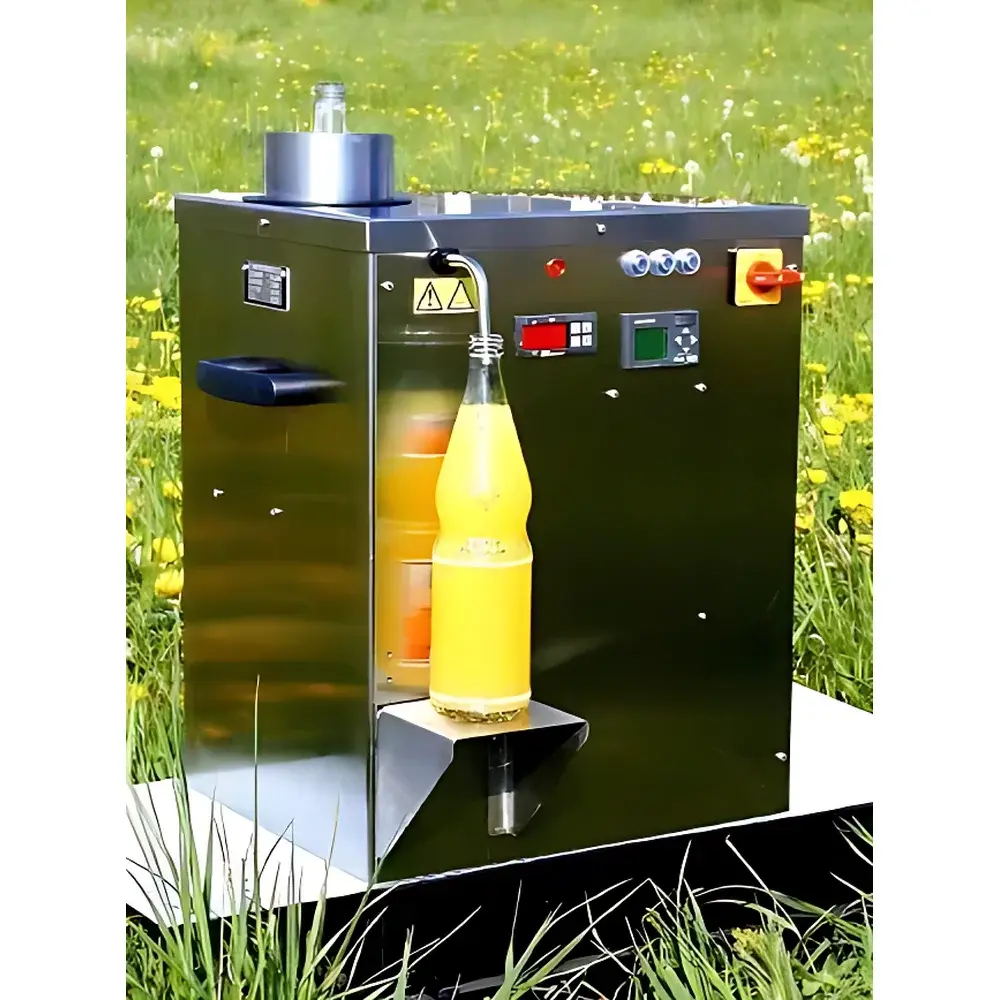
Laboratory-Scale Pasteurizer BX-10
| Origin | Shanghai, China |
|---|---|
| Manufacturer Type | Authorized Distributor |
| Model | BX-10 |
| Pricing | Available Upon Request |
| Output Capacity | 100 L/h |
| Minimum Batch Volume | 1000 mL |
| Pasteurization Temperature Range | 30–90 °C |
| Temperature Control Accuracy | ±1 °C |
| Power Supply | 8.5 kW, 380 V, 3-phase 5-wire |
| Net Weight | 50 kg |
| Dimensions (L×W×H) | 550 × 450 × 500 mm |
| Fill Volume Control | Automatic, Level-Sensing Quantitative Filling |
| Compatible Packaging | PET bottles, PE bottles, glass bottles, heat-resistant flexible pouches |
| Safety Interlock | Fill cycle disabled until product temperature reaches setpoint |
Overview
The BX-10 Laboratory-Scale Pasteurizer is an engineered benchtop thermal processing system designed to replicate industrial continuous-flow pasteurization under controlled, scalable conditions. It operates on the principle of time–temperature-controlled heat treatment—specifically low-temperature long-time (LTLT) or high-temperature short-time (HTST) regimes—within a precisely regulated stainless-steel heating loop and hold tube configuration. Unlike batch-style hot-water immersion units, the BX-10 employs dynamic flow-through thermotreatment with real-time inline temperature monitoring at both inlet and outlet zones, enabling accurate validation of microbial log-reduction kinetics (e.g., for Escherichia coli, Salmonella, or Listeria monocytogenes) per ISO 11133, ISO 7218, and FDA Pasteurized Milk Ordinance (PMO) benchmarks. Its compact footprint and plug-and-play electrical interface (380 V, 3-phase, 5-wire) allow integration into QC laboratories, R&D pilot facilities, and university food science departments without requiring steam boilers, chilled water loops, or compressed air infrastructure.
Key Features
- Benchtop form factor (550 × 450 × 500 mm) optimized for Class II biosafety cabinets and standard lab countertops
- Integrated PID-controlled electric heating system with ±1 °C thermal stability across 30–90 °C operating range
- Automated fill sequence governed by optical liquid-level sensing—prevents dispensing unless target holding temperature is verified and maintained for user-defined dwell time
- Modular contact surfaces constructed from AISI 316 stainless steel; all wetted parts meet FDA 21 CFR §177.2600 and EC 1935/2004 food-contact compliance
- Dual-point RTD temperature monitoring (inlet and hold-tube exit) with data logging capability via RS485 interface
- Variable flow-rate control (100 L/h max) enabling residence time adjustment from 15 s to >120 s, supporting both HTST and LTLT protocol development
Sample Compatibility & Compliance
The BX-10 accommodates Newtonian and moderately non-Newtonian fluids with viscosities up to 500 mPa·s and particulate content ≤2 mm diameter—including clarified fruit juices, dairy-based beverages, plant-protein emulsions, functional teas, and probiotic suspensions. Its filling module accepts standard packaging formats: 100–1000 mL PET, PE, and borosilicate glass containers, as well as retortable laminated pouches rated for ≥95 °C. All process parameters—including temperature profiles, flow rates, and hold times—are fully traceable and exportable in CSV format, supporting adherence to GLP (Good Laboratory Practice), GMP (21 CFR Part 11), and internal audit requirements. The system complies with IEC 61000-6-2 (immunity) and IEC 61000-6-4 (emission) electromagnetic compatibility standards.
Software & Data Management
While the BX-10 operates via intuitive front-panel touchscreen HMI (Human-Machine Interface), optional Ethernet-enabled firmware permits remote supervision through secure HTTP(S) endpoints. Process logs—including timestamped temperature curves, start/stop events, and interlock status—can be synchronized to local network drives or cloud-hosted LIMS platforms. Audit trails retain operator ID, parameter changes, and system alarms with immutable timestamps, satisfying FDA 21 CFR Part 11 electronic record integrity criteria. No proprietary software installation is required; raw data exports are natively compatible with MATLAB, Python (pandas), and JMP for statistical modeling of D-value and z-value relationships.
Applications
- Formulation optimization: Screening stabilizer/emulsifier systems under thermal stress to assess phase separation, sedimentation, or viscosity drift
- Sensory trial preparation: Generating statistically representative batches (≥1 L) for blind taste panels while preserving original flavor volatiles
- Shelf-life prediction: Accelerated ambient/accelerated refrigerated storage studies following AOAC 992.14 protocols
- Regulatory dossier support: Generating validated thermal process data for novel food submissions to EFSA, Health Canada, or China’s NHC
- Scale-up correlation: Correlating lab-scale lethality (F0) values with commercial UHT or HTST line performance using Arrhenius-based kinetic models
FAQ
What is the minimum volume required for a valid pasteurization run?
A minimum of 1000 mL is required to ensure full wetting of the heating loop and thermal stabilization across all sensors.
Can the BX-10 be used for sterilization trials (e.g., UHT)?
No—the system is certified for pasteurization only (≤90 °C); it lacks the pressure-rated construction and temperature redundancy required for true sterilization (≥135 °C).
Is third-party calibration documentation available?
Yes—NIST-traceable RTD calibration certificates are provided with each unit; annual recalibration services are supported globally via authorized service partners.
Does the system support programmable multi-step temperature profiles?
Not natively; the controller supports single-setpoint operation with adjustable hold duration. Custom ramp-hold-cool sequences require external PLC integration via Modbus RTU.
How is cleaning-in-place (CIP) performed?
The system includes dedicated CIP ports and is compatible with 1–2% alkaline detergent (pH 12) and 0.5–1% nitric acid solutions at ≤70 °C; full CIP validation reports can be generated using conductivity and temperature profiling.



